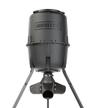
Why a gravity feeder instead of a timed one
A timed feeder is a machine. It has a battery, a timer board, a motor and a spin plate, and every one of those is a thing that can fail in February in a place you have to drive to. A gravity feeder has none of them. Feed moves because of gravity, deer take it from ports or tubes at the bottom, and the only failure mode is feed bridging in the hopper — which is exactly what the internal cone on the HECASA and the three funnels on the Moultrie are published to prevent.
That difference splits the two formats by purpose, not by quality:
- Gravity suits a nutrition program. Free-choice feeding is how you run protein pellets through the spring and summer, when the point is herd condition and antler growth rather than getting a deer under a stand at 4:30 p.m. Nothing throws, so nothing is wasted into the dirt for raccoons and hogs to clean up.
- Timed suits hunting, where hunting over feed is legal at all. The only thing a timer genuinely buys you is conditioning deer to arrive during legal shooting light. If that is your goal, our main deer feeder roundup ranks the timed and hanging options alongside these.
- Gravity costs less to own. No batteries, no timer board, no motor, and nothing that needs a trip out to reprogram after a cold snap.
It is worth being honest about the limit of the nutrition argument too. The NDA’s position on minerals and supplements is that there is no scientifically documented antler or health benefit for wild deer, beyond cases where local soils are genuinely deficient — age and overall nutrition drive antler size. A gravity feeder full of protein is a supplement to habitat, not a replacement for it. Our attractants versus food plots page is the honest comparison on where that money does the most good.
Capacity per dollar swings by a factor of four
This is the number nobody puts on the box, and it is the most interesting thing in the group. Take the published capacity of each complete feeder and divide by what it costs today and the spread is enormous — the steel 450 lb hopper delivers several times the feed capacity per dollar of the premium post feeder, and the premium post feeder holds less than half as much as the steel one while costing more.
We are deliberately not printing those ratios as fixed numbers, because the prices move and a stale ratio is worse than no ratio. Every buy button above carries a live, date-stamped price; do the division when you are actually buying. What we can say structurally is that steel buys capacity and poly buys portability, and that is the real fork in this category.
Here is the published evidence for that. The HECASA holds 450 lb in a zinc-plated steel hopper on a 78-inch tripod with a 25 by 25 inch base, and it weighs 73 lb empty. The Moultrie holds 250 lb in UV-resistant poly on a 74-inch tripod, and it weighs 37 lb empty. The steel feeder holds 80 percent more feed and weighs roughly twice as much before you put anything in it. Neither of those is a flaw; they are answers to different questions.
The question nobody asks until it is standing in the field: can you fill it?
Capacity is the spec everyone shops on and the lift is the spec that decides whether you regret the purchase.
Four hundred and fifty pounds of corn is roughly nine 50-pound bags, and the top of that hopper is 78 inches off the ground. That is nine bags lifted above your head, on uneven ground, in whatever the weather is doing. Two hundred and fifty pounds at 74 inches is five bags, which one strong person can manage with a bucket and some patience and two people can do comfortably. The gravity tube attachment bolted to a 30-gallon barrel is two or three bags at waist height.
So site by access before you site by deer sign. A 73 lb empty steel feeder with a 450 lb appetite needs a truck or an ATV route, not a half-mile walk from the gate. If the only good feed site on your ground is a hand-carry, the honest answer is a smaller hopper you refill more often — or the attachment-and-barrel route, because a barrel you can roll is easier to deal with than a tripod you cannot move. Our feeder setup guide covers siting, filling and varmint control in detail, and most of it applies more strongly to a gravity feeder than to a timed one, precisely because the feed is always available.
Feed-flow control is the spec that separates these five
Every one of these feeders works on gravity. What they do not share is how much control you have over the rate at which feed leaves the hopper, and that turns out to be the most consequential published difference on the page.
The Moultrie publishes three adjustable feed-flow funnelsand explicitly states that they accommodate corn, pellets and mixed grains. Pellets and whole corn do not flow the same way — pellet feed is lighter, smaller and far more prone to running freely — so an adjustable funnel is the difference between a hopper that lasts six weeks and one that empties in ten days.
The American Hunter attachment publishes the most detail of anything here: three 8-inch tubes at 3.5 inches in diameter, set at a 9-degree angle, with adjustable inner sleeves, a hooded overhang against rain and a 3/4-inch lip to cut spillage. That is a more complete description of how feed actually exits a hopper than either complete tripod feeder on this page provides, which is a striking thing to find on the cheapest item in the group.
The Boss Buck publishes removable feed tubesas its mechanism, which is the format most associated with free-choice protein, and the removability is the maintenance story — a tube you can take off is a tube you can clear and clean.
The HECASA publishes an internal cone rather than a port count, which answers the bridging problem but leaves you unable to compare how many deer can feed at once. We record the feed-port count as not published rather than counting ports off a product photograph.
Spoilage: the reason a bigger hopper is not always a better one
A gravity feeder holds feed in a sealed container exposed to weather for as long as it takes deer to eat it. That is a storage problem as much as a feeding one, and it is the argument against buying the biggest hopper you can afford.
If a 450 lb hopper takes two months to empty on your ground, that is two months of corn sitting in humidity and temperature swings. Moldy feed is not a neutral outcome — it is worse than no feed, and it is the reason the twist-on lid, the hooded overhang and the rain-shedding geometry show up in the published feature lists of the better options here. Size the hopper to how quickly your deer actually clear it, not to how rarely you would like to drive out.
The second, quieter reason to resist the biggest hopper: a feed site that never runs out is a feed site where deer are in constant contact with each other, which is exactly the mechanism the NDA describes when it explains how feed sites accelerate disease transmission. Running a smaller hopper that empties and sits empty for a week is not just cheaper. It is the more defensible way to do this at all.
Where a gravity feeder fits in the rest of the setup
A feed site is only worth the money if you know what visits it, which means a camera, and it is only worth hunting near if the feed is legal to hunt over where you are. Our trail camera hub covers the watching half; set the camera on the approach trail rather than on the feeder itself, because the trail tells you which direction deer come from and the feeder only tells you that corn is popular.
For the food side of the category, our deer attractants roundup ranks the granulars, minerals and liquids that go in or near one of these, including the honest note on which are worth it. And if the real goal is holding deer on your ground rather than concentrating them in one spot, read attractants versus food plotsfirst — a feeder is the fastest answer to that question and rarely the best one.
What a gravity feeder will not do
It will not condition deer to show up in shooting light. Nothing arrives on a schedule at a feeder that is always open; if that is what you want, you want a timer, and you want to check whether hunting over feed is legal where you are at all.
It will not grow bigger antlers on its own. The NDA’s position on supplementation is that age and overall nutrition drive antler size, with no scientifically documented benefit for wild deer from supplements except where soils are genuinely deficient.
It will not keep raccoons, hogs or squirrels out. A gravity feeder wastes less than a spin-plate feeder because nothing is thrown onto the ground, but a tube full of corn at nose height is an invitation to everything in the woods.
And it will not make feeding legal where it is not. That is the first check and the last word on this page, and it is a check that changes by county and by season.