Attractants · How-to
Homemade Deer Attractant Recipes
A five-dollar bucket of corn and molasses will pull deer about as well as a twenty-dollar bag of the branded version. What neither one does is the thing the marketing implies.
How this is funded:we earn a commission if you buy through our links, at no extra cost to you. It never changes which product we recommend, and we’ll tell you plainly when to skip one. Full disclosure.
Homemade attractants have a devoted following for two good reasons: they are cheap, and they work about as well as the branded equivalents. A commercial attractant is usually grain, sugar and a strong smell. So is a bucket of corn with molasses stirred through it, and the deer cannot read the label.
Before any recipe, though, two things have to be said plainly, because both matter more than the mix.
First: check whether you can legally do this
Baiting and feeding rules are among the most heavily regulated and most frequently changed parts of deer hunting law. States differ, counties within states differ, rules differ between the hunting season and the rest of the year, and in many places they have been tightened specifically in response to disease management.
Nothing about a homemade mix changes its legal status. A bucket of your own corn is bait in exactly the way a commercial product is. Verify with your state wildlife agency for the specific unit you hunt, every season. Our legality guide explains what to look for.
Second: understand the disease question
This is the part enthusiasts skip and it deserves a straight answer. The National Deer Association is clear that concentrating deer at a bait or feed site increases both direct animal-to-animal contact and indirect contact through shared saliva at the feed — and that this is a mechanism by which diseases including chronic wasting disease can spread faster.
That is not an argument that ends the discussion; plenty of legal, responsible baiting happens in areas with no known CWD presence. It is an argument for knowing your local disease status, following your agency’s guidance, and taking the CDC’s handling precautions seriously when you process an animal. If you hunt in or near a CWD management zone, feeding is very often prohibited outright — and where it is not, it is still worth thinking hard about.
The recipes that actually work
Every effective attractant does the same two things: it provides high-energy food, and it smells strongly enough to be found. Deer navigate primarily by smell, which is why aroma matters as much as calories. Here are the mixes hunters genuinely use.
Corn and molasses — the standard
Whole or cracked corn with molasses stirred through until the kernels are coated. Roughly one part molasses to eight or ten parts corn, adjusted by feel — you want it tacky, not soup. Molasses is the active ingredient here as much as the corn: it is sweet, it is aggressively aromatic, and it makes the pile stick together instead of scattering.
This is the closest thing to a universal recipe. It costs a few dollars a bucket, it is available at any feed store, and it is functionally similar to a large share of commercial products.
Apples and molasses
Cut apples — drops and windfalls are perfect, no need for good fruit — mixed with a splash of molasses or apple juice. Cutting matters: a whole apple has almost no exposed surface releasing scent, while a quartered one broadcasts. Where apples are a natural food on your ground this can outperform corn because the deer already recognize it.
Peanut butter
The cheapest tool on this list. Smear a spoonful on a tree trunk at nose height, a few feet off the ground, in front of a camera. The oil content makes it extremely aromatic and it stays put in a way loose feed does not. It is a superb trail camera lure precisely because it draws a deer to one exact spot and holds it there for a moment, giving you a clear photo instead of a blur.
Acorn and persimmon mash
If your ground has oaks or persimmons, collecting and crushing the mast and piling it works well and has an obvious logic: it is exactly what the deer are already eating. The labor-to-reward ratio is poor compared with a bag of corn, but the deer take to it immediately because there is nothing novel about it.
Homemade mineral sites — with a caveat
The usual recipe is stock salt mixed with dicalcium phosphate and trace minerals, worked into turned soil. Deer will use it, particularly in spring and summer, and it is a reliable camera site.
What it will not reliably do is grow bigger antlers. The National Deer Association’s position is that there is no scientifically documented antler or health benefit for wild deer from mineral supplementation, although supplements may help where soils are genuinely mineral-deficient — and that age and nutrition are what actually drive antler size. Build a mineral site for the trail camera photos and the summer inventory. Do not build one expecting inches.
Where homemade loses to commercial
Three real disadvantages, and it is worth being honest about them:
- It does not last. Loose corn and cut fruit are gone fast and spoil in warm weather. Blocks and formulated products are designed to weather and to be consumed slowly.
- Non-target animals. Raccoons, opossums and, in much of the South, feral hogs will find a loose corn pile and clean it out overnight. A protected feeder or a hard block slows them down considerably.
- No formulation. If you specifically want a formulated mineral or a long-duration liquid, mixing it yourself is not really an option.
If those matter to you, a commercial product is a reasonable buy rather than a rip-off. Our attractant roundup covers the ones worth the money.
If you would rather buy than mix
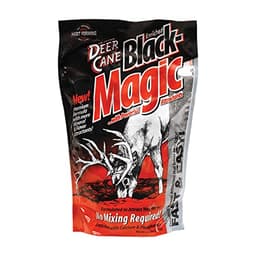
Evolved Habitats Deer Cane Black Magic
Best budget mineral-site starter
- Type
- Mineral-site activator
- Form
- Granular
- Size
- 4.5 lb
Price as of October 3, 2026. #ad How we’re funded
Using it well — site, timing and camera
The mix matters less than where you put it. A few things that consistently make the difference:
- Put it where deer already are. An attractant concentrates existing deer movement; it does not conjure deer onto ground they do not use. Site it near a known trail or between bedding and feeding, not in the middle of an empty field.
- Think about wind and access. A site you cannot check without walking through the bedding area will cost you more than it gives you.
- Put a camera on it. Otherwise you are guessing. A camera tells you whether deer are using it, at what hours, and whether it is mostly raccoons.
- Refresh, and clean up. Never leave spoiled feed on the ground. Moldy corn is genuinely harmful to deer, and a rotten site stops working anyway.
And keep expectations calibrated. Attractants get deer to visit a spot, often at night. That makes them excellent scouting tools and mediocre hunting strategies on their own. On ground you control long-term, a food plot does more, for longer, and with fewer of the disease concerns that come from concentrating animals at one small pile.
General guidance, not legal or safety advice. Hunting regulations vary by state and change every year — always verify seasons, legal equipment and requirements with your own state wildlife agency before you hunt. Wear a full-body harness and stay attached to the tree from the ground up whenever your feet leave the ground.
Frequently asked questions
What is the best homemade deer attractant?
The simplest ones work as well as anything: whole corn with molasses stirred through it, or cut apples with a little molasses or apple juice. Peanut butter smeared on a tree at nose height is the other reliable one. All of them work by being high-energy food that smells strongly — which is the entire mechanism behind commercial attractants too.
Is homemade deer attractant as good as store-bought?
For pure attraction, largely yes — a corn-and-molasses mix is not meaningfully different from many commercial products, and it costs a fraction as much. Where commercial products can differ is in formulated mineral content and in shelf-stable form factors like blocks and long-lasting liquids. For simply getting deer to visit a spot, homemade is competitive.
Is it legal to put out homemade deer attractant?
It depends entirely on your state, and in many states on the specific county or unit. Baiting and feeding rules vary enormously, are frequently changed in response to disease management, and often differ between hunting season and the rest of the year. Verify with your state wildlife agency before you put anything on the ground — a homemade mix is legally identical to a bought one.
Do homemade mineral licks grow bigger antlers?
The National Deer Association's evidence-based position is that there is no scientifically documented antler or health benefit from mineral supplementation for wild deer, though supplements may help where soils are genuinely mineral-deficient. Age and nutrition drive antler size. A mineral site is a good place to get trail camera photos; treat the antler claims skeptically.
Can deer attractants spread disease?
Concentrating deer at a single site increases both direct contact between animals and indirect contact through shared saliva at the feed, which the National Deer Association identifies as a mechanism that can accelerate the spread of diseases including CWD. That risk applies to homemade mixes exactly as it does to commercial ones, and it is a large part of why so many states regulate baiting.
How long does a homemade attractant last?
Not long, which is its main practical disadvantage. Corn and fruit mixes get eaten quickly, spoil in warm weather, and attract raccoons, hogs and other non-target animals that will clean a site out overnight. Expect to refresh a homemade site more often than a commercial block, and never leave spoiled feed on the ground.
Sources
- National Deer Association — Can Baiting and Feeding Really Spread Deer Diseases Faster? — NDA on how concentrating deer at bait and feed sites increases direct and indirect contact and the spread of diseases including CWD (accessed August 7, 2026)
- National Deer Association — Minerals for Whitetails — NDA's evidence-based position: no scientifically documented antler or health benefit for wild deer, though supplements may help where soils are mineral-deficient; age and nutrition drive antler size (accessed August 7, 2026)
- CDC — About Chronic Wasting Disease (CWD) — Federal guidance: wear gloves when field-dressing, bone out the meat, minimize handling of brain and spinal tissue, and consider testing before eating meat from CWD areas (accessed August 7, 2026)
- National Deer Association — Understanding Deer Senses (Dr. Gino D'Angelo) — NDA research summary on the three senses that keep a deer alive — sight, hearing, and, above all, smell (accessed July 22, 2026)
Keep reading
Are deer attractants legal?
The rules vary by state and change often — how to check yours before you put anything out.
Check the rulesBest deer attractants
The commercial products worth buying, and what they do that a home mix does not.
See the picksHow to use deer attractants
Siting, timing and the camera setup that tells you whether it is working at all.
Read the guideAttractants vs food plots
The longer-term alternative, and honestly the better investment on ground you control.
Compare the two