Optics · Head to head
Hunting vs Golf Rangefinder
Same laser, same physics, two opposite jobs. A golf unit is built to ignore the trees and find the flag. A hunting unit is built to ignore the flag and find what is standing in front of the trees.
How this is funded:we earn a commission if you buy through our links, at no extra cost to you. It never changes which product we recommend, and we’ll tell you plainly when to skip one. Full disclosure.
The hardware inside a golf rangefinder and a hunting rangefinder is nearly the same. Both fire an invisible laser pulse, time how long it takes to bounce back, and turn that into a distance accurate to about a yard. Both use similar optics and similar displays. If you already own a golf unit, the temptation to just take it hunting is entirely reasonable.
The difference is not in the laser. It is in what the software does when there is more than one thing to range, and that difference is designed in deliberately, in opposite directions, for two sports with opposite problems.
Angle-compensating hunting unit
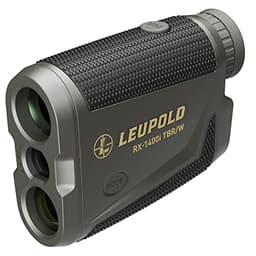
Leupold RX-1400i TBR/W Gen 2
Stand hunters who want angle-compensated range
- Max range (reflective)
- 1,400 yd
- Magnification
- 6x
- Angle compensation
- Yes — TBR/W (true horizontal + wind hold)
Price as of October 3, 2026. #ad How we’re funded
Budget hunting unit with angle mode
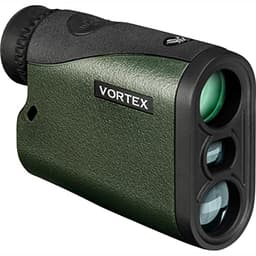
Vortex Crossfire HD 1400
A no-frills name-brand rangefinder
- Max range (reflective)
- 1,400 yd
- Magnification
- Not published
- Angle compensation
- Yes — HCD (horizontal component distance)
Price as of October 3, 2026. #ad How we’re funded
Difference 1: which target the unit chooses
This is the big one, and it is the reason a golf rangefinder can frustrate you in the woods.
Golf uses first-target priority. The flagstick is small, close, reflective and standing in front of a clean background. A golf unit is tuned to report the nearest thing it detects and to reject the background — because on a golf course the background is trees you do not care about.
Hunting uses distant-target priority. A deer is large, non-reflective, and very frequently standing behind a lattice of branches, saplings and tall grass. A hunting unit is tuned to look past the near clutter and report the more distant solid return.
Point a first-target-priority golf unit at a buck standing behind a screen of brush and it may well tell you the range to the brush. That is not a defect; it is the unit doing exactly what it was designed to do. It is simply the wrong design for the problem, and there is no setting on most golf units that reverses it.
Difference 2: slope mode is not quite an angle mode
Both categories can do the trigonometry that matters for a shot taken from an elevated stand. The physics is the same either way: your arrow or bullet follows the true horizontal distance to the animal, not the longer line-of-sight distance your eye travels along, so aiming for the line-of-sight number on a steep downhill shot makes you shoot high.
The gaps are in calibration and in availability:
- Presentation. A golf slope mode often shows a “plays like” distance, adjusted for how a golf ball behaves. If you use a golf unit for hunting, work from the raw slope-corrected horizontal distance, not from a plays-like number built around a different projectile.
- Availability. Many golf rangefinders are sold with slope switched off or removed entirely, because slope-enabled devices are restricted in tournament play. A golf unit without slope cannot do the one correction that matters most to a treestand hunter.
- Bow-specific features. Hunting units aimed at archers add arrow-arc or flight-path displays that show whether an intervening limb will clear. No golf unit has any reason to offer that.
Angle compensation is the feature we rank first in the rangefinder buying guide, and it is the single reason most bowhunters should not settle for a golf unit.
Difference 3: the things you notice in the field
- Color and finish. Golf units are frequently white, chrome or brightly colored. Hunting units are matte black or camo. Deer are red-green colorblind but see movement and contrast very well — a bright white object moving in a treestand is not what you want.
- Display type. Golf units are commonly LCD, which reads crisply against a bright fairway and can vanish against a dark deer in timber at last light. A hunting unit with an illuminated display and adjustable brightness is far better in the light you actually hunt in.
- Weatherproofing. Both categories vary, but rain and fog resistance is a headline feature on hunting units and an afterthought on cheaper golf ones.
- Reflective range claims. Both categories quote headline ranges measured off reflective targets. Ranging a deer’s matte hide works at a fraction of that. Ignore the number on the box in both categories — deer are shot close.
When a golf rangefinder is genuinely fine
This is not a page arguing you must buy a second device. A golf unit does the job well enough in some real hunting situations:
- Ranging landmarks before the hunt. Sitting in your stand at first light, ranging the big oak, the fence post and the trail crossing so you know your distances before a deer arrives. There is no clutter problem and no time pressure, and this is the smartest way to use a rangefinder anyway.
- Open-country gun hunting. A deer standing in a cut field with nothing in front of it is very close to a flagstick, from the laser’s point of view.
- Flat ground. If you hunt from a ground blind on level terrain, the angle correction that a golf unit may lack is not doing much for you anyway.
The verdict
If you hunt from a treestand with a bow or crossbow, buy a hunting rangefinder with genuine angle compensation. The combination of first-target priority and possibly-absent slope is working against you in exactly the two situations that matter most — a deer behind brush, and a steep shot from height.
If you gun hunt open ground on flat terrain, the golf unit you already own will get you through the season, and the best thing you can do with it is range your landmarks before the deer show up. When you do upgrade, spend the money on angle compensation and a display you can read at dusk, not on the biggest reflective range number in the catalog.
Frequently asked questions
Can you use a golf rangefinder for hunting?
You can, and it will give you a number. The problem is which number. Golf units are tuned to lock onto the nearest small reflective object and to ignore background clutter, which is exactly wrong when a deer is standing behind a screen of branches — the unit is inclined to read the branches. Hunting units prioritize the more distant target instead, which is why the same laser gives different answers.
What is the difference between slope mode and angle compensation?
Functionally they do the same trigonometry — both convert the line-of-sight distance into the true horizontal distance for an uphill or downhill shot. The difference is calibration and presentation: a golf slope mode is built around a golf ball's flight and often displays a 'plays like' distance; a hunting angle mode gives the corrected horizontal yardage, and better units add an arrow-arc display for bowhunters. If you use a golf unit, use its raw slope-corrected distance, not the 'plays like' number.
Is a golf rangefinder accurate enough for bowhunting?
Accuracy is not usually the limiting factor — modern lasers are accurate to about a yard, and bow ranges are short. The limiting factors are target acquisition through brush and, on some models, the fact that slope mode is disabled or removed for tournament legality. A rangefinder that cannot compensate for angle is a real handicap for a treestand bowhunter.
Why do golf rangefinders lock onto branches?
Because that is the behavior they are designed for. A flagstick is a small, near, highly reflective object with a clear background, so golf units use first-target priority — they report the closest thing they detect. Point that at a deer behind a branch and the branch is the closest thing. Hunting units use distant-target priority to solve exactly this.
Do I need a rangefinder for deer hunting at all?
For bowhunting, it is one of the highest-value things you can carry — arrows have a steep trajectory and a ten-yard estimation error is a miss or worse. For gun hunting inside 150 yards it matters less, though it still saves you from the classic overestimate across an open field. Buying an angle-compensating unit matters more than buying an expensive one.
Will a hunting rangefinder work on a golf course?
Yes, though it may be slower to lock onto the flag and its distant-target priority can read the trees behind the green. It is also worth knowing that many competitive golf formats restrict slope-enabled devices — a hunting rangefinder with angle compensation may not be tournament legal, which is a rules problem rather than a performance one.
Sources
- Realtree — Can You Trust Angle-Compensating Rangefinders? — On why an arrow follows the true horizontal distance, not line-of-sight, on an angled shot from a stand (accessed July 22, 2026)
- Bowhunting.com — How Far Should You Shoot With a Crossbow? — On ethical crossbow range for whitetail and how energy drops downrange (accessed July 22, 2026)
- Wasp Archery — How to Calculate the Kinetic Energy of Your Arrow — The kinetic-energy formula (arrow weight and speed) used to judge penetration (accessed July 22, 2026)
Keep reading
How to choose a hunting rangefinder
Angle compensation, display type, bow modes and the specs that are mostly marketing.
Read the guideBest hunting rangefinders
Our picks, compared on angle compensation, glass and low-light display readability.
See the picksBest rangefinders under $200
Where budget rangefinder value sits, and which corners are safe to cut.
See value picksRangefinder vs binoculars
Which optic to buy first for the way you hunt.
Compare the two