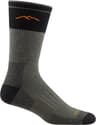
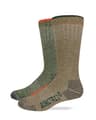
Why merino, specifically
Wool’s advantage over synthetics is not warmth, it is what happens when it gets damp. The Woolmark Company’s research summary puts numbers on it: wool fibers absorb around twice the water vapor of cotton and roughly thirty times that of polyester, pulling moisture into the fiber rather than leaving it sitting against your skin. That is precisely the problem you have when you arrive at the stand slightly sweaty and then sit still for four hours.
The same research covers the second benefit, which matters more to a deer hunter than to anyone else: wool binds odor compounds inside the fiber where bacteria do not thrive. In assessor testing, unwashed wool retained about 66% less body-odor intensity than polyester. You will still play the wind — nothing you wear beats the wind — but a sock that does not turn into a scent source over a three-day hunt is a genuine advantage.
Cotton, by contrast, does the exact opposite of everything above. It holds water against the skin, loses effectively all insulating value when wet, and dries slowly. It is the one material to actively avoid.
Weight: match the sock to the hunt, not the temperature
The instinct is to buy the thickest sock for the coldest day. That is only right if you are not moving.
- Heavyweight / full cushion. For sitting still in cold weather, in a boot with room for it. This is the December stand sock. It is the wrong sock for walking a mile in.
- Midweight. For hunts where you walk in. Enough warmth to sit in for a while, thin enough that you arrive dry rather than soaked. If you have one pair of hunting socks, this is arguably the one to own.
- Lightweight. Early season, warm weather, or as a liner under a heavier sock in genuinely severe cold.
The boot has to have room
Insulation works by trapping air. Compress it and it stops working, which is why a heavyweight sock in a snug boot can leave you colder than a midweight sock in the same boot. Try boots on with the socks you will actually hunt in, and if you plan to run heavyweight socks in late season, size the boot accordingly. Our boot sizing guide covers this in detail.
The dry-spare trick
Here is the single most effective thing on this page, and it costs about fifteen dollars: put a second pair of socks in your pack, and change into them at the base of your tree after the walk in.
You get cold because you arrive damp and then stop generating heat. Swapping to a dry pair at the exact moment you stop moving removes the moisture before it has a chance to cost you anything. It works better than buying a heavier sock, better than buying a warmer boot, and it works on every hunt regardless of temperature. Keep the damp pair in a plastic bag in the pack — do not leave it out to freeze.
What about boot heaters and toe warmers?
Chemical toe warmers work, with one caveat: most air-activated warmers need oxygen, and sealed inside a tight rubber boot they can underperform. Stick them on top of the sock at the toe box rather than under it, and give them a couple of minutes in open air to get going before you close the boot. They are a supplement, not a substitute for a dry sock and a boot with room in it.
Height matters more than you think
A crew sock inside an 18-inch rubber boot leaves the boot cuff rubbing bare calf for however long you walk. Match sock height to boot height: tall crew or boot-height socks for tall rubber boots, standard boot height for leather hunting boots. It is a small detail that turns into a blister on the hike out.