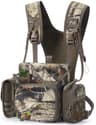
Silent closure is the whitetail specification
Western hunters glass from six hundred yards away and can make whatever noise they like. A whitetail hunter is often working at twenty to forty yards with an animal that has already decided something is wrong, and the sound of hook-and-loop tearing open carries a very long way in still timber.
This is the reason the top pick here leads on closure type rather than on capacity or organization. Magnetic and hook-style silent closures let you open a case slowly and quietly, which is what you need when the deer is close enough that opening the case at all is a risk.
The trade is real: silent closures hold less firmly than hook-and-loop, so a harness that stays shut when you lean over a stand rail is worth checking. And test the closure at home wearing your winter gloves — half of what makes a harness silent is being able to open it slowly, and a heavy glove changes that entirely.
Fit is not a formality
“Binocular harness” is not a size. A compact 8x32 and a rangefinding 10x42 differ enormously in objective diameter, body length and weight, and a case sized for one is either impossible or sloppy for the other.
- Too small means forcing the binocular in, which means the closure does not seat, which means you stop using the harness.
- Too large means the binocular rattles inside the case as you walk, which is its own noise problem, and the objectives take knocks.
Measure your binocular — length and objective diameter — and check it against the harness listing. If you own a rangefinding binocular, assume you need the large size; the electronics make those bodies noticeably longer and heavier than a plain 10x42.
The rangefinder pouch is the money-saving feature
Our rangefinding binocular roundup makes the case that separates usually beat a combo on value. This is the piece that makes separates work: a harness with a dedicated rangefinder pouch puts both optics on your chest, both reachable one-handed, both accessible from a seated position without reaching into a pack.
The workflow that follows is the whole point. Deer appears, glass it with the binocular, range it with the rangefinder, both hands stay in front of you, and you never lean forward or twist to reach a pack pocket — which is what gets a hunter caught moving.
Check the pouch against your actual rangefinder before you buy. Pouch dimensions are frequently not published, and rangefinder bodies vary more than you would expect.
Attachment: MOLLE and what to actually hang on it
Some harnesses carry MOLLE webbing, which lets you attach small pouches. Useful, and worth a caveat: everything you add to a chest harness is bulk between you and the stand rail, and in a small hang-on that starts to matter.
The things genuinely worth carrying there are a grunt tube or bleat can, a wind checker, and a phone. The things not worth carrying there are anything you use once a season, which belongs in the pack.
Where the money goes
The gap between a thirty-dollar harness and a hundred-and-twenty-dollar one is not waterproofing or features. It is webbing quality, how the load spreads across your shoulders, and whether it still sits right at hour eight.
That is a specification that only shows up over time, which makes it hard to justify in a shop and easy to justify after two seasons. The realistic guidance: if you glass from a stand a dozen times a season, the entry harness is completely adequate. If you wear one every day of a long season, the expensive one is worn more rather than less, and comfort at hour six is what makes you actually carry a binocular.
Setting it up properly
- Adjust it wearing the clothes you hunt in. A harness fitted over a T-shirt in August is strangling you over a bib and a jacket in December.
- Set the height so the case sits above your belt line, high enough that it does not fold into your lap when you sit down and low enough that you can see over it.
- Check bow clearance. Draw your bow — unloaded, at home — wearing the harness and your hunting layers. A harness that the string catches is a harness that has to be adjusted or replaced, and finding that out at full draw on a deer is the wrong time.
- Keep the lens covers. A case protects a binocular from the outside; the covers protect the objectives from the inside of the case, which is where dust and pine needles collect.
A note on cost versus what it protects
A harness is the least interesting purchase in optics and one of the highest-leverage ones. It costs a small fraction of the binocular, it stops that binocular from swinging into a climbing stick or falling out of a stand, and it is what makes the difference between an optic you use every hunt and one that lives in a pack.
If you have just spent real money on glass — and if you are reading our binocular roundup you probably have — buy the harness in the same order. It is the cheapest insurance on the whole purchase.