Trail cameras · Head to head
Stealth Cam vs SPYPOINT
This looks like a brand comparison. It is really a decision about whether you want to walk to your camera — and that decision changes what the camera costs you over a season.
How this is funded:we earn a commission if you buy through our links, at no extra cost to you. It never changes which product we recommend, and we’ll tell you plainly when to skip one. Full disclosure.
Search “Stealth Cam vs SPYPOINT” and you will find a lot of brand loyalty and not much clarity, mostly because the two brands are usually being compared across different categories. Stealth Cam’s volume sits in inexpensive SD-card cameras. SPYPOINT’s sits in cellular. So the useful version of this comparison is not “which brand is better” — it is “do you want to walk to your camera, and what is that walk worth?”
SD card, no running cost
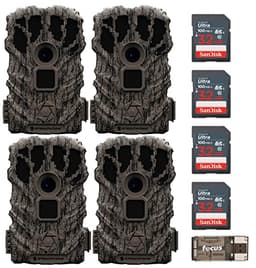
Stealth Cam Browtine 14MP
A ready-to-hang budget SD camera
- Connectivity
- Non-cellular (SD card)
- Flash
- Low-glow infrared
- Ongoing cost
- None — no data plan
Price as of October 3, 2026. #ad How we’re funded
Cellular, free tier included
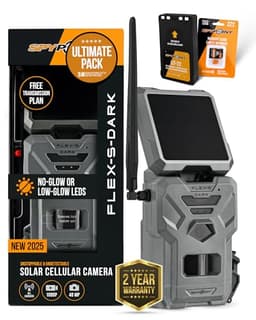
SPYPOINT Flex-S Dark
Trying cellular without a monthly bill
- Connectivity
- Cellular (auto carrier-select) + solar
- Flash
- Selectable no-glow or low-glow IR (100 ft)
- Ongoing cost
- Free plan (~100 photos/mo); paid plans for more
Price as of October 3, 2026. #ad How we’re funded
The two cameras, plainly
Stealth Cam Browtine — the cheap camera that owes you nothing
This is the archetype of the budget SD-card camera: it takes photos, it writes them to a card, and it never asks you for money again. There is no app, no account, no coverage question and no plan. You buy it once. When you want the photos, you go and get them.
That model has a real advantage nobody talks about much: it works everywhere. Cellular cameras die in dead zones, and plenty of good deer ground has no signal at all. An SD card does not care about coverage. It also means you can run several cameras for the price of one cellular camera’s first year, which is often the better scouting strategy — more cameras on more trails beats one camera reporting faster.
SPYPOINT Flex-S Dark — photos on your phone, and a free tier to start
The Flex-S Dark sends images to your phone over the cellular network, auto-selects a carrier rather than making you guess between AT&T and Verizon, and carries a solar panel so you are rarely swapping batteries. Its flash is selectable, so you can set it to no-glow and have nothing visible when it fires at night. SPYPOINT’s distinctive feature is the free photo tier — enough images per month to genuinely use the camera without paying anything.
The honest caveat: free tiers are sized for light use. Put this camera on a heavily traveled trail during the rut and it will hit the monthly limit fast, at which point you are either waiting for the calendar or paying. Budget for the plan you will actually end up on, not the one on the box.
What the subscription is really buying
It is tempting to frame the cellular premium as paying for convenience. It is not, quite. What you are buying is not walking into the spot.
Every card pull is an intrusion at the exact location you are trying to hunt. You leave scent on the ground and on the tree, you make noise, and you do it on a schedule that has nothing to do with the wind. On a field edge you can reach by truck, that costs you almost nothing. On a bedding-area pinch point you have spent two seasons learning, it can cost you the spot.
So the question is not “is the monthly fee worth faster photos?” It is “how sensitive is this site, and what would I pay not to walk into it?” That reframing makes the decision easy for most hunters — and it is usually a per-camera answer, not a per-hunter one.
Cost over a season
Purely on money, the SD-card camera wins and it is not close. It has one price and no second one. The cellular camera has a purchase price plus, realistically, a plan — and the plan is billed by photo volume, so the busier your trail the more you pay.
The number people miss is the multi-camera version of the same budget. A season of cellular service on one camera often costs about what a second and third budget SD-card camera would. Three cameras on three trails tell you more about deer movement than one camera reporting instantly, especially early in the year when you are still working out where deer are rather than watching a specific buck. We work the arithmetic out properly in the cellular subscription cost breakdown.
Flash: the other real difference here
These two specific models answer the flash question differently. The Browtine is fixed low-glow — brighter, cleaner night photos with a faint red ring visible to anyone standing in front of it. The Flex-S Dark is selectable: set it to no-glow and nothing is visible at all, at the cost of darker, grainier night images, or leave it on low-glow and it behaves much like the Browtine after dark.
Deer are unlikely to care either way: they lack the long-wavelength cone that would let them register a low-glow flash as anything meaningful. People do care, which is why no-glow matters on public ground and boundary trails and matters far less deep inside a private property. The no-glow vs low-glow comparison covers the evidence in full.
Who should buy which
Buy the Stealth Cam if you are scouting new ground and need coverage rather than speed, if you hunt anywhere with poor cell signal, if you want several cameras out at once, or if you flatly do not want a recurring bill attached to a piece of hunting gear. It is also the right first camera for anyone still working out where the deer are.
Buy the SPYPOINT if the camera is going somewhere you cannot afford to walk into, if you are watching one specific deer and need to know the same day rather than next weekend, if you hunt ground far enough from home that a card-pull trip is a half-day, or if the site is prone to theft — a no-glow cellular camera tells you it has been moved before you drive out to discover an empty tree.
The short answer
Neither brand is better. The SD-card camera is cheaper to own and works where there is no signal; the cellular camera is more expensive to run and buys you the ability to stop disturbing your best spot. Most hunters who run both end up with the same layout: budget SD-card cameras spread wide for general scouting, and one cellular camera on the site that matters, where the walk in costs more than the subscription does.
Frequently asked questions
Is Stealth Cam or SPYPOINT better for deer hunting?
They are answering different questions. Stealth Cam's budget SD-card cameras cost you nothing to run but require you to walk in and pull a card, which disturbs the site every time. SPYPOINT's Flex line sends photos to your phone and includes a limited free plan, so you never walk in — but heavy use will push you onto a paid plan. Pick on whether the walk-in or the monthly bill bothers you more.
Does SPYPOINT really have a free plan?
Yes. SPYPOINT includes a free photo tier that is genuinely usable — enough for a slow trail or a first cellular camera. What it is not is unlimited: an active trail in the rut will burn through a small monthly photo allowance in days, and after that you are choosing between waiting for the next month or paying.
Which is cheaper over a whole season?
The SD-card camera, almost always, if you only count money. A budget Stealth Cam has no recurring cost at all. What the cellular camera buys with its subscription is not photos, it is access — you stop walking into the spot you are hunting. Whether that is worth a monthly fee depends on how sensitive the site is.
What flash types do they use?
It varies by model in both lines, and it is worth checking before you buy. The budget Stealth Cam models are typically low-glow, which gives brighter night images and a faint red glow visible to people. SPYPOINT's Flex-S Dark lets you choose in the app: run it no-glow and nothing is visible at all, at the cost of darker night photos, or switch it to low-glow for brighter ones.
Do I need cellular at all?
Not if you can check a camera without hunting past it. The whole argument for cellular is that walking to a camera leaves scent and disturbance at the exact spot you care about. If a camera sits on a field edge you can drive to, or on ground you are not hunting yet, an SD-card camera does the same job for no ongoing money.
Sources
- National Deer Association — Find Next Season's Buck in Last Season's Trail-Cam Photos — NDA on reading trail-camera data to pattern deer movement and bedding-to-food travel (accessed July 22, 2026)
- National Deer Association — The Hunter's Guide to Deer Vision — Deer lack the long-wavelength (red) cone, so they cannot distinguish red or orange from green; they lack a UV filter and carry more rods than humans, which is why they see so well at last light (accessed August 19, 2026)
Keep reading
What cellular trail cameras really cost to run
The plan math for a full season, including what happens when the free tier runs out.
See the cost breakdownTactacam Reveal vs SPYPOINT Flex
The other cellular comparison hunters ask about — two cellular cameras, head to head.
Compare the cellularsBest trail cameras without a subscription
If the answer here is 'no monthly bill', these are the SD-card cameras worth running.
See the no-fee picksNo-glow vs low-glow flash
The other spec that separates these two models — and what deer actually see.
Read the comparison