Tag & Timber

Attractants · Rut tactics

Best Deer Decoys: What to Buy, and Where It Has to Stand

A decoy is a story a buck has to believe at two hundred yards and again at ten. Six picks compared on published weight and size, on how many angles they survive, and on whether you will actually carry them in.

By Stephen V.Last updated How we pick

A decoy is the only piece of whitetail gear that works by being seen. Everything else in your pack is an attempt to go unnoticed, which is why decoying feels backwards the first time you try it and why most decoys end up living in a shed. The ones that kill deer are the ones that get carried, set in the right place, and pointed the right way — and two of those three things are decided before you buy.

So we ranked on four things, in this order:

  • Will you actually carry it? This is the whole category in one question. The premium full-body buck here is published at 60 inches nose to tail and 22 pounds. The best collapsible doe is published at 30 ounces including its poles, folding to 13 by 16 inches. One of those goes in a pack a half mile from the road, and the other needs a truck.
  • How many angles does it survive? A three-dimensional body reads from everywhere. A printed photographic panel reads beautifully broadside and poorly head-on, which is a real limitation and a manageable one, because you choose the approach angle when you choose the set.
  • Can it move? A whitetail will stare at something new in its field for as long as it takes, and a static shape loses that contest. A tail attachment that flicks in a light breeze is the cheapest fix in hunting.
  • What does the maker actually publish? Flambeau publishes four real dimensions and no weight. Montana publishes a weight, a folded size and an unfolded size — and, on one page, two different weights. Those disclosures are the only way to compare a decoy you cannot stand next to.

Prices are live and dated. We have not shot deer over these to rank them and will not claim to — the picks come from each maker’s published figures and from deer behavior research we cite below, and the placement advice is reasoning from that research rather than a story about one good morning.

How this is funded:we earn a commission if you buy through our links, at no extra cost to you. It never changes which product we recommend, and we’ll tell you plainly when to skip one. Full disclosure.

Quick picks

Ranked on published specs, package value and buyer fit. Select a row to jump to the full write-up. We have not tested these products — here is exactly what we do instead.

#ProductBest forPrice
1
Montana Decoy Dreamy Doe Whitetail Decoy

Montana Decoy Dreamy Doe Whitetail Decoy

The decoy most hunters will actually carry, which is the only kind that kills deer. Montana publishes it at 30 oz including poles, folding to 13 by 16 inches and opening to 37 by 40 — meaning it goes in or on a daypack instead of riding in a truck bed, and a public-land hunter can set it a half mile from the road. The compromise is honest: a printed photographic panel reads superbly from the broadside angles a deer usually approaches from, and poorly from head-on.

Best overall
$77.15 · View on Amazon

$87.9912% off

Price as of October 6, 2026. #ad How we’re funded

2
Flambeau Master Series Boss Buck Deer Decoy

Flambeau Master Series Boss Buck Deer Decoy

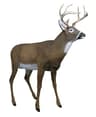
If you are decoying a mature buck during the rut rather than calming a doe, this is the shape to put in the field. Flambeau publishes real dimensions — 60 inches nose to tail, 58 inches to the antler tips, 41 inches at the shoulder — which is a mature-buck silhouette at a mature-buck size, and that scale is what makes a territorial buck commit instead of circling. It is also 22 pounds of hollow plastic you have to get to the field and back.

Best full-body buck
$170.99 · View on Amazon

Price as of October 6, 2026. #ad How we’re funded

3
Flambeau Master Series Grazing-Doe Decoy

Flambeau Master Series Grazing-Doe Decoy

The full-body decoy that tells the quieter and more useful story. A buck decoy says there is a rival here; a feeding doe says it is safe here, and safety is what moves deer into a field in daylight. Flambeau publishes it at 41 inches nose to tail and 33 at the shoulder, with opposable ears so the head posture can be set relaxed, and the calm pose does not carry the risk of running a subordinate buck off.

Best full-body doe
$139.51 · View on Amazon

Price as of October 6, 2026. #ad How we’re funded

4
Montana Decoy Trixie Whitetail Doe Decoy Bundle with Carrier Bag

Montana Decoy Trixie Whitetail Doe Decoy Bundle with Carrier Bag

The packable doe to buy if you want movement in the set without buying an add-on. Trixie ships with Teaser Tails, and a tail that flicks in the lightest breeze is the single cheapest way to make a static decoy survive the long stare a whitetail gives anything new in its field. This is the bundle listing, which adds the carrier bag — the bare-decoy listing went unavailable while we were verifying, and a decoy you carry in a bag is a decoy that lives in a truck rather than a shed.

Best for motion
$132.99 · View on Amazon

Price as of October 6, 2026. #ad How we’re funded

5
Montana Decoy Whitetail Dream Team, Buck and Doe

Montana Decoy Whitetail Dream Team, Buck and Doe

The set that tells the most provocative story in whitetail hunting: a buck already standing with a doe. That is the scene a mature buck will cross a field in daylight to break up, and it is the one configuration a single decoy cannot stage. Montana lists the pair at 3.85 pounds folding figure-eight style, which is remarkable for two deer — a pair of full-body decoys is 40-plus pounds and two trips.

Best rut pair
$152.15 · View on Amazon

Price as of October 6, 2026. #ad How we’re funded

6
VEVOR HDPE Doe Hunting Decoy with Foldable Legs

VEVOR HDPE Doe Hunting Decoy with Foldable Legs

The cheapest way into a three-dimensional decoy, and it is the honest budget pick as long as you know what you are getting. HDPE construction, legs that come off without tools, and a published 11.24 pounds — half what the premium full-body buck weighs. What it does not have is a hunting pedigree: the same listing sells it as garden decor, and no published claim traces to anyone who hunts.

Best budget full-body
$108.66 · View on Amazon

Price as of October 6, 2026. #ad How we’re funded

The picks in full

#1Best overall

Montana Decoy Dreamy Doe Whitetail Decoy

The decoy most hunters will actually carry, which is the only kind that kills deer. Montana publishes it at 30 oz including poles, folding to 13 by 16 inches and opening to 37 by 40 — meaning it goes in or on a daypack instead of riding in a truck bed, and a public-land hunter can set it a half mile from the road. The compromise is honest: a printed photographic panel reads superbly from the broadside angles a deer usually approaches from, and poorly from head-on.

Strengths

  • Published at 30 oz including poles, which is the difference between a decoy you own and a decoy you use
  • Folds to a published 13 x 16 in and opens to 37 x 40 in — it fits in a pack with room for the rest of your gear
  • A photographic image panel, so hair detail and color are a real photo rather than a paint scheme
  • Takes the maker's Teaser Tail and tip-up stand, so motion can be added later without a new decoy

Trade-offs

  • Two-dimensional: from directly in front or behind it is a panel, so the set-up angle does the work
  • Montana's own page contradicts itself on weight, listing 30 oz in the specification and 64 oz in the additional-information block
  • No material composition is published anywhere we could read
  • Teaser Tail and the tip-up stand are both sold separately, so the useful configuration costs more than the sticker
TypeCollapsible photographic doe decoy
Weight30 oz including poles (maker's spec)
Folded13 x 16 in
Unfolded37 x 40 in
IncludedLeg poles
MaterialNot published

Worth knowing. Montana publishes two different weights for this decoy on the same page (30 oz in the spec, 64 oz in additional information); both are recorded rather than averaged.

Specs read from the product listing, on October 5, 2026. “Not published” means the manufacturer does not state that figure.

#2Best full-body buck

Flambeau Master Series Boss Buck Deer Decoy

If you are decoying a mature buck during the rut rather than calming a doe, this is the shape to put in the field. Flambeau publishes real dimensions — 60 inches nose to tail, 58 inches to the antler tips, 41 inches at the shoulder — which is a mature-buck silhouette at a mature-buck size, and that scale is what makes a territorial buck commit instead of circling. It is also 22 pounds of hollow plastic you have to get to the field and back.

Strengths

  • Publishes four real dimensions (60 in nose to tail, 58 in antler tip to ground, 41 in shoulder, 13 in wide) so you can judge the silhouette before buying
  • A full three-dimensional body reads from every approach angle, unlike a printed panel
  • Legs, head, ears and antlers stow inside the body cavity, so storage and transport are better than the size suggests
  • An 8-point antler set and a blaze orange carry sling are included — the sling is the safety item this category needs

Trade-offs

  • 22 lb and 60 inches long: this is a decoy for a truck, a side-by-side or a short walk, not a mile-in set
  • Flambeau publishes no weight and no material on its own page — the 22 lb and HDPE construction come from the Amazon listing
  • A buck decoy can intimidate a young buck out of a field entirely, which is the opposite of what you wanted
  • Carrying an antlered decoy into the woods during firearms season is a genuine hazard, which is exactly why the orange sling is in the box
TypeFull-body 3-D buck decoy
Nose to tail60 in
Antler tip to ground58 in
Shoulder to ground41 in
Weight22 lb (Amazon listing; not published by Flambeau)
Included8-point antler set, blaze orange carry sling

Worth knowing. Flambeau's own page lists the legs, head, ears and antlers as stowing in the body cavity — assemble at the set, never carry it assembled in gun season.

Specs read from the product listing, on October 5, 2026. “Not published” means the manufacturer does not state that figure.

#3Best full-body doe

Flambeau Master Series Grazing-Doe Decoy

The full-body decoy that tells the quieter and more useful story. A buck decoy says there is a rival here; a feeding doe says it is safe here, and safety is what moves deer into a field in daylight. Flambeau publishes it at 41 inches nose to tail and 33 at the shoulder, with opposable ears so the head posture can be set relaxed, and the calm pose does not carry the risk of running a subordinate buck off.

Strengths

  • A calm feeding posture is lower-risk than a buck decoy: it rarely intimidates a deer out of the field
  • Opposable ears let you set a relaxed head position rather than an alert one
  • Published dimensions (41 in nose to tail, 33 in shoulder, 11 in wide) describe a real adult doe, not a scaled-down model
  • Legs stow in the body cavity on a lug-and-keyhole fitting, so it breaks down without tools

Trade-offs

  • Flambeau publishes neither weight nor material on its own page, and the Amazon listing's 1 lb item weight is clearly a shipping artifact rather than the decoy's weight
  • Stakes are not included even though the maker tells you to anchor it in strong winds
  • Full-body plastic: bulky to carry and awkward to store even broken down
  • A grazing posture gives you no motion at all, so it needs wind, a tail attachment or a calling sequence to look alive
TypeFull-body 3-D feeding doe decoy
Nose to tail41 in
Shoulder to ground33 in
Body width11 in
EarsOpposable
WeightNot published

Worth knowing. Flambeau says the decoy can be staked in heavy winds but does not include stakes — buy a pair of tent stakes with it or expect to re-set it after gusts.

Specs read from the product listing, on October 5, 2026. “Not published” means the manufacturer does not state that figure.

#4Best for motion

Montana Decoy Trixie Whitetail Doe Decoy Bundle with Carrier Bag

The packable doe to buy if you want movement in the set without buying an add-on. Trixie ships with Teaser Tails, and a tail that flicks in the lightest breeze is the single cheapest way to make a static decoy survive the long stare a whitetail gives anything new in its field. This is the bundle listing, which adds the carrier bag — the bare-decoy listing went unavailable while we were verifying, and a decoy you carry in a bag is a decoy that lives in a truck rather than a shed.

Strengths

  • Teaser Tails included, so the motion that sells the illusion is in the box rather than a separate purchase
  • Carrier bag included, which is what makes a folding decoy survive a season of being thrown in a truck
  • A calming pose that works on does too, which keeps a field group settled instead of alert
  • Leg poles included and quick to set, and it folds flat like the rest of the Montana line

Trade-offs

  • The bundle listing publishes no weight and no dimensions at all, so its footprint cannot be compared with the maker's other decoys
  • No material composition published either
  • Two-dimensional, with the same head-on weakness as every photographic panel decoy
  • A tail needs breeze: in dead-calm conditions it adds nothing at all
TypeCollapsible photographic doe decoy + carrier
MotionTeaser Tails included
IncludedLeg poles, carrier bag
WeightNot published
Folded sizeNot published
MaterialNot published

Worth knowing. Motion is what defeats a whitetail's stare — a tail attachment moving in a light breeze buys the seconds a static decoy loses. Montana publishes this decoy as compatible with its Whitetail Tip Up Stand, sold separately.

Specs read from the product listing, on October 5, 2026. “Not published” means the manufacturer does not state that figure.

#5Best rut pair

Montana Decoy Whitetail Dream Team, Buck and Doe

The set that tells the most provocative story in whitetail hunting: a buck already standing with a doe. That is the scene a mature buck will cross a field in daylight to break up, and it is the one configuration a single decoy cannot stage. Montana lists the pair at 3.85 pounds folding figure-eight style, which is remarkable for two deer — a pair of full-body decoys is 40-plus pounds and two trips.

Strengths

  • A buck-and-doe pair is the strongest rut story available, and it is the one a single decoy cannot tell
  • Listed at 3.85 lb for both deer, which no pair of full-body decoys can approach
  • Folds figure-eight style for carrying, so the pair still fits a pack
  • Both deer take the maker's Teaser Tail and tip-up stand for motion

Trade-offs

  • A buck in the set can push a subordinate buck out of the field, so this is a pick for hunting a specific mature deer rather than for seeing more deer
  • No dimensions published for either decoy on the listing
  • Teaser Tails and the Quickstand are both sold separately, so the complete setup costs noticeably more
  • Two panels to set, stake and angle correctly in the dark, which is twice the chance of a wrong-facing decoy
TypeCollapsible photographic buck + doe pair
Weight3.85 lb for the pair (Amazon listing)
FoldingFigure-eight fold
AccessoriesTeaser Tail and Quickstand sold separately
DimensionsNot published

Worth knowing. The listing describes the buck as a revised 2023 design; both decoys are stated as compatible with the maker's Quickstand and Teaser Tail.

Specs read from the product listing, on October 5, 2026. “Not published” means the manufacturer does not state that figure.

#6Best budget full-body

VEVOR HDPE Doe Hunting Decoy with Foldable Legs

The cheapest way into a three-dimensional decoy, and it is the honest budget pick as long as you know what you are getting. HDPE construction, legs that come off without tools, and a published 11.24 pounds — half what the premium full-body buck weighs. What it does not have is a hunting pedigree: the same listing sells it as garden decor, and no published claim traces to anyone who hunts.

Strengths

  • Published at 11.24 lb, roughly half the weight of the premium full-body buck here
  • Three-dimensional, so it reads from every angle a printed panel does not
  • Legs fold or detach without tools for transport
  • The cheapest full-body decoy we could verify as purchasable

Trade-offs

  • Marketed simultaneously as a hunting decoy and as lawn decoration, which tells you where the design priorities are
  • No paint-durability, UV or temperature claims published, and HDPE decoys fade
  • No reachable maker spec page for the SKU, so everything here comes from the listing
  • Listed dimensions describe the shipped object rather than a nose-to-tail measurement, so you cannot compare its silhouette to a Flambeau
TypeFull-body HDPE doe decoy
Weight11.24 lb (Amazon listing)
MaterialHDPE
LegsFoldable / tool-free removal
Nose to tailNot published

Worth knowing. A faded decoy is a liability rather than a neutral: a chalky, blue-shifted hide reads wrong to an animal that sees short wavelengths better than we do.

Specs read from the product listing, on October 5, 2026. “Not published” means the manufacturer does not state that figure.

Buying the decoy is the easy part

Three decisions decide whether a decoy works, and only the first one happens in a shopping cart: what it is, where it stands, and which way it faces. Hunters who say decoys do not work have almost always made a set that could not have worked — a decoy in cover where nothing can see it, forty yards out with no shooting lane to the side a deer approaches from, or facing the wrong direction so a buck that commits ends up walking directly away from the stand.

Weight is the sleeper spec here because it determines how many of your sets are possible. A 22-pound full-body buck means you are hunting field edges you can drive to, and that is a legitimate way to hunt a food plot on your own ground. A 30-ounce folding doe means every stand on the property is in play, including the one at the back of the public parcel that nobody walks to. Buy the heavy one for a known field and the light one if you expect to move.

Where to stand it

Start with visibility. A decoy has to be seen from distance to do anything, so it belongs in the open: a food plot, a field edge, a clear-cut, a logging road, a power-line cut. Thirty yards into the timber is a decoy nothing will ever look at.

Then set the distance for your weapon, not for the photograph. Twenty yards from a bowhunter’s stand is a good working distance, because a buck that comes to the decoy generally does not walk into it — he stops short, posture up, reading it. Setting the decoy at your maximum range means the shot you get is beyond it. Our bow setup guide covers the range question from the equipment side.

The direction a buck arrives from is the part that is actually researched. In Dr. Mickey Hellickson’s three-year rattling study, summarized by the National Deer Association, 60% of responding bucks approached from downwind. That research is about rattling rather than decoys, but the behavior it describes is the one that matters here: a buck investigating something interesting checks it with his nose before he commits to his eyes. So the set that works is one where the downwind side of the decoy is still in front of you — a decoy upwind or crosswind of your stand, with the wind carrying your scent away from the arc the deer will swing through. A decoy set directly downwind of you is a decoy you have scented first.

Which way it faces, and what that says

Decoy posture is a sentence, and the two sentences are different. A buck decoy says there is a rival standing here, and a buck that answers it usually comes head-on and wants to be face to face — so a buck decoy generally faces your stand, which puts the approaching deer broadside or quartering as he circles to square up. A doe decoy says it is safe here and nothing is wrong, and a buck approaching a doe tends to come to the back half. Facing a doe decoy away from you, quartering, tends to put the deer where you want it.

That difference also carries a risk worth stating plainly: a buck decoy is a challenge, and a young or subordinate buck can read the challenge and leave the field entirely. If your goal is to see deer and your ground holds mostly young bucks, the feeding doe is the safer decoy. If you are hunting one mature deer during the rut and are content for the field to clear of yearlings, the buck is the right tool. The buck-and-doe pair tells the most provocative version of the story — a rival already standing with a doe — and carries the biggest version of the same risk.

Motion is what defeats the stare

A deer’s visual system is built around movement, and it processes visual information faster than ours does. The practical consequence for decoying is that a perfectly still deer shape, inspected for two full minutes at eighty yards, starts to look wrong, because real deer are never still that long. Ears move, tails move, the head comes up and goes down.

That is the whole argument for a tail attachment, and it is why the Trixie earns its slot by including the tails rather than selling them separately. A strip of white fabric flicking in a breeze costs nothing in weight and buys you the seconds a static decoy loses. If your decoy has no motion option, the budget version is a short length of white toilet tissue or surveyor tape tied where the tail belongs — genuinely effective, and it comes down with the decoy.

One caveat: a tail needs wind. In dead-calm conditions the attachment does nothing, which is another reason the calling-plus-decoy combination matters. Sound brings the deer to where it can see the decoy; the decoy answers the question the sound raised. Our deer call picks cover the grunt tubes, bleat cans and rattle bags that do that job, and the same research above found that loud rattling sequences drew nearly three times the responses of quiet ones, with 54% of all responses falling between 7:30 and 10:30 in the morning.

Timing: the window repeats every year

Decoying is a rut tactic. It works when bucks are moving in daylight, looking for does and willing to confront rivals, and that period is more predictable than hunting folklore suggests: nine years of New Brunswick fetal data covering more than 1,600 does found the mean conception date falling inside a 7-day window every single year, and inside the same 4-day window in eight of nine years, because breeding is driven by photoperiod rather than weather or moon phase.

For a decoy that means the calendar, not the forecast, tells you when to carry it. The back end of the pre-rut through the chase phase is the productive stretch, and the same rattling research points at the morning: more than half of all responses came in the 7:30-to-10:30 window, with only 16% at midday. The same work also found that observers on the ground missed 57% of the responses elevated observers saw — which is a quiet argument for running your decoy from a stand rather than from a ground set, and for trusting that deer are looking at it even when you cannot tell.

Our whitetail season checklist lays out how the rest of the kit changes across those same phases.

Handling, scent and the stuff nobody mentions

A decoy is a large object you touch with your hands, haul against your body, and then place twenty yards upwind of where you are going to sit for four hours. Smell is a deer’s primary defense, and it is the sense most likely to end your hunt before anything sees anything.

So handle a decoy the way you handle the rest of your setup: gloves on, stored away from gasoline, bug spray and the inside of a truck cab, and set with a long carry handle or a sling rather than hugged to your chest. Our scent control picks cover the sprays and storage that make that routine realistic. If you add a scent to the set — a wick near the decoy is a common pairing — check the rules first, because natural cervid urine is restricted in a number of states; our deer scent guide and attractant legality guide both cover that ground.

The safety rule this category needs

Flambeau includes a blaze orange carry sling in the box with a full-body antlered buck decoy, and that inclusion is the most honest statement any maker on this page makes: a hunter walking through the woods carrying a deer-shaped object with antlers on it is the genuine hazard in decoying, and it is far more likely than any of the risks hunters actually worry about.

Three rules follow, and they are not optional during any firearms season. Carry the decoy broken down, not assembled — both Flambeau models stow their legs, and the collapsible decoys fold flat, so there is no reason to walk with a deer silhouette on your shoulder. Cover it in blaze orange on the way in and the way out. And think hard about running an antlered decoy at all on public ground during a gun season, no matter how much orange you hang on it.

A last note on color, because it cuts the other way from intuition: deer lack the long-wavelength cone that lets people separate red and orange from green, so blaze orange is not the liability to your concealment that it is to a hunter’s eye. You can be visible to people and invisible to deer at the same time, which is the entire reason hunter orange works.

Check your state before you set one

Decoys are legal for deer hunting in most states and the rules are not uniform — some states restrict electronic or moving decoys, some have specific language about decoys on public land, and the scents hunters pair with them carry their own restrictions. Read your own agency’s current regulations rather than a forum post; our guide to attractant legality explains how to find the authoritative rule for your state, and the same method applies here.

Frequently asked questions

Do deer decoys actually work?

They work when the set is right and they do nothing when it is not, which is why hunters disagree so sharply about them. A decoy needs to be visible from distance, close enough to your stand that a deer stopping short of it is still in range, positioned so the downwind arc a buck swings through is in front of you rather than behind you, and facing the direction that matches the story it is telling. Get those right during the rut and a decoy converts the bucks that would have passed at eighty yards into bucks that commit. Get them wrong and you have carried a large plastic deer into the woods for nothing.

Should I use a buck decoy or a doe decoy?

A doe decoy is the lower-risk choice and the better default. A feeding doe says the field is safe, which is what moves deer into the open in daylight, and it almost never pushes a deer out. A buck decoy is a challenge: it is the stronger tool when you are hunting one mature deer during the rut, and it can send a young or subordinate buck out of the field entirely. If your ground holds mostly yearling bucks and you want to see deer, run the doe. If you are after a specific mature buck and do not care what the yearlings do, run the buck — or the buck-and-doe pair, which is the most provocative set available.

How far from my stand should I put a deer decoy?

Close enough that a deer stopping short of the decoy is still inside your effective range — around twenty yards for most bowhunters, and further is fine with a crossbow or a rifle. The mistake is setting a decoy at your maximum range, because a responding buck typically stops before he reaches it and reads it from a distance, so your actual shot ends up past your range. Also pick the spot so your shooting lanes cover the side a deer will circle to, not just the decoy itself.

Which way should a deer decoy face?

Face a buck decoy toward your stand. A buck answering a rival wants to be head-on, so a decoy facing you tends to put the approaching deer broadside or quartering as he squares up. Face a doe decoy away from you or quartering away, because a buck approaching a doe tends to come to her back half. With a buck-and-doe pair, set the buck facing your position and the doe quartering away, and give yourself a lane on both sides.

When is the best time to use a deer decoy?

The rut, in the morning. Breeding dates are driven by photoperiod rather than weather or moon phase — nine years of fetal data from more than 1,600 does put the mean conception date inside the same 7-day window every year — so the productive stretch repeats on roughly the same calendar dates on your ground annually. The back of the pre-rut through the chase phase is when bucks are willing to confront a rival in daylight. The research on rattling responses found 54% of them between 7:30 and 10:30 a.m. against 16% at midday, which is the clearest timing signal available.

Are deer decoys legal?

In most states, yes, but the rules are not uniform and they change. Some states restrict electronic or mechanically moving decoys, some have specific language about leaving decoys on public land, and the scents hunters commonly pair with a decoy carry their own restrictions — natural cervid urine is limited or banned in a number of states on disease grounds. Read your own wildlife agency's current regulations for the season you are hunting rather than trusting a forum post or a product page.

Full-body or collapsible decoy — which is better?

Full-body decoys read from every angle and are the more convincing object; collapsible photographic decoys read superbly broadside, poorly head-on, and weigh a fraction as much. The deciding question is honestly logistical. A 22 lb, 60-inch full-body buck is a decoy for ground you can drive to. A 30-ounce doe that folds to 13 by 16 inches is a decoy you can carry a mile and set in the dark, which means it gets used on more hunts. A decoy in the shed has a conversion rate of zero, so weight is a performance spec.

How do I keep my scent off a deer decoy?

Treat it like the rest of your setup rather than like a piece of yard furniture. Handle it with gloves, store it away from gasoline, exhaust and bug spray rather than in a truck bed or garage corner, and carry it with a sling or handle instead of against your chest. Smell is a deer's primary defense and a decoy is a large object you touch with bare hands and then place upwind of your stand — which is the worst combination of those two facts. Spraying it down with a scent-eliminating treatment before you set it is a reasonable final step.

Is it safe to use a deer decoy during gun season?

It demands real caution, and the makers know it: a full-body antlered decoy ships with a blaze orange carry sling for exactly this reason. Never carry a decoy assembled — both full-body picks here stow their legs and the collapsible models fold flat — cover it in blaze orange going in and coming out, and think carefully before running an antlered decoy on public land during any firearms season. Deer cannot distinguish orange from green because they lack the long-wavelength cone humans have, so the orange costs you nothing in concealment while being the only thing that makes you and your decoy legible to another hunter.

Sources

  • Montana Decoy — Dreamy Doe (product page) — Manufacturer's published figures: weight 30 oz including poles; folded 13 in x 16 in; unfolded 37 in x 40 in; leg poles included; compatible with the brand's Whitetail Tip Up Stand and its Teaser Tail, both sold separately; a lightweight, durable design with no material composition published. The same page's additional-information block separately lists a weight of 64 oz, which contradicts the 30 oz figure in its own specification — recorded here rather than resolved, because the maker publishes both. Cited as manufacturer claims (accessed October 5, 2026)
  • Flambeau Outdoors — Master Series Boss Buck (product page) — Manufacturer's published figures: nose to tail 60 in; antler tip to ground 58 in; body width at widest point 13 in; shoulder to ground 41 in; threaded post legs with locking lugs; the legs, head, ears and antlers fit inside the body cavity for transport or storage; a blaze orange carry sling is included; sculpted by Chris Schiller; item number 5965MS; ships via FedEx. Flambeau publishes no weight and no material for this decoy on its own page — the 22 lb and the 3-D blow-molded HDPE construction are published on the brand's Amazon listing. Cited as manufacturer claims, and for the blaze orange sling, which exists because a hunter carrying an antlered decoy through the woods is the real hazard in this category (accessed October 5, 2026)
  • Flambeau Outdoors — Master Series Grazing-Doe (product page) — Manufacturer's published figures: nose to tail 41 in; shoulder to ground 33 in; body width at widest point 11 in; a lug-and-keyhole leg attachment for quick disassembly, with the legs stowing in the body cavity; opposable ears; realistic hair detail and a life-like paint scheme; it can be anchored in strong winds, with stakes not included; ships via FedEx. No material composition, no weight and no country of manufacture is published on this product page, although the brand's Amazon listing for the same decoy states it is made in the U.S.A. Cited as manufacturer claims (accessed October 5, 2026)
  • National Deer Association — 10 Tips for Rattling More Bucks Using Science — Dr. Mickey Hellickson's three-year rattling research: a 65% overall response rate (73% for collared bucks), 54% of responses between 7:30 and 10:30 a.m. against 16% midday, better response as temperature and wind dropped and cloud cover rose, greater than one buck per attempt during peak rut, 60% of bucks approaching from downwind, loud sequences drawing nearly three times the responses of quiet ones, and ground-level hunters missing 57% of the responses elevated observers saw (accessed August 24, 2026)
  • National Deer Association — No Link Between Moon Phase and Rut Peak — Nine years of New Brunswick fetal data from over 1,600 does: the mean conception date fell inside a 7-day window every year and inside the same 4-day window (November 26-29) in eight of nine; breeding dates are driven by photoperiod and are consistent year to year within a population, regardless of moon phase (accessed August 24, 2026)
  • National Deer Association — The Hunter's Guide to Deer Vision — Deer lack the long-wavelength (red) cone, so they cannot distinguish red or orange from green; they lack a UV filter and carry more rods than humans, which is why they see so well at last light (accessed August 19, 2026)
  • National Deer Association — Understanding Deer Senses (Dr. Gino D'Angelo) — NDA research summary on the three senses that keep a deer alive — sight, hearing, and, above all, smell (accessed July 22, 2026)

Keep reading