What this category publishes, and what it keeps to itself
We looked for the four things that should decide a blaze orange purchase — whether the orange is solid, how many square inches of it there are, what the fabric is, and what it weighs — across all six listings. One column is nearly full and three are nearly empty.
| Vest | Solid or camo | Published coverage | Fabric | Named feature |
|---|
| Allen Deluxe | Solid | Not published | Not published | None stated |
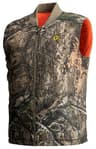
| Gamehide Naked North | Camo orange | Not published | Not published | Quiet fabric |
| ScentBlocker Evolve | Reversible camo / blaze | Not published | Not published | Reversible |
| Hi-Vis 500+ panel | Camo orange | 500+ sq in (listing claim) | Not published | Waterproof, mesh back |
| Hi-Vis buckle vest | Solid | Not published | Not published | Quick-release buckle, mesh back |
| Hunter’s Specialties | Solid | Not published | Not published | None stated |
Five of six publish no coverage figure, none of the six publishes a fabric composition, and none publishes a weight. The one that does publish a coverage figure — 500-plus square inches of bright panel — is a camo orange vest, which means the number it publishes is only legally useful in a state that accepts camo orange in the first place. That is not a coincidence. A solid orange vest has no incentive to print square inches because it satisfies every rule regardless, and a camo vest has every incentive to print them because square inches is the argument it has left.
Treat the absence as a disclosure gap rather than proof a vest is too small. But do the arithmetic yourself if you hunt in a state with an area rule: an adult vest front panel is roughly a foot and a half wide and two feet tall, so a solid front and back clears 250 square inches comfortably and is in the neighborhood of 400. Nobody will guarantee that for you in writing, which is why the states that care most about the number also tell you to wear a hat.
Solid versus camo orange, which is the only question that can make a vest useless
Blaze orange camo is a real product category and it exists for a real reason: a solid orange panel is a shape, and a shape is what a deer notices moving. Breaking the orange up with a pattern keeps the color (which the deer cannot see as orange anyway) while softening the outline. Several states accept it.
Several do not, and they are explicit. Wisconsin’s DNR says camo-blaze is legal when 50% or more of the material is blaze orange or fluorescent pink — and then recommends 100% solid anyway. Pennsylvania’s code says camouflage orange clothing is lawful provided it contains the minimum amount of fluorescent orange material, which puts the burden on you to know how much of the garment is orange. Hunter-education guidance records Illinois as a state where camo orange does not qualify at all, and notes that most states require solid blaze orange and that camouflage with orange panels may not comply unless the garment is labeled as compliant.
Not one of the camo vests on this page is labeled as compliant with anything. So the honest rule is this: if you hunt one state and it accepts camo, buy the camo vest and get the quieter, better-looking garment. If you hunt more than one state, hunt public land you do not know well, or simply do not want to read a regulations digest before every trip, buy solid. The two cheapest picks here are solid, so this is not a decision that costs you money.
What the incident data actually says, and why we are not going to scare you
The usual version of this paragraph claims that most hunting-accident victims were not wearing orange. We went to a state agency’s own annual report instead of repeating it, and the numbers do not say that.
New York’s DEC recorded seven hunting-related shooting incidents in 2025, none of them fatal, against a ten-year average of 12.7. Of those seven, five were self-inflicted and two were two-party. The per-incident detail records whether the victim was wearing orange: yes in five cases, not applicable in two, and no in none of them. The incidents were a hunter who slipped while rabbit hunting, a holstered handgun that discharged into a thigh, a crossbow injury to a foot, a loaded firearm pulled from a vehicle, a handgun that went off during a blood trail, and two cases where a shooter hit someone else.
Read that honestly and it says two things. Orange is not the main thing standing between you and a hunting injury — muzzle control is, and most of the incidents in that report were a person and their own gun. But orange is the only thing that addresses the failure mode it is designed for, which is another hunter resolving a patch of brown at eighty yards into a deer. Two of those seven were exactly that scenario. And in a majority of states it is the law, which settles the argument whatever you think of the statistics. The DEC lists “wear hunter orange” among the primary rules of hunter safety for that reason.
The hat question, and the part a vest cannot solve
Three of the state rules we read reach above your shoulders. Pennsylvania counts the head, chest and back combined toward its 250 square inches. Wisconsin requires that a hat, if worn, be at least 50% blaze orange or fluorescent pink — so a camo beanie over a compliant orange vest can put you in violation in Wisconsin even though the vest is fine. Hunter-education summaries record several states requiring an orange hat outright alongside an area figure.
None of the vests on this page includes a hat. If your state has a headwear rule, budget for an orange knit cap as part of this purchase rather than as an afterthought — our headwear and face-mask picks cover the warmth side of that decision, and the cheapest orange beanie you can find covers the legal side.
Pennsylvania has a second requirement a vest cannot satisfy at all: during firearms seasons for deer, elk or bear, a minimum of 100 square inches of orange must be placed within 15 feet of a qualifying blind, visible in a 360-degree arc. If you hunt a ground blind in a state with that rule, you need an alert band for the blind in addition to whatever you are wearing.
Will the orange cost you deer?
Not as color. Whitetails are dichromats: they lack the long-wavelength cone that lets people separate red and orange from green, which is why blaze orange reads to a deer as a drab yellow-grey rather than as the beacon it is to you. The research the National Deer Association summarizes on deer vision is unambiguous on this point and it is the single most useful fact in this whole category.
What can cost you deer is everything else about a vest. Shape, because a solid rectangle of one tone is a shape. Movement, because a loose panel flaps. And noise, because deer hear across roughly 0.25 to 30 kHz with their best sensitivity in the 4 to 8 kHz band, which is precisely where a stiff synthetic panel sliding across a jacket lives. That is the entire argument for the Gamehide vest costing four times what the Hunter’s Specialties panel costs, and it is a real argument even though nobody publishes a decibel figure to prove it.
It is also the argument for buying a vest that fits. A sized garment that lies flat against a coat is quieter and less visible to a deer than a one-size panel stretched over a parka, and four of these six are sized.
Who should not buy a vest at all
If you only bowhunt, and your state exempts archery hunters, you may not need one — though several states require orange for bowhunters moving during an open firearms season, which is the trap. The honest answer for an October-only bowhunter in an exempt state is to own the cheap panel for the walk in and out of public land during gun season and leave it in the truck the rest of the year.
And if you are shopping because the gun opener is this weekend and you own nothing, buy solid and buy cheap. The difference between the best vest on this page and the cheapest is comfort and quiet. The difference between the cheapest vest and no vest is whether you are legal.
What to buy with it
A vest is the last layer, not a layer. It goes over whatever you were going to wear anyway, which means the purchase that actually determines your November is underneath it: our cold-weather jacket picks and the layering guide are the two pages to read if the vest is going over a system you have not sorted out yet.
If you are putting an orange vest on for the first time this year because you are moving from bow season into the firearms opener, the rest of that transition is a gear problem as much as a legal one — our gun season gear list covers it, and our blaze orange requirements guide explains the square-inch and percentage rules in full, including blaze pink and the states with no requirement at all.