Clothing · Blaze orange
Blaze Orange Requirements: Square Inches, Percentages and Pink
The rule is not written in the same unit from one state to the next — 250 square inches in one, 50% of your outer clothing in another, nothing at all in six of them. Here is how to read your own rule, and what to buy once you have.
How this is funded:we earn a commission if you buy through our links, at no extra cost to you. It never changes which product we recommend, and we’ll tell you plainly when to skip one. Full disclosure.
There is no national blaze orange rule, and more importantly, there is no national unit. Most hunters assume the question is “how many square inches?” and that the answer is a number they can look up once. It is not. Pennsylvania writes its rule as 250 square inches on the head, chest and back combined. Wisconsin does not use an area at all — it requires at least 50% of your outer clothing above the waist to be blaze orange or fluorescent pink. Six states have no statewide requirement whatsoever. A manufacturer cannot print one figure that satisfies all of that, which is why almost no blaze orange garment publishes a coverage figure at all.
This guide does three things: it shows you the two ways the rule gets written so you can recognize which one you are reading, it covers the four clauses that catch people out (headwear, camo, blinds, and the archery overlap), and it tells you what to buy that works under both styles of rule. It is not a fifty-state table, because a fifty-state table written once is wrong within a year — these rules change, and two of our own sources say so on their own pages.
The two ways the rule is written
Once you know there are only two shapes to this, your own digest becomes much easier to read.
Area rulesspecify a minimum number of square inches of fluorescent orange, usually with a placement requirement. Pennsylvania’s codified version is the clearest example and worth reading in full because it contains every clause this style of rule tends to have: a minimum of 250 square inches of daylight fluorescent orange-colored material on the head, chest and back combined; visible in a 360-degree arc; worn while hunting or while moving to or from a hunting location; from one hour before to one hour after legal hunting hours; when outside a motorized vehicle. Four separate conditions on one number.
Percentage rulesspecify a proportion of what you are wearing rather than an area. Wisconsin’s is the model: when and where a firearm deer season is in progress, at least 50% of the hunter’s outer clothing above the waist must be colored blaze orange or fluorescent pink, for hunting any game other than waterfowl. Hunter-education summaries record Michigan and Maine using the same 50% approach.
The practical difference matters more than it looks. Under an area rule, a vest is a fixed quantity of orange and you either have enough or you do not. Under a percentage rule, the same vest can be compliant over a t-shirt and non-compliant over a full camo parka, because the denominator changed. A percentage rule effectively requires that your orange be your outermost layer and that it cover most of it.
The published figures we found across both styles, cited to hunter-education guidance: 144 square inches at the low end (Alabama wildlife management areas, Iowa blinds), 200 (Kansas, New Jersey), 250 (Maryland, New York, Pennsylvania), 400 (Illinois, Montana, Washington, and Texas public land), and 500 at the top (Colorado, Florida, Georgia, Massachusetts, Mississippi, Tennessee). Several of those states layer a hat requirement on top. The six states listed as having no statewide requirement are Alaska, Arizona, California, Nevada, New Hampshire and Vermont — though individual refuges, wildlife management areas and public hunting lands in those states can still impose one, so the property matters as well as the state.
Clause one: your hat is part of the rule, and it can fail you
Three different things happen to headwear across these rules, and they are easy to confuse.
Some states countthe head. Pennsylvania’s 250 square inches is on the head, chest and back combined, so an orange hat contributes to the total and an orange hat plus an orange vest satisfies it comfortably.
Some states require a hat outright, in addition to an area figure. Hunter-education summaries record Illinois requiring 400 square inches of blaze orange and a hat for firearm deer hunting, and Kansas requiring a hat plus 200 square inches split 100 front and 100 back. In those states a vest alone is not enough however big it is.
And one of the rules we read can be failed by your hat. Wisconsin requires that a hat or other head covering, if worn, must itself be at least 50% blaze orange or fluorescent pink. Read that carefully: a camo beanie pulled on over a fully compliant orange vest puts you in violation in Wisconsin, because the hat you chose to wear is subject to the rule independently. This is the single most commonly missed clause in the whole category.
The practical conclusion is the same under all three: buy the hat with the vest. Our headwear picks deal with the warmth side of that decision; the legal side costs a few dollars and removes a whole category of problem.
Clause two: solid orange versus camo orange
Blaze orange camo exists for a defensible reason. A solid orange panel is a shape, and shape is one of the few things a whitetail can actually use against you — the color is not, because deer lack the long-wavelength cone that separates orange from green and read blaze orange as a drab yellow-grey. Breaking the orange up with a pattern keeps the visibility to humans and softens the outline.
The states split on whether that is acceptable, and they split explicitly:
- Wisconsin:camo-blaze is legal if 50% or more of the material is blaze orange or fluorescent pink — and the DNR recommends 100% solid anyway.
- Pennsylvania: camouflage orange clothing is lawful provided it contains the minimum amount of fluorescent orange-colored material. The burden of knowing how much of your garment is orange is yours.
- Illinois: recorded in hunter-education guidance as a state where camo orange does not qualify at all.
The same guidance warns generally that most states require solid blaze orange, and that camouflage with orange panels may not comply unless the garment is labeled as compliant. We compared six blaze orange vests and not one of them is labeled as compliant with any state rule. So the honest advice is unglamorous: if you hunt a single state and it accepts camo, buy the camo vest and enjoy the quieter garment. If you hunt more than one state, hunt unfamiliar public land, or would rather not carry a regulations question into the woods with you, buy solid. It is not more expensive — the two cheapest vests we found are both solid.
Clause three: the blind and tree stand rule, which no vest satisfies
Pennsylvania has a second requirement that lives outside the clothing section and catches blind hunters every year. During firearms seasons for deer, elk or bear, a minimum of 100 square inches of daylight fluorescent orange material must be placed within 15 feet of a qualifying blind, visible in a 360-degree arc. That is an alert band for the structure, not a garment for you, and nothing you wear will cover it.
Hunter-education summaries record similar provisions elsewhere written differently — Iowa, for instance, appears with a 144-square-inch figure tied to blinds. If you hunt a pop-up ground blindduring a firearms season, search your digest for “blind” as well as for “orange,” because the clause is frequently filed under the former.
Clause four: the archery overlap, which is where bowhunters get caught
Archery exemptions are real and widespread. The trap is that they are usually written for the season, not for the hunter. Where an archery season runs concurrently with an open firearms season, a bowhunter is commonly subject to the full orange requirement — and sometimes to a narrower version of it, such as orange while moving to and from a stand but not while on it.
If you are an October bowhunter who also hunts the November overlap, the cheap answer is to own a solid orange panel and keep it in the pack for the walk in and out. That is one of the two reasons our vest roundup includes a pick that costs less than a box of shells. The other is that it makes a good loaner for the friend who turns up in a camo coat on opening morning.
What the incident data says, honestly
The standard justification for all of this is that most hunting-accident victims were not wearing orange. We went to a state agency’s own report rather than repeating it, and the numbers tell a more useful story.
New York’s DEC recorded seven hunting-related shooting incidents in 2025 — none fatal, against a ten-year average of 12.7 — of which five were self-inflicted and two were two-party. Deer hunting accounted for four of the seven, and the average age of the shooters involved was 48. In the per-incident detail, the victim is recorded as wearing orange in five cases and as not applicable in two. In none of the seven is the victim recorded as not wearing orange.
So orange is not what stands between most hunters and a hunting injury; muzzle discipline is, and the report lists both among the primary rules of hunter safety for a reason. What orange does is answer one specific failure: another hunter resolving brown movement in cover into a deer at distance. Two of those seven incidents were that scenario, and that is the scenario every one of these laws was written for. It is also, in most states, simply the law — which settles the practical question regardless of what you make of seven data points.
What to buy under either style of rule
A solid orange vest and a solid orange hat satisfy the large majority of both area and percentage rules, and the two together cost less than a tank of fuel. If you want one decision that is correct in every state that requires orange at all, that is it.
Solid orange, sized
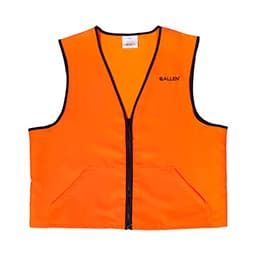
Allen Company Deluxe Blaze Orange Safety & Hunting Vest
Any hunter who wants one vest that is legal in every orange state
- Color
- Solid blaze orange
- Type
- Pull-over safety vest
- Size on this listing
- Large
Price as of November 12, 2026. #ad How we’re funded
Solid orange, cheapest
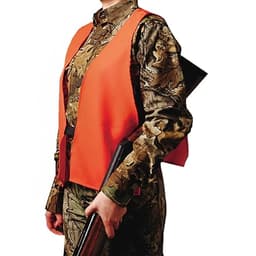
Hunter's Specialties Safety Vest, Blaze Orange
A spare in the truck, a loaner, or the honest minimum
- Color
- Solid blaze orange
- Type
- High-visibility safety vest
- Size
- Adult (one size)
Price as of November 12, 2026. #ad How we’re funded
Three refinements are worth the money in specific cases. If you sit still rather than walk, a quiet-fabric vest is a genuine hunting advantage because a stiff synthetic panel sliding over a jacket is loudest at the moment you raise a gun. If you bowhunt October and gun hunt November, a reversible camo-to-blaze vest replaces two garments with one. And if your orange has to go over a December parka, a strap-and-buckle vest goes on without coming over your head and your hat. All three are in the vest roundup, with the honest trade-offs on each.
Two things not to do. Do not buy a camo orange vest for a state you have not checked, because it is the one purchase in this category that can be legally worthless. And do not keep hunting in a vest that has gone salmon in the back window of a truck — Wisconsin says outright that faded or stained blaze orange is unsafe and may not meet legal requirements, and it is the cheapest item in your kit to replace.
If the orange is going on because the firearms opener is here, the rest of that transition is a gear question too. Our gun season gear list covers what actually changes between the bow sits and the gun opener, and our whitetail season checklist is the season-wide version of the same thing.
General guidance, not legal or safety advice. Hunting regulations vary by state and change every year — always verify seasons, legal equipment and requirements with your own state wildlife agency before you hunt. Wear a full-body harness and stay attached to the tree from the ground up whenever your feet leave the ground.
Frequently asked questions
How much blaze orange is required for deer hunting?
There is no national figure, and the states do not even use the same unit. Pennsylvania's codified rule is a minimum of 250 square inches of daylight fluorescent orange on the head, chest and back combined, visible in a 360-degree arc. Wisconsin's rule is not an area at all: at least 50% of your outer clothing above the waist must be blaze orange or fluorescent pink. Hunter-education summaries record 400 square inches in states including Illinois, Montana and Washington, and 500 square inches in states including Colorado, Georgia and Mississippi, with the overall range running roughly 144 to 500. An orange vest plus an orange hat satisfies the large majority of these rules, but you still need to read your own state's current digest.
Which states do not require blaze orange?
Hunter-education guidance lists six states with no statewide requirement: Alaska, Arizona, California, Nevada, New Hampshire and Vermont. That is not the same as orange being a bad idea there, and it is not the same as no rule applying - individual wildlife management areas, national wildlife refuges and some public hunting lands set their own requirements even in states with no statewide rule. Verify the specific property as well as the state.
Does blaze orange have to be solid?
In some states yes, in others a camo-orange pattern is acceptable if enough of the material is orange. Wisconsin's DNR states camo-blaze is legal if 50% or more of the material is blaze orange or fluorescent pink, while recommending 100% solid. Pennsylvania's code allows camouflage orange clothing provided it contains the minimum required amount of fluorescent orange material. Hunter-education guidance records Illinois as a state where camo orange does not qualify, and notes that most states require solid blaze orange and that camouflage with orange panels may not comply unless labeled as compliant. If you hunt more than one state, buy solid and stop thinking about it.
Is blaze pink legal for hunting?
In a growing number of states. Wisconsin's own regulations treat fluorescent pink as fully equivalent to blaze orange, including for its hat rule. Hunter-education summaries list twelve states accepting pink in place of or alongside orange: Alabama, Colorado, Georgia, Louisiana, Maryland, Minnesota, New York, Tennessee, Virginia, Washington, Wisconsin and Wyoming. The same source warns that pink rules vary and are changing quickly, so check the current year's digest rather than any list - including this one.
Do bowhunters have to wear blaze orange?
Usually not during an archery-only season, and often yes when an archery season overlaps a firearms season. That overlap is where hunters get caught: the exemption is typically written for the archery season rather than for the archer, so a bowhunter walking to a stand during an open gun season can be subject to the full requirement. Some states additionally require orange while moving but not while on stand. Read the exemption language in your own digest rather than assuming a blanket archery exemption.
Does my ground blind need blaze orange on it?
In Pennsylvania, yes, and this is the requirement a vest cannot satisfy. During firearms seasons for deer, elk or bear, a minimum of 100 square inches of daylight fluorescent orange material must be placed within 15 feet of a qualifying blind, visible in a 360-degree arc. Other states have similar blind and tree-stand rules written differently or not at all. If you hunt from a pop-up blind in gun season, check for this clause specifically - it is easy to miss because it is not in the clothing section.
Can faded blaze orange still be legal?
Wisconsin's DNR says plainly that faded or stained blaze orange or fluorescent pink clothing is unsafe and may not meet legal requirements. That is worth knowing because the cheapest safety vest in anyone's truck is usually the oldest one, and sun exposure through a windshield fades fluorescent dye faster than washing does. If your orange has gone salmon, replace it - it is the cheapest piece of gear you own.
Does wearing blaze orange actually prevent accidents?
It addresses one specific failure mode rather than most of them. New York's DEC recorded seven hunting-related shooting incidents in 2025, none fatal, and five of the seven were self-inflicted - a slip while rabbit hunting, a holstered handgun discharging, a crossbow injury, a loaded firearm pulled from a vehicle, a handgun that went off during a blood trail. Only two were two-party. In its per-incident detail, the victim is recorded as wearing orange in five cases and not applicable in two, and as not wearing it in none of the seven. Orange answers the case where another hunter resolves movement in cover into a deer. Muzzle control answers the rest, and in that report it was the bigger share.
Sources
- 58 Pa. Code § 141.20 — Protective material required (Pennsylvania) — The codified Pennsylvania rule, written in square inches rather than as a percentage: a minimum of 250 square inches of daylight fluorescent orange-colored material on the head, chest and back combined, visible in a 360-degree arc, worn while hunting or moving to or from a hunting location, from 1 hour before to 1 hour after legal hunting hours, when outside a motorized vehicle. For firearms seasons for deer, elk or bear, a minimum of 100 square inches of daylight fluorescent orange-colored material must also be placed within 15 feet of a qualifying blind, likewise visible in a 360-degree arc. On camouflage: camouflage orange clothing is lawful provided it contains the minimum amount of fluorescent orange-colored material. A separate exception allows woodchuck hunters a solid orange hat on the head only (accessed November 2, 2026)
- Wisconsin DNR — Highly Visible Clothing (hunting regulations) — The state agency's own published rule, written as a percentage rather than an area: when and where a firearm deer season is in progress, at least 50% of the hunter's outer clothing above the waist must be colored blaze orange or fluorescent pink, for hunting game other than waterfowl. A hat or other head covering, if worn, must itself be at least 50% blaze orange or fluorescent pink. Camo-blaze is legal if 50% or more of the material is blaze orange or fluorescent pink, and the DNR separately recommends 100% solid blaze orange or fluorescent pink. The page also states that faded or stained blaze orange or fluorescent pink clothing is unsafe and may not meet legal requirements. Highly visible clothing requirements do not apply to hunters participating in legal night hunting, 30 minutes after sunset to 30 minutes before sunrise (accessed November 2, 2026)
- Hunter-Ed — Blaze Orange Regulations in Every State — The hunter-education publisher's state-by-state summary. Range for firearm deer season given as typically 144-500 square inches. Figures recorded on the page include 144 square inches (Alabama WMAs, Iowa blinds), 200 (Kansas, New Jersey), 250 (Maryland, New York, Pennsylvania), 400 (Illinois, Montana, Texas public land, Washington) and 500 (Colorado, Florida, Georgia, Massachusetts, Mississippi, Tennessee). Several states instead use a percentage of outer clothing above the waist -- at least 50 percent in Wisconsin, Michigan and Maine. Six states are listed as having no statewide requirement: Alaska, Arizona, California, Nevada, New Hampshire and Vermont. Twelve states are listed as accepting fluorescent pink in place of or alongside orange: Alabama, Colorado, Georgia, Louisiana, Maryland, Minnesota, New York, Tennessee, Virginia, Washington, Wisconsin and Wyoming. On patterns: most states require solid blaze orange, camouflage with orange panels may not comply unless labeled compliant, some states accept camo orange meeting a minimum orange percentage, and others require solid orange only. Illinois is recorded as a state where camo orange does NOT qualify. Cited as a secondary summary -- its own page advises checking current state regulations, and so do we (accessed November 2, 2026)
- New York State DEC — Hunting Safety Statistics 2025 (preliminary) — The state agency's own annual tally of hunting-related shooting incidents (HRSI), described on the document as compiled from preliminary reports and not final. 2025: 7 total incidents, 0 fatal, 7 non-fatal, 5 self-inflicted, 2 two-party -- against a 5-year average of 9.6 total and a 10-year average of 12.7. Deer accounted for 4 of the 7. By implement: 3 shotgun, 1 rifle, 2 handgun, 1 crossbow. Average age of the shooters involved was 48. The report lists 'Wear hunter orange' among the primary rules of hunter safety. Its per-incident detail records a 'Victim wearing orange' field for each of the seven: Yes in five cases, N/A in two, and No in none of them. One incident involved a shooter who had no hunting license. The document covers only incidents involving firearms, bows or crossbows -- not, for example, heart attacks or falls (accessed November 2, 2026)
- National Deer Association — The Hunter's Guide to Deer Vision — Deer lack the long-wavelength (red) cone, so they cannot distinguish red or orange from green; they lack a UV filter and carry more rods than humans, which is why they see so well at last light (accessed August 19, 2026)
- Hunter-Ed — Fall-Arrest Systems (FAS) — State-approved hunter-ed guidance on full-body harness + fall-arrest components (accessed July 22, 2026)
Keep reading
Best Blaze Orange Hunting Vests
Six vests compared on solid versus camo orange, published coverage and quiet fabric - with live prices.
See the vest picksGun Season Deer Hunting Gear
What changes when the firearms opener arrives, and the purchases that change with it.
See the gun season listCrossbow Hunting Laws by State
The other regulation that varies wildly state to state, read the same way: from the rule as written.
Read the crossbow rulesBest Hunting Face Masks and Headwear
The headwear half of the rule - several states count your hat, and one of them can fail you on it.
See the headwear picks