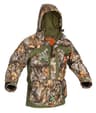
The orange is not optional, and the rule is not one number
If you take one thing from this page, take this: there is no national blaze orange figure, and the states do not write the rule in the same unit, so “how many square inches?” is a question with no portable answer.
Pennsylvania’s codified rule is a minimum of 250 square inches of daylight fluorescent orange on the head, chest and back combined, visible in a 360-degree arc, worn while hunting or moving to or from a hunting location, from one hour before to one hour after legal hunting hours. Wisconsin does not use an area at all: at least 50% of your outer clothing above the waist must be blaze orange or fluorescent pink, and a hat, if worn, must itself be at least 50% orange or pink. Hunter-education guidance records 400 square inches in states including Illinois, Montana and Washington, and 500 in states including Colorado, Georgia and Mississippi — and six states (Alaska, Arizona, California, Nevada, New Hampshire, Vermont) with no statewide requirement at all.
Two consequences for what you buy. First, buy solidorange unless you have checked that your state accepts camo orange — hunter-education guidance records Illinois as a state where camo orange does not qualify, and most states require solid. Second, buy the hat with the vest: some states count your head toward the total, some require an orange hat outright, and Wisconsin can fail you for a camo beanie worn over a compliant vest. Our blaze orange requirements guide works through all of it, including blaze pink and the blind alert-band rule, and the vest roundup compares six of them on solid-versus-camo and published coverage.
One fact that should settle any worry about what the orange costs you: whitetails lack the long-wavelength cone that separates orange from green, so a deer reads blaze orange as a drab yellow-grey rather than as the color you see. The orange is not your problem. A vest that rustles when you raise a gun is.
Why the glass matters more with a gun than with a bow
A bowhunter’s whole season happens inside about forty yards. At that distance you can see everything you need with your eyes, and the useful senses are your ears and the wind. A rifle or a slug gun moves the decision out to a range where you genuinely cannot tell a shootable deer from a yearling, or antlers from branches, without magnification.
A 10x42 binocular is the default for this job for a reason: ten times magnification is as much as most people can hold steady unsupported, and a 42 mm objective gathers enough light to still be useful in the first and last twenty minutes, which is when the deer move. That combination is why the Vortex Diamondback HD is the pick here.
An honest note on what this group publishes. Every binocular in our registry publishes magnification, objective diameter and weatherproofing — and not one of them publishes a field of view, an eye relief figure or a weight. Those are the three numbers that would actually let you compare two binoculars at the same magnification, and they are absent across the whole category, which is why we rank on what is published and say so. Our magnification guide covers the arithmetic of choosing between 8x and 10x; the binocular roundup has the full set of picks.
Carry them where you can reach them. Binoculars hanging on a neck strap swing, bang against a gun stock and end up in a coat pocket by nine in the morning, which is the same as not owning them — our harness picks fix that for about the cost of a box of ammunition.
The rangefinder is about the shot you do not take
Most hunters buy a rangefinder to confirm a shot. Its more valuable use is to rule one out. Range estimation by eye degrades badly past about a hundred yards, especially across open ground, downhill, or in the flat light of a November morning — and the error is almost always an underestimate, which is exactly the direction that produces a wounded deer.
The practical habit is to range landmarks when you sit down, not deer when they appear. The fence post, the lone tree, the field corner, the near edge of the standing corn: get those numbers before first light and you have a yardage map rather than a stopwatch problem when a buck walks out at legal light. Our rangefinder buying guide explains angle compensation and why it matters more from an elevated stand than on the flat, and the rangefinder roundup has the rest of the picks.
The Leupold RX-1400i publishes a 1,400-yard reflective maximum, which is marketing rather than a hunting figure — nobody shoots deer at 1,400 yards. The spec that matters on this unit is the angle compensation, which gives you a true horizontal distance rather than the line-of-sight number, and that is worth having whether you shoot a gun from a stand or a bow.
November is a colder, longer sit than October
Firearms seasons in most whitetail states land in the back half of November, which is a genuinely different weather problem from the bow opener. Add hunting pressure — which pushes deer movement later into the morning and earlier into nothing at all — and the gun hunter’s day is a longer, colder, more static sit than the bowhunter’s.
That is why a layer-over parka and a box of air-activated warmers are on this list and a new base layer is not. Your base layers are fine; it is the outer shell and your hands that fail. Cold-safety guidance is consistent on the principle: several loose layers, a dry base layer, and protect the extremities — and a trigger finger is an extremity with a job to do.
Buy the warmers by the box rather than the pair. At forty pairs they cost pennies each, they live in a coat pocket all season, and the pack you did not open is not wasted. If your hands are the thing that ends your sits, a muff beats a warmer and a warmer inside a muff beats both — see the hand warmer and muff picks. If the sits are genuinely brutal, the late-season kit is the next step up from this list.
The back half of the job: low light, a blood trail, and a long drag
Gun hunters shoot more deer than bowhunters do, and a lot of those shots happen in the last fifteen minutes of light because that is when deer move. Which means the two things that go wrong are both after the shot.
A dedicated blood-tracking light is not the same tool as a headlamp. It filters the spectrum so blood separates from wet leaves, which is the exact discrimination a white beam makes hardest. Carry both: the headlamp to walk, the blood light to look. And give the deer time before you start — our guide to how long to wait is the single highest-value page on this site for a hunter who just shot one, and the blood light picks have the full comparison.
Then there is getting it out. A cart is the item on this list most likely to be dismissed as excessive by someone who has not yet dragged an adult deer six hundred yards uphill in the dark alone. The Guide Gear cart publishes a 300 lb capacity, 16-inch solid rubber wheels and a 19 by 64 inch platform — real figures, which is rarer in this category than it should be. It only works where you can push it: check your ground for logging roads and field edges before you buy, because a cart in a creek bottom is worse than no cart. The deer cart and hauler roundup covers the sled alternatives for ground a cart cannot handle.
What you do not need to buy again
In the interest of not selling you things: your boots, base layers, knife, pack, headlamp and stand all carry straight over from bow season. So does your harness, and the reason to mention it is that a gun hunter climbing in the dark with a rifle slung is in more danger on the way up than a bowhunter is, not less.
Scent control matters less with a gun than with a bow, straightforwardly because you are shooting from further away and the wind has further to carry you. It still matters on a field edge at 60 yards. But if you were going to spend money on either a scent-control system or a binocular for your first gun season, buy the binocular.
And a note on the weapon, since it is the obvious omission from a gun season gear list: we do not cover firearms, and we do not pretend to. What we cover is everything that goes around one.