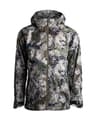
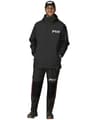
Buy a suit, not a jacket
This is the mistake almost everyone makes. Rain jackets are what get sold, and a rain jacket keeps your torso dry while your legs soak through in twenty minutes of sitting in a stand with rain running off the jacket onto your thighs.
Wet trousers are worse than a wet jacket for two reasons. There is far more skin surface involved, and your legs are the part of you that is pressed against a cold stand seat with no air gap. A hunter with a dry torso and soaked legs is a hunter who climbs down at nine o’clock.
If you buy a jacket — and there are good reasons to, mainly cut and quietness — buy rain trousers separately in the same order. Do not tell yourself you will get them later.
Packable beats durable, for most hunters
The best rain gear is whichever set is in your pack when the sky goes gray at two in the afternoon. Rain arrives in the middle of hunts, not before them, and a suit in the truck is a suit that has never kept anyone dry.
That pushes the decision toward light, compressible material, which is also generally the least durable material. This is a genuine trade rather than a compromise: a lightweight packable suit tears on briars in a way a reinforced shell does not, and it is also the one you will have with you.
The rule that resolves it: if your hunting involves walking a lane to a ladder stand, buy light and packable and accept it is a two-or-three-season item. If it involves pushing through cover to a hang-on, buy the reinforced shell and carry the extra weight.
The noise problem
The chemistry that makes a fabric waterproof also tends to make it crisp, and crisp fabric is loud. That is a minor annoyance for a rifle hunter at a hundred and fifty yards and a serious problem for a bowhunter at twenty.
This is the one place where premium hunting rain gear genuinely earns a premium price. What you buy at the top of the market is a face fabric that stays soft and quiet while remaining waterproof, and there is no cheap version of that engineering.
If you can only test one thing in a shop, test this. Crumple a sleeve. If it crackles, a deer will hear you draw. If you cannot test it, assume a general-purpose or fishing rain suit is loud and a purpose-built hunting shell is quieter.
The hood is not a detail
A hood that does not turn with your head is a hunting problem rather than a comfort one. You hear a deer to your left, you turn your head, and you are looking at the inside of a hood.
Look for a hood with a rear volume adjuster or a brim stiff enough to move with you, and a cut that leaves peripheral vision open. Hunting-specific shells generally get this right because they were designed by people who needed to turn their heads; general outdoor shells frequently do not.
Also check the cut when seated. A shell cut for standing rides up when you sit, which puts the hem above your bib and lets water in exactly where you do not want it. Hunting-cut jackets are longer at the back for this reason.
Waterproof, water-resistant, and DWR
Three different things, sold with overlapping words.
- Waterproof means a membrane or coating that water cannot pass through, with taped seams. This is rain gear.
- Water-resistant means it sheds frost and light drizzle for a while. Most insulated hunting outerwear is this. It is not rain gear.
- DWR — durable water repellent — is the treatment on the outer face that makes water bead. It wears off, and when it does the face fabric wets out and the garment feels like it is leaking even though the membrane is fine.
That last point saves a lot of money. Most jackets people declare dead are jackets with worn-out DWR. A wash-in or spray-on repellent and a tumble dry on low restores the beading and most of the perceived performance. Try that before replacing anything.
Rain and scent
Rain is genuinely good for a hunter’s scent profile: it knocks scent particles down and dampens the ground so you leave less on the walk in. What it does not do is excuse ignoring the wind. The National Deer Association’s work on thermals makes the point that how air moves through your setup is what decides whether a deer smells you, and rain changes that behavior rather than switching it off.
The related practical point: a wet blood trail is a disappearing blood trail. If rain is forecast and you are hunting anyway, be more conservative about shot selection and get on the track sooner than you otherwise would. Our blood tracking guide covers what helps and what does not.
Care, so it lasts
Waterproof shells fail at the seams and the face fabric long before the membrane wears out. Two habits extend their life considerably: hang it to dry properly after every wet hunt rather than stuffing it damp into a pack, and wash it occasionally with a technical cleaner rather than detergent, which strips DWR.
Store it loose rather than compressed. A packable suit left crushed in the bottom of a pack for a year develops permanent creases, and creases are where coatings crack first.