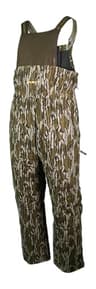
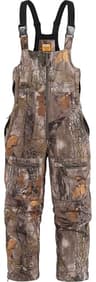
Why a bib and not insulated trousers
Insulated trousers stop at your waist and rely on a jacket to overlap them. In a chair on flat ground that works fine. In a stand it does not, for two reasons.
First, you spend a lot of time leaning forward — watching a trail, drawing, looking down at your feet on the platform. Every time you do, the jacket rides up and the trousers ride down, and cold air goes straight to your lower back. Second, the seat of a pair of trousers is a single layer of fabric between you and whatever the stand seat is made of.
A bib solves both structurally rather than by asking you to be careful. The insulation is continuous from your ankles to your chest, and the seat is a properly insulated panel.
Leg zippers decide whether you wear it
This is the specification that separates a bib you use from a bib in a cupboard.
Without leg zippers you have to take your boots off to put the bib on. In practice that means putting the bib on at home, driving in it, walking in wearing it, and arriving at the tree soaked with sweat — which is precisely the problem the bib was meant to solve. Wet insulation does not insulate.
With full leg zippers you carry the bib in your pack, sit down at the base of the tree, and pull it on over the boots you are already wearing in two minutes. That is the correct way to use a bib, and it is why we rank the leg-zip model as highly as we do.
Practice the sequence at home — zippers are a noise source, and the base of your tree in the dark is not the time to learn where they catch.
The noise test
A bib is a large area of fabric that moves whenever you do. If it rustles, it rustles at the exact moment you shift to shoot, which is when a deer is closest and most attentive.
The test is simple and you can do it before you take the tags off: rub a fold of the fabric against itself. If you can hear it across a room, a deer will hear it at twenty yards in still timber. Brushed polyester, fleece-faced shells and soft-shell fabrics pass. Coated nylon and hard-finish waterproof shells usually do not.
Duck canvas sits in the middle: noisier than brushed fabrics, dramatically tougher. Which end of that trade you want depends entirely on whether you walk to a lane or crawl through multiflora rose to get where you sit.
Insulation: buy for the sit, not the walk
The instinct is to buy the warmest bib for the coldest day. That is right only if you are not moving to get there, and most hunters are.
Because a bib should be carried and put on at the tree, you can afford more insulation in a bib than you can in a jacket you have to walk in. That is a genuine advantage of the format. What you cannot afford is to wear it on the walk — a heavily insulated bib on a mile hike means you arrive wet, and then sit still in wet insulation for four hours.
Not every listing publishes an insulation weight, and where it does not we say so in the spec table rather than guessing. What is more useful anyway is the format: fleece-lined for quiet warmth at rest, duck canvas for brush, uninsulated for early season over your own layers.
The early-season case for an uninsulated bib
An uninsulated bib sounds like a contradiction until you have sat through a forty-degree October morning. You get the closed waist, the insulated-seat geometry and the wind block without heat you do not want, and you control the insulation underneath. For a lot of hunters this is the more versatile purchase, because you can layer up to late-season warmth and layer down to early-season comfort. Our early-season clothing picks cover the rest of the October kit that bib is designed to sit over.
Fit, over the layers you actually wear
Try a bib on over a base layer and a mid layer, not over a T-shirt. Bibs that fit in a shop over jeans are tight over a fleece and a base layer, and tight insulation is compressed insulation, which does not work.
Check three things while you are wearing it: can you sit down and cross your legs, can you raise both arms to full draw, and does the bib front sit high enough on your chest that it does not gap when you lean forward. Adjustable shoulder straps and adjustable height matter more on a bib than on almost any other garment, because torso length varies enormously between people of the same nominal size.
Where the bib fits in the system
A bib replaces your insulating trouser layer; it does not replace your base layer or your outer shell. The full stand-hunting system is a wicking base layer, a bib for the lower half and chest, a jacket over the top, and a waterproof shell in the pack for when the front comes through.
The base layer under a bib matters more than usual, because it is what handles the moisture from the walk in that the bib will then trap. Our base layer comparison covers which material suits how far you walk, and the layering guide puts the whole system in order.