Guides · Wind and scent
How to Play the Wind for Deer Hunting
Playing the wind is a stand-selection problem, not a product problem. Here is how to choose a set for the forecast, what thermals do to your scent at first and last light, and the one statistic that explains why so many called-in bucks are never seen.
How this is funded:we earn a commission if you buy through our links, at no extra cost to you. It never changes which product we recommend, and we’ll tell you plainly when to skip one. Full disclosure.
Playing the wind is a decision you make before you leave the truck, and it is about which stand you sit in rather than what you spray on your boots. A deer’s nose is its primary defence — the National Deer Association’s own summary of deer senses puts smell above sight and hearing — and the honest position on scent products is the NDA’s: to beat a buck’s nose, remember thermals. Wind beats chemistry.
The three things the wind decides
Not one thing. Three, and most hunters only plan for the first.
- Where your scent goes while you sit. The obvious one, and the only one most people check the forecast for.
- Where your scent goes on the walk in. Ground scent on a trail at dawn costs you the sit before you have climbed the tree, and you will never know it happened.
- Where your scent goes on the walk out. This is how good stands quietly stop producing. Deer are usually in the food source at dark, between you and the truck.
Thermals reverse twice a day, and they do it at the worst times
Thermals are vertical air movement driven by temperature, and the mechanism is simple: warm air rises, cool air sinks. After sunrise the ground warms and the air over it lifts, carrying your scent uphill. As the light goes at the end of the day the ground cools and the air slides downhill, taking your scent with it into the low ground.
Those two reversals land exactly on the two windows when deer move most. The practical rules that fall out of it:
- Morning sits favour the low side. If your scent is going to rise, you want the deer above you, not below.
- Evening sits favour the high side. If your scent is going to sink into the bottom, do not hunt the bottom.
- On a dead-calm day, the thermal is the wind. A zero-mile-per-hour forecast does not mean your scent is staying put. It means the only thing moving it is temperature.
- A strong wind overrides the thermal; a light one does not. Above roughly a steady breeze you can hunt the forecast. Below it, hunt the terrain.
Build a rotation, not a stand
The single biggest improvement most hunters can make is to stop owning one good stand per area and start owning two to four, each for a different wind. It is not a gear upgrade, it is an arrangement: the same money spread across cheaper sets, or one mobile setup that goes wherever the wind allows.
When you hang them, aim for a quartering or crosswindrather than a perfect headwind. A straight headwind puts your scent cone over everything behind you, which usually includes your exit route. A crosswind keeps the trail clean and leaves you a way out. And set up so the downwind side is visible and shootable, because that is where a mature deer is most likely to come from — 60% of responding bucks in Hellickson’s rattling research approached from downwind.
What to look for in scent-control gear, now that the wind plan exists
With the stand chosen correctly, reducing the odor you put into the air is a real marginal gain. The order that makes sense:
- Attack the biggest source first, which is you. A scent-free wash before the hunt removes more odor than anything you can spray on afterwards.
- Stop re-contaminating clean clothes. Washing hunting clothes and then wearing them in a truck that smells of coffee and fuel undoes the laundry. A sealed storage bag and dressing at the truck is the fix.
- Carry a field spray for the parts that touch cover. Boots, cuffs, pack straps and the stand itself. This is where a top-up genuinely helps.
- Treat cover scent as masking, not attraction. Earth wafers hide a little human odor in the right conditions. They do not make a bad wind survivable.
The three purchases that support a wind plan
The full routine
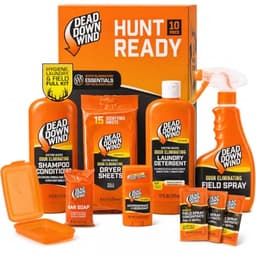
Dead Down Wind Hunt Ready 10-Piece Kit
Building a complete scent-control routine
- Type
- Scent-elimination kit (10 pieces)
- Includes
- Field spray, body/hair wash, laundry detergent + more
- Approach
- Reduce odor at the source
Price as of October 16, 2026. #ad How we’re funded
Field top-up
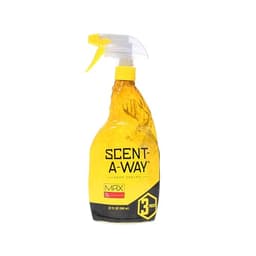
Hunter's Specialties Scent-A-Way Max Odorless Spray
Everyday field spray you'll actually use
- Type
- Odor-eliminating field spray
- Scent
- Odorless
- Use
- Boots, cuffs, pack, stand on the walk in
Price as of October 16, 2026. #ad How we’re funded
Masking only
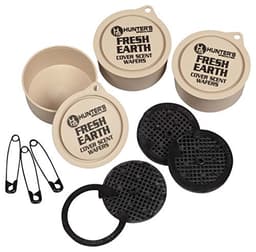
Hunter's Specialties Fresh Earth Cover Scent Wafers, 9-pack
Masking, not attracting — and only as a supplement to wind discipline
- Type
- Cover scent wafers
- Quantity
- 9 wafers, 3 storage containers
- Scent
- Fresh earth
The Dead Down Wind ten-piece kit is the route in if you have no routine at all, because it covers the wash, the laundry and the field spray in one purchase. The Scent-A-Way spray is the one that lives in the pack and gets used on the walk in. The Fresh Earth wafers are included with their job stated honestly on the card: masking, as a supplement to wind discipline, not as a replacement for it. The whole group is compared in our scent control picks, and how to wash hunting clothes covers the step that makes the rest of it worth doing.
The one-page version
Check the forecast the night before. Pick the stand that wind allows. Plan the entry so your ground scent misses the trail, and the exit so it misses the food. Expect the thermal to rise after sunrise and sink at dusk, and hunt above or below accordingly. Keep the downwind side shootable. And remember what the gear can and cannot do: a clean body, clean clothes and a field spray reduce what you put into the air, and none of them choose your stand for you.
General guidance, not legal or safety advice. Hunting regulations vary by state and change every year — always verify seasons, legal equipment and requirements with your own state wildlife agency before you hunt. Wear a full-body harness and stay attached to the tree from the ground up whenever your feet leave the ground.
Frequently asked questions
How do you play the wind when deer hunting?
Pick the stand that the day's wind allows, rather than trying to make your favourite stand work. That means owning a rotation of sets - two to four per area, each hunted on a different wind - and choosing on the forecast. Then plan the entry and exit routes so your ground scent never crosses the trail between bedding and food, and set up so the downwind side is somewhere you can see and shoot, because that is where a mature deer is most likely to appear. The National Deer Association's own framing is that beating a buck's nose is about wind and thermals rather than trusting scent products alone.
What are thermals in deer hunting?
Vertical air movement driven by temperature. As the ground warms after sunrise, air rises and carries your scent uphill; as it cools toward dark, air sinks and carries your scent downhill. On a calm morning or evening - exactly when deer are moving - the thermal can matter more than the forecast wind, and it reverses direction twice a day. That is why a stand that is perfect at 4 p.m. can be wrong at 6:30 p.m. on the same breeze.
Do scent control products actually work?
They help at the margin and they do not replace a wind plan. The argument for them is simple enough: less human odor leaving you is better than more, and a scent-free wash, clean clothes stored in a sealed bag and a field spray on boots and cuffs all reduce what you are putting into the air. The argument against relying on them is that a deer's nose is its primary defence, and no product on the market claims to make you scentless. Use them as a supplement to the stand you chose for the wind, not as a substitute for choosing it.
Why do bucks come in from downwind?
Because it works for them. In Dr. Mickey Hellickson's three-year rattling research, 60% of responding bucks approached from downwind - they circle to smell what they are walking toward before they commit to seeing it. The practical consequence is that your downwind side is not dead ground; it is the most likely approach. Set up so you can see and shoot it, and accept that a stand where the downwind side is unhuntable is a stand with a built-in failure mode.
Is it worth hunting on a bad wind?
Occasionally, and only with your eyes open. A marginal wind on a stand you can afford to burn - a fringe set, a late-season food source you are done with - can be worth a sit. Doing it on your best stand during the rut usually costs more than the sit is worth, because deer learn a location. The better answer is to own enough sets that the forecast always allows one of them.
Sources
- National Deer Association — To Beat a Buck's Nose, Remember Thermals — NDA on how wind and thermals carry human scent — why playing the wind beats trusting scent products alone (accessed July 22, 2026)
- National Deer Association — Understanding Deer Senses (Dr. Gino D'Angelo) — NDA research summary on the three senses that keep a deer alive — sight, hearing, and, above all, smell (accessed July 22, 2026)
- National Deer Association — 10 Tips for Rattling More Bucks Using Science — Dr. Mickey Hellickson's three-year rattling research: a 65% overall response rate (73% for collared bucks), 54% of responses between 7:30 and 10:30 a.m. against 16% midday, better response as temperature and wind dropped and cloud cover rose, greater than one buck per attempt during peak rut, 60% of bucks approaching from downwind, loud sequences drawing nearly three times the responses of quiet ones, and ground-level hunters missing 57% of the responses elevated observers saw (accessed August 24, 2026)
- National Deer Association — Listen to These 5 Facts About Deer Hearing — NDA on deer hearing: a range of roughly 0.25 kHz to 30 kHz against a human ceiling near 20 kHz, best sensitivity between about 4 and 8 kHz — the band deer vocalizations fall in — ears that rotate independently to locate a sound, and research finding deer nearly twice as likely to flee human speech as predator calls (accessed August 24, 2026)
Keep reading
Best Scent Control Gear
Washes, sprays, storage and ozone - what each one does and where the honest limits are.
See the scent control picksRut Hunting Gear
The six purchases for the rut, ordered by phase, with the rattling research behind the calling.
See the rut picksBest Tree Stands
A rotation of sets is the real answer to wind - here is what each stand type costs to own and move.
See the stand picksDeer Hunting Gear for Public Land
A mobile setup, which is the other way to always have the right stand for today's wind.
See the public land kit