Tag & Timber

Guides · Public land

Deer Hunting Gear for Public Land: What Has to Come Out With You

Public ground punishes permanent setups and rewards gear you can carry in, hang in the dark, and strip out the same morning. Seven picks for a mobile whitetail setup, with live prices and published weights.

By Stephen V.Last updated How we pick

The one purchase that changes public-land hunting is a saddle system — the XOP Complete Tree Saddle System, for the hunter who wants to hunt a different tree every sit without leaving anything behind. Everything else on this page exists to serve that: a way up, a way to stay attached, a way to carry it, and a way to keep what you do leave behind from walking off.

Public ground is not private ground with more people on it. It is a different problem with three specific constraints, and gear that ignores them fails in predictable ways. Whatever you hang will be found. Whatever you leave may not be there next week. And every pound you buy is a pound you carry past the hunters who parked at the gate and walked four hundred yards.

So we ranked on four things, in this order:

  • Does it come out with you? A setup you strip at the end of the sit cannot be stolen, cannot be hunted by somebody else, and cannot be claimed under a rule about leaving stands overnight. That single property is worth more on public ground than comfort, platform size or price.
  • What does it weigh, as published? Carry weight is a performance spec here, not a comfort spec, because it decides how far from the parking area you are willing to hunt — and distance from the parking area is the most reliable edge available on pressured ground. The harness pick publishes 2.5 pounds. The decoy publishes 30 ounces including its poles.
  • Does it work in the dark, alone? Nobody is holding the bottom of your sticks. The lineman’s rope on this list is here for exactly that, and its maker names public-land hunters stripping a setup out the same day in its own description of who it is for.
  • What does the maker actually publish? Several spec cells below render “Not published” — no capacity figure on some items, no named safety standard on the harness, no cable diameter on the lock. Those gaps are recorded rather than guessed at.

Prices are live and dated. We own none of this gear and have not tested it; the picks come from published specifications, the safety research cited below, and the three constraints above.

How this is funded:we earn a commission if you buy through our links, at no extra cost to you. It never changes which product we recommend, and we’ll tell you plainly when to skip one. Full disclosure.

Quick picks

Ranked on published specs, package value and buyer fit. Select a row to jump to the full write-up. We have not tested these products — here is exactly what we do instead.

#ProductBest forPrice
1
XOP Complete Tree Saddle System (Edge platform + Mondo harness)

XOP Complete Tree Saddle System (Edge platform + Mondo harness)

A complete saddle kit — saddle, platform and the bits to get hunting — for hunters curious about the lightest, most mobile way to hunt trees. A saddle packs smaller than any stand and works on nearly any tree, but there's a genuine learning curve.

Best mobile setup
$217.41 · View on Amazon

$249.9913% off

Price as of October 6, 2026. #ad How we’re funded

2
Hawk Helium Climbing Sticks (4-pack)

Hawk Helium Climbing Sticks (4-pack)

Light aluminum sticks that pair with any hang-on or saddle. Four sticks get most hunters to a workable height, and the Helium line is the standard-bearer for lightweight, quiet climbing sticks.

Best way up the tree
$129.99 · View on Amazon

Price as of October 6, 2026. #ad How we’re funded

3
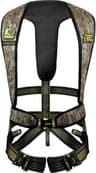
Hunter Safety System Ultra-Lite Harness (Mossy Oak Bottomland)

Hunter Safety System Ultra-Lite Harness (Mossy Oak Bottomland)

The harness to buy if the reason you sometimes skip one is bulk. At a published 2.5 pounds with a mesh upper body and 1.25-inch webbing, it is the lightest thing HSS sells that still comes with a tree strap and a suspension relief strap in the box, and it has lineman's loops built in so you can add a climbing rope later without buying a different vest. The one thing it does not give you is a named standard: HSS says it surpasses all industry safety standards and declines to say which.

Best harness to wear every sit
$132.99 · View on Amazon

Price as of October 6, 2026. #ad How we’re funded

4
Hunter Safety System Lineman's Climbing Rope

Hunter Safety System Lineman's Climbing Rope

The piece that turns a one-person stand hang from a stunt into a job. Clipped around the trunk and into your harness loops, a lineman's rope holds you against the tree so both hands are free to run a stick, a bracket or a ratchet strap — and it keeps you attached during the part of a hang where you are highest, most tired and least secured. At 8.5 feet it fits most trees a whitetail hunter is working with.

Best for hanging and stripping solo
$39.99 · View on Amazon

Price as of October 6, 2026. #ad How we’re funded

5
ALPS OutdoorZ Pursuit

ALPS OutdoorZ Pursuit

The right pack for the hunter who mostly does day sits and short walks in. The Pursuit carries a day's gear — layers, calls, snacks, a saw, a knife kit — with a molded suspension that's comfortable on a morning hike, plus a lash system to carry a bow or gun hands-free. It's not a haul-out-an-elk frame pack, and for whitetail it doesn't need to be.

Best walk-in pack
$119.99 · View on Amazon

Price as of October 6, 2026. #ad How we’re funded

6
Montana Decoy Dreamy Doe Whitetail Decoy

Montana Decoy Dreamy Doe Whitetail Decoy

The decoy most hunters will actually carry, which is the only kind that kills deer. Montana publishes it at 30 oz including poles, folding to 13 by 16 inches and opening to 37 by 40 — meaning it goes in or on a daypack instead of riding in a truck bed, and a public-land hunter can set it a half mile from the road. The compromise is honest: a printed photographic panel reads superbly from the broadside angles a deer usually approaches from, and poorly from head-on.

Best decoy you will actually carry
$77.15 · View on Amazon

$87.9912% off

Price as of October 6, 2026. #ad How we’re funded

7
Master Lock 8417D 6ft Python Adjustable Cable Lock

Master Lock 8417D 6ft Python Adjustable Cable Lock

The default trail-camera lock, and cheap enough that there is no argument for skipping it. It will not stop someone carrying bolt cutters, but it comprehensively stops the opportunist who finds your camera while walking a property line.

Best lock for anything you leave
$10.32 · View on Amazon

$11.9914% off

Price as of October 6, 2026. #ad How we’re funded

The picks in full

#1Best mobile setup

XOP Complete Tree Saddle System (Edge platform + Mondo harness)

A complete saddle kit — saddle, platform and the bits to get hunting — for hunters curious about the lightest, most mobile way to hunt trees. A saddle packs smaller than any stand and works on nearly any tree, but there's a genuine learning curve.

Strengths

  • Lightest, most packable way to hunt from a tree
  • Works on crooked and multi-trunk trees stands can't use
  • Comes as a complete system rather than piecing it together

Trade-offs

  • Real learning curve — practice at ground level first
  • Shot positions differ from a stand; some hunters never adapt
TypeTree saddle system
IncludesMondo saddle harness, Edge platform, bridge, tether, lineman's belt, carrying bag
Harness sizingAdjustable, one size fits most
PlatformFully leveling aluminum
Best treeAlmost any tree (with climbing sticks)
Learning curveModerate — practice before season

Worth knowing. Saddle hunting rewards practice — set up a foot off the ground in the backyard until the positions feel natural before you trust it on a hunt.

Specs read from the product listing, on September 22, 2026. “Not published” means the manufacturer does not state that figure.

#2Best way up the tree

Hawk Helium Climbing Sticks (4-pack)

Light aluminum sticks that pair with any hang-on or saddle. Four sticks get most hunters to a workable height, and the Helium line is the standard-bearer for lightweight, quiet climbing sticks.

Strengths

  • Lightweight aluminum — easy to pack in
  • Standoffs hold the sticks off the tree for foot room
  • Quiet to attach with the right rope or strap

Trade-offs

  • Four sticks may not reach full height on a fat trunk
  • Requires practice to hang quietly and safely
TypeAluminum climbing sticks (set of 4)
Pairs withHang-on stands and saddles
MaterialAluminum (lightweight)
AttachmentRope/strap (check what's included)

Worth knowing. Always use a lineman's belt and a full-body harness while hanging sticks and a stand — most tree-stand falls happen during the climb and setup, not the sit.

Specs read from the product listing, on July 22, 2026. “Not published” means the manufacturer does not state that figure.

#3Best harness to wear every sit

Hunter Safety System Ultra-Lite Harness (Mossy Oak Bottomland)

The harness to buy if the reason you sometimes skip one is bulk. At a published 2.5 pounds with a mesh upper body and 1.25-inch webbing, it is the lightest thing HSS sells that still comes with a tree strap and a suspension relief strap in the box, and it has lineman's loops built in so you can add a climbing rope later without buying a different vest. The one thing it does not give you is a named standard: HSS says it surpasses all industry safety standards and declines to say which.

Strengths

  • Published at 2.5 lb — light enough that early-season heat stops being a reason to leave it in the truck
  • Capacity is published per size (S/M 100-175 lb, L/XL 175-250 lb, 2X/3X 250-300 lb) rather than as one vague number
  • Comes with the adjustable tree strap and a suspension relief strap that doubles as a deer drag, so the box is a complete stand-level system
  • Built-in lineman's loops mean you can add a lineman's rope later and be attached on the climb too

Trade-offs

  • HSS names no standard, no test and no certifying body on this page — only that the harness surpasses all industry safety standards
  • No warranty period is published for this model, which matters on a product the same maker says to replace every 3-5 years
  • Mesh and 1.25-inch webbing is less padded than a heavier vest, which some hunters feel on a six-hour sit
  • Costs more than twice what the brand's own basic vest does, and the extra buys lightness, not a higher rating
TypeFull-body harness vest, mesh upper
Harness weight2.5 lb
CapacityS/M 100-175 lb; L/XL 175-250 lb; 2X/3X 250-300 lb
Webbing1.25 in upper body
In the boxTree strap, suspension relief strap/deer drag, instructions
Standard namedNot published

Worth knowing. HSS publishes its own replacement rule in its FAQ: replace the harness every 3-5 years, or immediately if it shows wear, damage or has been in a fall.

Specs read from the product listing, on October 5, 2026. “Not published” means the manufacturer does not state that figure.

#4Best for hanging and stripping solo

Hunter Safety System Lineman's Climbing Rope

The piece that turns a one-person stand hang from a stunt into a job. Clipped around the trunk and into your harness loops, a lineman's rope holds you against the tree so both hands are free to run a stick, a bracket or a ratchet strap — and it keeps you attached during the part of a hang where you are highest, most tired and least secured. At 8.5 feet it fits most trees a whitetail hunter is working with.

Strengths

  • Frees both hands at height, which is the whole reason hang-on setups go wrong
  • Published at 8.5 ft, long enough for most mature hardwoods a stand goes in
  • Includes two carabiners, so it is ready to use with harness lineman's loops out of the package
  • Adjusts quickly while you are on the tree rather than requiring you to re-tie

Trade-offs

  • Needs a harness with lineman's loops, which not every budget vest has
  • No published rope diameter, breaking strength or service life on the listing
  • 8.5 ft is short for a big-timber trunk, and there is no longer option in this SKU
  • It is for the climb and the hang — it is not a substitute for a tether or a lifeline once you are seated
TypeLineman's rope for hanging stands, sticks and steps
Length8.5 ft
HardwareTwo Recon carabiners included
Breaking strengthNot published
Service lifeNot published

Worth knowing. The maker's stated use is hands-free installation of ladder sections, hang-on stands or tree steps when used with a tree strap.

Specs read from the product listing, on October 5, 2026. “Not published” means the manufacturer does not state that figure.

#5Best walk-in pack

ALPS OutdoorZ Pursuit

The right pack for the hunter who mostly does day sits and short walks in. The Pursuit carries a day's gear — layers, calls, snacks, a saw, a knife kit — with a molded suspension that's comfortable on a morning hike, plus a lash system to carry a bow or gun hands-free. It's not a haul-out-an-elk frame pack, and for whitetail it doesn't need to be.

Strengths

  • Comfortable molded suspension sized for a day's whitetail gear
  • Bow/gun carry system frees your hands on the walk in
  • Fleece-lined pockets and a quiet build at a fair price

Trade-offs

  • A day pack, not a meat-hauling frame — limited for packing out quarters
  • Capacity is modest if you like to carry a full run-and-gun saddle or climber setup
TypeDay/hunt pack
FrameMolded internal suspension
Weapon carryYes — bow/gun lash system
CapacityNot published

Worth knowing. For the way most people hunt whitetails — a walk to a stand and back — a comfortable day pack beats an oversized frame pack you'll never fill. Buy for your actual hunt, not a Western elk fantasy.

Specs read from the product listing, on August 7, 2026. “Not published” means the manufacturer does not state that figure.

#6Best decoy you will actually carry

Montana Decoy Dreamy Doe Whitetail Decoy

The decoy most hunters will actually carry, which is the only kind that kills deer. Montana publishes it at 30 oz including poles, folding to 13 by 16 inches and opening to 37 by 40 — meaning it goes in or on a daypack instead of riding in a truck bed, and a public-land hunter can set it a half mile from the road. The compromise is honest: a printed photographic panel reads superbly from the broadside angles a deer usually approaches from, and poorly from head-on.

Strengths

  • Published at 30 oz including poles, which is the difference between a decoy you own and a decoy you use
  • Folds to a published 13 x 16 in and opens to 37 x 40 in — it fits in a pack with room for the rest of your gear
  • A photographic image panel, so hair detail and color are a real photo rather than a paint scheme
  • Takes the maker's Teaser Tail and tip-up stand, so motion can be added later without a new decoy

Trade-offs

  • Two-dimensional: from directly in front or behind it is a panel, so the set-up angle does the work
  • Montana's own page contradicts itself on weight, listing 30 oz in the specification and 64 oz in the additional-information block
  • No material composition is published anywhere we could read
  • Teaser Tail and the tip-up stand are both sold separately, so the useful configuration costs more than the sticker
TypeCollapsible photographic doe decoy
Weight30 oz including poles (maker's spec)
Folded13 x 16 in
Unfolded37 x 40 in
IncludedLeg poles
MaterialNot published

Worth knowing. Montana publishes two different weights for this decoy on the same page (30 oz in the spec, 64 oz in additional information); both are recorded rather than averaged.

Specs read from the product listing, on October 5, 2026. “Not published” means the manufacturer does not state that figure.

#7Best lock for anything you leave

Master Lock 8417D 6ft Python Adjustable Cable Lock

The default trail-camera lock, and cheap enough that there is no argument for skipping it. It will not stop someone carrying bolt cutters, but it comprehensively stops the opportunist who finds your camera while walking a property line.

Strengths

  • Adjustable braided cable cinches to any tree diameter
  • Six feet is long enough to reach around a mature oak
  • Cheap enough to buy one per camera without thinking about it

Trade-offs

  • A braided cable yields to bolt cutters — this deters, it does not defeat
  • Keyed, so you are carrying another key you must not lose
TypeAdjustable braided cable lock
Cable length6 ft
LockingKeyed
Cable diameterNot published

Worth knowing. Buy keyed-alike locks if you run several cameras. One key for the whole property beats a ring of near-identical keys in the dark.

Specs read from the product listing, on August 22, 2026. “Not published” means the manufacturer does not state that figure.

Why mobile beats comfortable on public ground

On your own forty acres, the right answer is usually a comfortable fixed set you hang in August and hunt in November. On public land that same logic produces a stand that somebody else finds in September, hunts in October, and that you cannot move when the deer change where they walk. Mobility solves all three problems at once, and it solves a fourth most hunters only notice in their second season: it lets you hunt the wind instead of hoping for it.

A saddle system is the purest version of mobile — a harness, a bridge, a tether and a small platform that between them weigh a fraction of a hang-on stand and work in almost any tree you can get sticks on. The cost is a genuine learning curve, which is why the honest advice is to buy it now and practice at eye level in a yard tree before opening day, not in the dark on the first cold morning. Our saddle hunting guide for beginners covers that progression, and our saddle vs tree stand comparison is the page to read if you are not yet convinced a saddle is for you.

If a saddle is a step too far this season, the mobile alternative is a lightweight hang-on carried in with the same sticks, hung at first light and stripped at the end of the sit. Our hang-on vs climbing stand comparison covers that choice honestly, including the case where a climber is still the better tool.

The safety gear is not optional, and it is the lightest thing you own

Falls are the dominant injury in whitetail hunting, and the National Deer Association has been direct for years that the fix is a harness worn on every hunt rather than on the hunts that feel risky. The Tree Stand Safety Awareness Foundation makes the same case with the industry’s own fall statistics behind it.

Two things follow for a mobile hunter specifically. First, the harness has to be light and comfortable enough that you wear it every single sit, because the harness you leave in the truck protects nobody — that is why the 2.5-pound mesh-upper vest is the pick here rather than a heavier, more padded one. Second, a harness only covers you while you are attached to the tree, and the most dangerous part of a mobile hunt is the climb and the hang, when you are not.

A lineman’s rope closes that gap. It keeps you attached to the trunk while both hands are busy setting sticks or a platform, which on public land you will be doing twice per hunt rather than once per season. State-approved hunter-education guidance on fall-arrest systems treats the full system — harness, tether, and a method of staying connected during the ascent — as a unit rather than as a harness plus optional extras, and a solo mobile hunter is the clearest case for that reading. Our harness and lifeline guide covers how the components fit together, and our harness picks cover the full range including the published capacities and service intervals.

One detail worth noting from the harness pick’s own spec sheet: it publishes capacity bands by size and a 1.25-inch upper-body webbing, but no named safety standard. That is a disclosure gap across most of this category, and our harness roundup goes through which makers publish a standard and which publish a slogan.

Carry weight decides how far you will walk

The most reliable advantage on pressured public ground is distance from the truck, and the thing that limits distance is not fitness — it is what you are carrying. Every item on this list was chosen with the half-mile walk in mind.

That is also why the decoy pick is the collapsible one rather than the full-body one. A premium full-body buck decoy is published at 60 inches nose to tail and 22 pounds, which is a decoy for ground you can drive to. The folding doe here publishes 30 ounces including its poles and folds to 13 by 16 inches, which is a decoy that goes in the pack with everything else. A decoy left in the shed converts nothing, so weight is a performance spec in that category too. Our decoy picks cover the full range and where a decoy has to stand to work.

For the pack itself, the public-land requirement is modest and specific: enough room for a saddle, a platform, sticks lashed on the outside, and a weapon carry so your hands are free on the climb. You do not need a freighter frame to hunt deer from a tree, and the packs built for hauling elk quarters are both heavier and more expensive than the job requires. Our hunting pack picks cover both ends, and our guide to choosing one explains when the frame is actually worth its weight.

Scouting without leaving a target

Trail cameras are the one thing a public-land hunter genuinely does have to leave behind, and the sensible planning assumption is that cameras on public ground go missing. A cable lock does not stop a determined thief and is not sold as one; what it stops is the opportunist who would otherwise lift a camera off a strap in four seconds, and at the price of a box of bolts that is a trade worth making on every camera you hang.

Two habits matter more than the lock. Hang above eye level and aim down, so the camera is not at the height a passing hunter scans. And check your agency’s rules before you hang anything — some public units restrict cameras, some require them to be marked with your name or license number, and some prohibit cellular models outright. Our trail camera theft prevention guide covers the placement and locking routine, and the National Deer Association’s work on trail cameras covers what the pictures can and cannot tell you about the deer using a property.

The cheaper scouting answer on public land is your feet and a map, and it does not get stolen. Boots on the ground in late winter, when sign is visible and the season is closed, is how most of the good public spots get found.

What this setup costs, and what to buy first

Buying all seven at once is a real amount of money, and it is not how anyone should do it. The order that wastes the least is: harness and lineman’s rope first, because they are the only items on the list that are about not getting hurt; then sticks, which you need regardless of what you hang; then the saddle or stand; then the pack; then the lock and the decoy, which together cost less than any single item above them.

If you already hunt from a climber or a hang-on, the first two purchases still apply and the rest can wait a season. Our budget deer hunting gear guide works through the same sequencing for a hunter building a kit from nothing, and our full deer hunting gear list covers the field and processing side this page deliberately leaves out.

One last note on scent, because public land makes it worse rather than better: smell is the sense that keeps a deer alive, and on ground where deer are being walked past by other hunters every weekend they are quicker to leave than deer on quiet private land. A mobile setup is the best scent tool you can own, because it lets you put the tree downwind of where you expect deer rather than hoping the wind suits the tree you already hung. Our scent control picks cover the rest of that routine.

Frequently asked questions

What gear do I need to hunt deer on public land?

A mobile setup and the safety gear to use it. At minimum: a full-body harness you will wear every sit, a lineman's rope so you stay attached while hanging sticks with both hands busy, climbing sticks, a saddle or a lightweight hang-on, and a pack with a weapon carry. Add a cable lock for any trail camera you leave and a collapsible decoy if you hunt the rut. The organizing rule is that everything comes out with you at the end of the sit.

Is a saddle better than a tree stand for public land?

For most public-land hunters, yes — not because it is more comfortable, but because it weighs less, fits almost any tree, and leaves nothing behind. That last point solves the three problems specific to public ground: a hung stand gets found, may not be there next week, and cannot be moved when the deer change. The real cost is a learning curve, so buy it before the season and practice at eye level in a yard tree rather than in the dark on opening morning.

Can I leave a tree stand on public land?

It depends entirely on the agency and the unit, and the rules vary widely — some allow stands for a defined season window, some require them marked with your name or license number, some prohibit leaving anything overnight, and some prohibit screw-in steps or anything that penetrates the tree. Check the current regulations for the specific property before you hang anything. Mobile gear sidesteps the question, which is one of its real advantages.

How much does a public land deer hunting setup cost?

Expect a four-figure total if you buy all of it at once, which is why nobody should. Buy in this order: harness and lineman's rope first, because they are the only items on the list that are about not getting hurt; then climbing sticks; then the saddle or stand; then the pack; then the lock and decoy, which together cost less than any single item above them. If you already own a climber, the first two purchases still apply and the rest can wait a season.

Do I need a harness if I am hunting from a saddle?

In a saddle the harness is the platform — you are suspended from it the entire hunt, so there is no version of saddle hunting without one. What a saddle hunter still needs on top of that is a way to stay attached during the climb and the hang, which is what a lineman's rope does. Falls are the dominant injury in whitetail hunting and the climb is when a mobile hunter is least protected, so treat the rope as part of the system rather than an accessory.

Will my trail camera get stolen on public land?

Plan on the possibility. A cable lock is not sold as theft-proof and will not stop someone determined, but it does defeat the opportunist who would otherwise lift a camera off its strap in a few seconds, and at the price it is worth putting on every camera you hang. Hang above eye level and aim down so the camera is not at scanning height, and check whether the property allows cameras at all — some units restrict them, require identification on them, or prohibit cellular models.

How far from the parking area should I hunt?

Further than most people walk, and the limit is what you can carry rather than how fit you are. Distance from the access point is the most reliable edge on pressured ground, which is why carry weight is treated as a performance specification throughout this page rather than as a comfort feature. A setup light enough to take a half mile past the last boot track is doing more for you than a more comfortable setup you will only hang near the truck.

Is a decoy worth carrying on public land?

Only if it is a decoy you will actually carry, which rules out the full-body models — a premium full-body buck is published at 60 inches and 22 pounds. A collapsible doe published at 30 ounces including its poles, folding to 13 by 16 inches, fits in the pack with everything else and gets used. Worth adding: a decoy only works where it can be seen, so it belongs in open ground during the rut, not thirty yards into timber.

Sources

Keep reading