Tag & Timber

Trail cameras · Carrier coverage

Best Cellular Trail Cameras for Weak Signal and Carrier Coverage

If your ground is on the edge of coverage, the camera that matters is the one that chooses its own carrier. Here are the three that publish that, the honest answer for US Cellular country, and the camera to buy if you have no bars at all.

By Stephen V.Last updated How we pick

Buy the Tactacam Reveal Pro 4.0. On marginal ground the specification that matters is not megapixels or flash — it is whether the camera picks its own network, and this one publishes multi-carrier LTE with automatic carrier selection, so it finds the strongest signal available instead of locking you to the carrier you guessed at in the store. The budget pick is the Moultrie Edge 3 — the cheapest camera here that publishes auto-connection across all four major networks, and it stores to built-in memory so there is no card to buy or forget. If you want to find out whether cellular works on your ground before paying a monthly bill, the SPYPOINT Flex-S Dark publishes a free plan of around 100 photos a month and adds solar so you rarely touch it. And if the honest answer is that you have no usable signal at all, stop shopping for a cellular camera and buy the Browning Strike Force Pro X, which publishes 24 MP on an SD card with no data plan at all.

This page exists because of a question our own search data shows people asking and this site has never answered: what to buy when you hunt in US Cellular country, or anywhere on the fringe of coverage. So here is the honest answer up front, before the picks.

Not one of the camera listings we read names US Cellular, or any other regional carrier, as a supported network. What the three cellular cameras here publish instead is the thing that actually solves the problem: automatic carrier selection across the major national networks. The camera scans, picks the strongest signal it can find, and uses it. That is strictly better than a camera sold as an AT&T model or a Verizon model, because it does not require you to know which carrier wins on a specific ridge before you buy.

Three things follow from that, and they are the whole page:

  • Buy auto-carrier, never a single-carrier SKU. A camera tied to one network is a bet. An auto-carrier camera is not.
  • Test before you commit the money. Your own phone standing at the tree, with mobile data on and Wi-Fi off, is a free and surprisingly good proxy. One bar of data at the camera is marginal; no bars means no cellular camera will work there, regardless of what it cost.
  • Where there is no signal, a no-subscription camera is not the consolation prize. It is the better camera. No plan, no transmission failures, and image quality that does not have to survive being compressed down a weak uplink.

We own none of these cameras and have hung none of them. Every figure below was read from the live listing on the date on each card, with one exception we flag in the body: the independent lab figures for the Reveal Pro 4.0, which are measured rather than claimed. Prices are live and dated.

How this is funded:we earn a commission if you buy through our links, at no extra cost to you. It never changes which product we recommend, and we’ll tell you plainly when to skip one. Full disclosure.

Quick picks

Ranked on published specs, package value and buyer fit. Select a row to jump to the full write-up. We have not tested these products — here is exactly what we do instead.

#ProductBest forPrice
1
Tactacam Reveal Pro 4.0

Tactacam Reveal Pro 4.0

The camera to buy if you want photos on your phone and don't want to fuss with carrier choice — it picks the strongest network on its own and adds GPS so a stolen camera can be tracked. The upgrade over the 3.0 that actually matters to a deer hunter is the flash: you now choose no-glow to stay invisible or low-glow for extra reach, instead of living with one. The catch, as with every cellular cam, is the plan, not the box price.

Best overall on marginal signal
$159.99 · View on Amazon

Price as of November 12, 2026. #ad How we’re funded

2
Moultrie Edge 3

Moultrie Edge 3

The cheapest genuinely good cellular camera here, and the successor to the Edge 2 that most budget buyers should now take instead. It auto-connects across all four major networks, stores to built-in memory so there is no card to buy or forget, and pins its own location by GPS. If you want on-your-phone scouting and don't need every premium feature, this is the value pick.

Budget pick, cheapest auto-carrier camera
$78.57 · View on Amazon

$99.9921% off

Price as of November 12, 2026. #ad How we’re funded

3
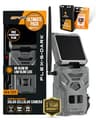
SPYPOINT Flex-S Dark

SPYPOINT Flex-S Dark

SPYPOINT's draw is the free plan — up to 100 photos a month at no cost — which makes it the easiest cellular camera to try without committing to a subscription. The solar panel on this Dark model means you rarely touch the batteries.

Best way to test cellular for free
$199.99 · View on Amazon

Price as of November 12, 2026. #ad How we’re funded

4
Browning Strike Force Pro X 1080

Browning Strike Force Pro X 1080

The one to buy if you're done paying monthly for photos. It records to an SD card, so there's no plan and no signal to worry about — you just pull the card. Browning's daytime image quality is the best of the no-subscription cameras here.

Buy this instead if you have no signal
$149.99 · View on Amazon

Price as of November 12, 2026. #ad How we’re funded

The picks in full

#1Best overall on marginal signal

Tactacam Reveal Pro 4.0

The camera to buy if you want photos on your phone and don't want to fuss with carrier choice — it picks the strongest network on its own and adds GPS so a stolen camera can be tracked. The upgrade over the 3.0 that actually matters to a deer hunter is the flash: you now choose no-glow to stay invisible or low-glow for extra reach, instead of living with one. The catch, as with every cellular cam, is the plan, not the box price.

Strengths

  • Auto-carrier selection finds the strongest network for you — no guessing AT&T vs Verizon
  • Flash is selectable: no-glow out to 80 ft to stay hidden, or low-glow out to 96 ft for reach
  • Built-in GPS if the camera walks off, and a side LCD that makes aiming it a one-person job

Trade-offs

  • Cellular means an ongoing data plan on top of the purchase price
  • Live View and on-demand photos require a higher subscription tier than the basic plan
ConnectivityCellular (multi-carrier LTE, auto-carrier selection)
FlashSelectable no-glow (80 ft) or low-glow (96 ft) infrared
Ongoing costData plan required; no activation fee
Photo resolution4K photo, 1080p video

Worth knowing. Cellular cameras are priced by the plan, not the box — budget the data plan before you buy. See our cellular subscription-cost breakdown.

Specs read from the product listing, on August 26, 2026. “Not published” means the manufacturer does not state that figure.

#2Budget pick, cheapest auto-carrier camera

Moultrie Edge 3

The cheapest genuinely good cellular camera here, and the successor to the Edge 2 that most budget buyers should now take instead. It auto-connects across all four major networks, stores to built-in memory so there is no card to buy or forget, and pins its own location by GPS. If you want on-your-phone scouting and don't need every premium feature, this is the value pick.

Strengths

  • Among the lowest entry prices for a multi-carrier cellular camera
  • 40 MP capture and a 0.5-second trigger — plenty to identify deer and catch them walking
  • Built-in memory means no SD card to buy, format or leave behind

Trade-offs

  • Still needs a data plan like any cellular camera
  • Low-glow flash is slightly more visible than a no-glow at close range
ConnectivityCellular (auto-connect, all four major networks)
FlashLow-glow infrared, 100 ft detection and flash range
Ongoing costData plan required; no contract
Photo resolution40 MP photo, 1080p video

Worth knowing. A low-glow flash emits a faint red glow at the LED; a no-glow does not. It matters most for close, wary bucks and for theft-prone public land.

Specs read from the product listing, on August 26, 2026. “Not published” means the manufacturer does not state that figure.

#3Best way to test cellular for free

SPYPOINT Flex-S Dark

SPYPOINT's draw is the free plan — up to 100 photos a month at no cost — which makes it the easiest cellular camera to try without committing to a subscription. The solar panel on this Dark model means you rarely touch the batteries.

Strengths

  • Free plan covers ~100 photos/month — genuinely usable before you pay
  • Integrated solar keeps it running without battery swaps
  • Auto carrier-select finds signal on its own

Trade-offs

  • The free tier fills up fast on an active trail — heavy users need a paid plan
  • App and delivery speed lag the premium cellular cameras
ConnectivityCellular (auto carrier-select) + solar
FlashSelectable no-glow or low-glow IR (100 ft)
Ongoing costFree plan (~100 photos/mo); paid plans for more
PowerIntegrated solar panel + battery

Worth knowing. The free photo tier is the reason to start here — but read the plan limits before you assume it's enough for a hot scrape.

Specs read from the product listing, on July 22, 2026. “Not published” means the manufacturer does not state that figure.

#4Buy this instead if you have no signal

Browning Strike Force Pro X 1080

The one to buy if you're done paying monthly for photos. It records to an SD card, so there's no plan and no signal to worry about — you just pull the card. Browning's daytime image quality is the best of the no-subscription cameras here.

Strengths

  • No data plan, ever — images save to an SD card you pull yourself
  • Fast trigger and strong daytime color for the price
  • Compact body is easy to hide

Trade-offs

  • No cellular — you have to physically visit the camera to see photos
  • Visiting the camera leaves scent and risks bumping deer
ConnectivityNon-cellular (SD card)
FlashLow-glow infrared
Ongoing costNone — no data plan
Photo resolution24 MP

Worth knowing. A no-subscription camera costs nothing to run, but you pay in boot leather and scent every time you swap the card.

Specs read from the product listing, on August 10, 2026. “Not published” means the manufacturer does not state that figure.

What these cameras publish about carriers, side by side

We looked for the three things that decide whether a camera will work on weak ground: how it chooses a network, what it costs to run, and whether it has a way to keep working when transmission fails. The fourth column is the one nobody thinks about until the first cold snap.

CameraCarrier behaviourOngoing costStoragePower
Tactacam Reveal Pro 4.0Multi-carrier LTE, automatic selectionData plan required; no activation feeBuilt-in 8 GB, expandable to 32 GB12 AA cells
Moultrie Edge 3Auto-connects across all four major networksData plan requiredBuilt-in memory — no card neededAA cells
SPYPOINT Flex-S DarkAuto carrier-selectFree plan, about 100 photos/monthmicroSDIntegrated solar + battery
Browning Strike Force Pro XNone — SD card, no network at allNoneSD cardAA cells

All three cellular cameras publish automatic carrier selection in some form, which is the answer to the regional-carrier question whether or not any of them says the words “US Cellular”. Where they differ is on everything around it: one has no card to manage, one has a free tier, and one has solar so you are not opening it in January.

How to test your ground before you spend anything

Walk to the tree you intend to hang the camera on. Turn Wi-Fi off on your phone so it is forced onto mobile data. Then try to send a photo — not a text, a photo, which is the same job the camera has to do. If that goes through in a reasonable time, a cellular camera will probably work there. If it crawls or fails, it will not.

Two refinements worth knowing. First, signal at head height in October is not signal in December: leaves fall and that usually helps, but snow, cold and a dead battery in the camera all hurt. Second, mounting height and direction change reception as well as photos — hanging a camera higher and aiming down is good practice anyway, and it often buys signal.

And if you hunt where several people carry different phones, ask them. The practical question is not which carrier is best in your state, it is which carrier works on your specific ridge — which is exactly the question an auto-carrier camera makes irrelevant.

What the plan actually costs, which is the real price of a cellular camera

This is the part the box does not tell you, and it is the single most important number in the category: over a season, the data plan usually costs more than the camera did. Our cellular subscription costs page does that arithmetic properly, carrier by carrier and tier by tier, and it is the page to read before you buy any camera on this list.

Two specific traps on weak signal. The first is that premium features — live view, on-demand photos, HD video pulls — sit on higher plan tiers and are also the first things to fail on a marginal connection, so you can end up paying for a tier you cannot use. The second is that a camera on a bad signal retries, and retries cost battery.

That is why the free-tier camera is on this page as the way to test. About 100 photos a month is not enough for a hot scrape, but it is plenty to answer the only question that matters in the first week: does this tree have signal? Our no-subscription cameras page covers the opposite choice, and our cellular roundup ranks the three cellular cameras here on overall merit rather than on signal.

Batteries, because weak signal is a battery problem as much as a reception problem

A camera on a strong signal transmits once and goes back to sleep. A camera on a weak signal wakes, searches, transmits slowly, retries, and burns power doing it. Then November arrives and the cold takes what is left.

Lithium AA cells are the fix, and this is one of the few places in trail-camera marketing where a manufacturer publishes a hard number. Energizer’s own L91 datasheet gives an operating range of −40°C to 60°C — that is −40°F to 140°F — a typical weight of 15 grams and a 25-year shelf life at 21°C. Alkaline cells do not publish anything like that cold tolerance, and the difference shows up as a camera that stops reporting in the first hard freeze.

For a camera on marginal signal, buy lithium or buy solar. The solar camera on this page exists for exactly that reason — a panel means the retry cycle does not end your season. Our battery and power pickscover the lithium, rechargeable and auxiliary-pack options, and the independent lab test we cite for the Reveal Pro 4.0 reports measured battery life of 12.4 months on pictures and 4.4 months on video at 15 daytime plus 15 nighttime captures a day on lithium AA cells — which is the kind of figure no manufacturer publishes.

The card question, and why one camera here sidesteps it

Cellular cameras generally keep a full-resolution copy on a card and send a compressed thumbnail to your phone. That is worth knowing twice over: the photo you see in the app is not the photo the camera took, and on weak signal the compressed version is what you get until you walk in and pull the card.

So the card matters. The SD Association’s own capacity table is the thing to read before buying one: plain SD covers up to 2 GB, SDHC is above 2 GB up to 32 GB on FAT32, and SDXC is above 32 GB up to 2 TB on exFAT. A camera that specifies a 32 GB maximum is specifying SDHC, and putting a larger SDXC card in it is how hunters end up with a camera that appears to work and records nothing. Our SD card picks cover the sizes and classes each camera actually accepts.

The Moultrie on this page avoids the whole question by publishing built-in memory, which on weak-signal ground is a genuine advantage: one fewer thing to buy, one fewer thing to forget in the truck, and one fewer failure mode when you are standing at the tree at 5am. And if the camera is going somewhere you cannot check often, lock it up — our theft prevention page covers the box-and-cable options.

What to do with the photos once they arrive

Getting the pictures to your phone is the easy half. The National Deer Association’s guidance on reading trail-camera data is about the hard half: using the timing and direction of movement to work out bedding-to-food travel rather than just collecting pictures of deer. On weak-signal ground where you get fewer, slower photos, that discipline matters more, not less — our how to read trail camera photos page and camera setup guide cover it.

Frequently asked questions

What trail camera works with US Cellular?

None of the camera listings we read names US Cellular, or any other regional carrier, as a supported network - and that is the honest answer. What the three cellular cameras here publish instead is automatic carrier selection across the major national networks: the camera scans, finds the strongest signal available and uses it. That is better than buying a single-carrier model, because it does not require you to know which network wins on your specific ridge before you spend the money.

What is the best trail camera for weak cell service?

The Tactacam Reveal Pro 4.0, on the published specs. It publishes multi-carrier LTE with automatic carrier selection, which is the specification that actually matters on marginal ground, plus built-in storage and a selectable no-glow or low-glow flash. The cheapest camera here that publishes auto-connection across all four major networks is the Moultrie Edge 3, which also stores to built-in memory so there is no card to buy or forget.

How do I check if there is enough signal for a cellular trail camera?

Stand at the exact tree you intend to use, turn Wi-Fi off on your phone so it is forced onto mobile data, and try to send a photo - not a text, a photo, because that is the same job the camera has to do. If it goes through in reasonable time, a cellular camera will probably work. If it crawls or fails, no cellular camera will work there regardless of price. Signal also changes with the seasons, and hanging the camera higher often buys reception as well as better photos.

Should I buy a cellular or SD card trail camera if I have poor signal?

SD card, and it is not the consolation prize. A no-subscription camera has no plan to pay, no transmission to fail, and no need to compress images down a weak uplink - the Browning Strike Force Pro X publishes 24 MP with no data plan at all. The trade is that you have to walk in to pull the card, which costs you scent and risks bumping deer, so it is a worse camera for pressured ground and a better one for ground with no bars.

Does weak signal drain trail camera batteries faster?

Yes, noticeably. A camera on a strong signal transmits once and sleeps; a camera on a weak signal wakes, searches, transmits slowly and retries, and every retry costs power. Then cold takes what is left. Lithium AA cells are the fix: Energizer's own L91 datasheet publishes an operating range of -40C to 60C, which alkaline cells do not come close to. Solar is the other fix, which is why the solar camera is on this page.

Is a free trail camera plan enough?

Not for a season, but it is exactly enough for the first week. A free tier of around 100 photos a month will not keep up with a hot scrape, but it will answer the only question that matters before you commit to a monthly bill: does this specific tree have usable signal? That is why the free-plan camera is on this page as the way to test cellular rather than as the camera to run all season.

Do cellular trail cameras still need an SD card?

Usually yes, because most keep the full-resolution file on a card and send a compressed version to your phone - so the photo in the app is not the photo the camera took, which matters most on weak signal. Check the camera's maximum card size against the SD Association's own capacity classes: SDHC covers above 2 GB up to 32 GB, SDXC above 32 GB up to 2 TB, and putting an SDXC card in a camera that specifies 32 GB is how a camera appears to work and records nothing. The Moultrie here sidesteps the issue with built-in memory.

Sources

  • National Deer Association — Find Next Season's Buck in Last Season's Trail-Cam Photos — NDA on reading trail-camera data to pattern deer movement and bedding-to-food travel (accessed July 22, 2026)
  • Trailcampro — Tactacam Reveal Pro 4.0 Solar Trail Camera Combo (Cellular) test report — An independent retailer-run test lab publishing its OWN measurements rather than the maker's claims. Measured: trigger-and-recovery speed for pictures 0.4 s to 11.0 s; trigger-and-recovery for videos 0.81 s to 5.2 s; detection range 80 ft at a 35.5-degree detection angle with a 56.9-degree field of view; transmission speed 41.3 s; battery life 12.4 months on pictures and 4.4 months on videos, both at 15 daytime plus 15 nighttime captures per day on Energizer Ultimate Lithium AA cells; resting power consumption 0.79 mW. Manufacturer-claimed figures recorded alongside: 4K photo (interpolated), 1080p video, 12 AA batteries, 8 GB built-in storage expandable to a 32 GB U3 Class 10 card, selectable red-glow or no-glow flash, 4 in x 3.5 in x 5.25 in. The lab marks its overall scoring for this model as still in progress (accessed October 26, 2026)
  • Energizer — L91 Ultimate Lithium AA Product Datasheet — Manufacturer datasheet: operating temperature -40C to 60C (-40F to 140F), typical weight 15 grams, shelf life 25 years at 21C (accessed August 22, 2026)
  • SD Association — Capacity (SD / SDHC / SDXC / SDUC) — The standards body's own capacity table: SD up to 2GB (FAT12/16), SDHC more than 2GB up to 32GB (FAT32), SDXC more than 32GB up to 2TB (exFAT), SDUC above that (accessed August 22, 2026)

Keep reading