Trail cameras · Security
How to Stop Trail Camera Theft
A cable lock stops the opportunist and nothing else. Everything that actually works is about where the camera is, not what it is bolted to.
How this is funded:we earn a commission if you buy through our links, at no extra cost to you. It never changes which product we recommend, and we’ll tell you plainly when to skip one. Full disclosure.
There is a hierarchy to this and most hunters work it backwards. They buy a lock, bolt the camera to a tree at chest height on the side of a well-walked trail, and then are surprised when it disappears. The lock was the least important decision they made.
The order that actually matters is: where the camera is, then how visible it is, then what is holding it on. Get the first two right and the third rarely gets tested.
1. Location does most of the work
Almost all trail-camera theft is opportunistic. Someone is walking — a trespasser, a hiker, a neighbor cutting through, another hunter — they see a camera at eye level, and they take it because it took five seconds and nobody was watching. Nobody set out that morning to steal trail cameras.
Which means the highest-value decision is not putting cameras where people walk. A camera thirty yards off a two-track, watching a trail that crosses it, gets you the same information as a camera on the two-track and is seen by a fraction of the people. On public land this is the whole game: the further your camera is from a parking area, a road, or an obvious access route, the less likely it is to be found at all.
The tension with good camera placement
Be honest that these goals conflict. The pinch points, field edges and water crossings that produce the best photos are also the places people walk. You will sometimes choose a slightly worse camera location for a much lower risk of losing the camera, and that is a reasonable trade — a mediocre camera that is still there in December beats a perfect one that vanished in October.
2. Height and angle
People scan at their own eye level. A camera mounted at eight to ten feet, tilted down toward the trail, is meaningfully less likely to be noticed by someone walking past, and considerably less convenient to reach if they do notice it.
This only works with a mount that lets you aim downward. A strap alone holds the camera flat against the trunk pointing at the horizon, which from ten feet up photographs a lot of sky. A bracket with a rotating or ball head is what makes the height usable, and it is cheap.
The cost is real: you now need a climbing stick, a step, or a long pole to service the camera. Factor that into how often you will actually check it, and pair it with the card-swap routine in our SD card guide so each visit is ninety seconds rather than ten minutes.
Check the land rules before you screw anything into a tree
Screw-in brackets are prohibited on a lot of public land, and on some private leases. That is not a technicality — it is the kind of thing that costs people access. Where screw-ins are not allowed, a strap-and-wedge setup can still get a camera high; it just takes longer to aim.
3. Then, and only then, the hardware
With the camera somewhere people do not walk, at a height people do not look, hardware becomes the last line rather than the only one. Three things are worth owning, and they do different jobs.
Cable lock
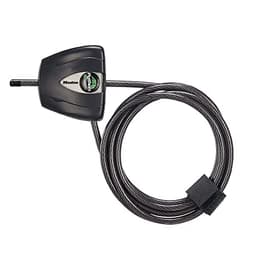
Master Lock 8417D 6ft Python Adjustable Cable Lock
The baseline lock every camera should have
- Type
- Adjustable braided cable lock
- Cable length
- 6 ft
- Locking
- Keyed
Security box
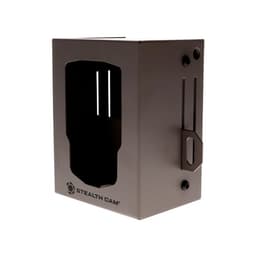
Stealth Cam Universal Security Box (Large)
Public land and any camera you cannot check often
- Material
- Steel
- Size
- Large
- Fit
- Universal (multiple camera bodies)
Price as of October 6, 2026. #ad How we’re funded
High mount
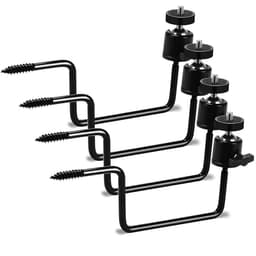
ALTIN 360° Trail Camera Tree Mount, 4-pack
Mounting cameras above eye level, aimed down
- Thread
- 1/4 in x 20
- Adjustment
- 360° rotating bracket
- Quantity
- 4-pack
Price as of October 6, 2026. #ad How we’re funded
The cable lock: cheap, and worth it every time
An adjustable braided cable through the camera’s lock channel and around the trunk. It will not survive bolt cutters and nobody claims otherwise. What it does is convert a five-second theft into a job that requires tools, time, and a decision to commit a crime rather than an impulse — and that removes the overwhelming majority of actual losses. At the price, there is no argument for going without.
If you run several cameras, buy keyed-alike locks. One key for the property beats a ring of near-identical keys in the dark at 5am.
The security box: for card theft and for bears
A cable holds the camera to the tree. It does nothing to stop someone unlatching the camera and taking the SD card, which is a theft that leaves you with an intact camera and no photos, and it does nothing about a bear. A steel box addresses both. It is the right call for public land, for cameras you check twice a season, and for anywhere with a bear population.
Check that the box has cutouts for your camera’s lens, IR array and motion sensor before ordering — “universal” covers a range of bodies, not all of them. And note that most boxes need a padlock or cable to hold them shut, sold separately.
Settings that help after the fact
Two things worth doing on every camera, both free:
- Record your serial numbers. Photograph the serial plate of every camera you own and keep it somewhere that is not the camera. A recovered camera is only provably yours if you can produce the number.
- Put a first photo on the card. Before a card goes into a camera, write a single image to it with your name and phone number. If an honest finder pulls the card, the first thing they see is how to return it.
If you run cellular cameras, a GPS-equipped model gives you a location for a camera that has moved. That is genuinely useful information to hand to a landowner or to law enforcement. It is not a reason to go and knock on a door yourself.
What this all costs, honestly
A cable lock is a few dollars. A bracket is a few dollars per camera. A steel box costs a meaningful fraction of a budget camera, which is why it belongs on the cameras that are genuinely exposed rather than on all of them.
The cheapest measure on this page costs nothing at all: put the camera somewhere people do not walk. Every hunter who has lost a camera on a well-used two-track already knows this, and every hunter who has not lost one usually has cameras nobody has found.
Frequently asked questions
Do trail camera locks actually work?
Against the person who finds your camera while walking and takes it because it was easy — yes, comprehensively. Against someone who came out intending to take cameras and brought bolt cutters — no. That is the honest boundary. A cable lock converts a five-second theft into a job requiring tools and time, which removes the large majority of real-world losses.
How high should I mount a trail camera to prevent theft?
Above normal eye level, angled down. Most camera theft is opportunistic, and opportunism depends on noticing the camera in the first place — people walking a trail scan at their own head height. A camera at eight to ten feet aimed down is both harder to see and harder to reach. The trade is that you need a stick or steps to service it.
Is a security box worth it for a trail camera?
On public land or any camera you cannot check often, yes. A steel box does two things a cable cannot: it stops someone simply opening the camera and taking the SD card, which is a theft that leaves the camera behind, and it stops bears and livestock, which cause more camera losses than people do in some areas.
Can you track a stolen trail camera?
Some cellular cameras include GPS, which gives you a location for a camera that has walked off. That is genuinely useful for recovery, but treat it as a last resort rather than a plan — recovering property is a matter for the landowner and law enforcement, not for confronting anyone yourself.
Should I put my name and number on a trail camera?
It cuts both ways. It makes an honestly found camera returnable and it identifies you to a landowner who finds it on ground you misjudged. It also tells a thief exactly whose camera they are taking, which some people find deterrent and others find the opposite. On land you have permission for, contact details are usually a net positive.
Does a no-glow camera reduce theft?
Yes, and this is an underrated benefit of flash type. A red-glow or low-glow camera announces itself at night to anyone walking past, and a person is far more likely to be walking past at night than a deer is to care about the glow. No-glow infrared is invisible to people as well as less alarming to deer.
Sources
- National Deer Association — Find Next Season's Buck in Last Season's Trail-Cam Photos — NDA on reading trail-camera data to pattern deer movement and bedding-to-food travel (accessed July 22, 2026)
- National Deer Association — The Hunter's Guide to Deer Vision — Deer lack the long-wavelength (red) cone, so they cannot distinguish red or orange from green; they lack a UV filter and carry more rods than humans, which is why they see so well at last light (accessed August 19, 2026)
- National Deer Association — Understanding Deer Senses (Dr. Gino D'Angelo) — NDA research summary on the three senses that keep a deer alive — sight, hearing, and, above all, smell (accessed July 22, 2026)
Keep reading
No-glow vs low-glow trail cameras
Flash type decides who notices your camera at night — deer and people both.
Read the comparisonHow to set up a trail camera
Height, angle and direction — the same decisions that reduce theft also decide photo quality.
Read the setup guideBest cellular trail cameras
Which cellular cameras include GPS, and what that is actually worth if one goes missing.
See the picksBest SD cards for trail cameras
The swap routine that gets you in and out in ninety seconds — less time at the camera is less exposure in every sense.
See the card picks