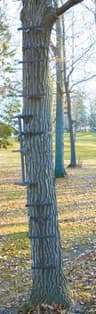
Length is the spec, because it decides how many sticks you carry
Three stick sets in our registry publish a length, and the spread is bigger than it sounds: 34 inches (XOP), 32 inches (Hawk Ranger Traction) and 30 inches (Hawk Helium Gen 2). Across a three-stick stack that is a foot of nominal length between the longest and the shortest.
Be careful about how much climb that translates to, because we are not going to overclaim it. Your actual height depends on three things the spec sheet cannot know: how much you overlap the sticks, how high you can reach to set the top one while tethered, and where you are willing to stand on the top step. A longer stick does not give you its full extra length in climb. What it gives you reliably is fewer sticks for the same height, and that is the saddle-hunting win: three long sticks instead of four short ones is one fewer item in the pack, one fewer attachment to make in the dark and one fewer thing to drop.
It is also the reason a saddle hunter should not buy for maximum height out of habit. Most whitetail hunting does not require 25 feet. Our how high should a tree stand be page works through what height actually buys you, and the honest answer for a saddle hunter is that cover and shot angles matter far more than altitude. Three 34-inch sticks is plenty of tree for almost any set.
Noise: the problem happens twice, and one maker addresses both
A saddle hunter makes noise at two distinct moments and they need separate solutions.
The pack. Three aluminium sticks in a bag clank against each other on the walk in and again when you pull them out at the base of the tree, in the dark, fifty yards from where a deer is bedded. Hawk publishes a Silent Stack nesting system for exactly this: the sticks nest into each other rather than rattling loose.
The attachment. Every stick has to be fixed to the tree, and the mechanism is where the metallic noise comes from. Hawk publishes a Helium rope attachment with a Silent Lock. Rivers Edge describes its system as “noiseless” — a maker’s description rather than a measurement, and we record it as such. Nobody in this category publishes a decibel figure, which is unsurprising but worth saying.
The Hawk Helium Gen 2 is the only set in our registry that publishes a named feature for both halves of that problem, which is why it ranks second on a page where it is neither the longest nor the cheapest. Whether that makes it quieter in your hands than a cam-buckle set is not something we can tell you — we own none of these sticks. What we can tell you is that it is the only one addressing the problem in two places rather than one.
It matters more for a saddle hunter than for anyone else, because the mobile hunt is specifically about setting up close to bedding on ground you have not pre-prepared. A deer’s hearing is the sense that most often catches a hunter who has beaten the wind, and the National Deer Association’s own work on how deer hear is the reason we treat this as a real spec rather than marketing. Cheap mitigation if you buy a noisier set: wrap each stick with a strip of self-adhesive felt or bike inner tube where they contact one another.
Step traction, and why it is a cold-weather spec
The Hawk Ranger Traction 32 publishes angled steps with a traction surface, and the Rivers Edge set publishes a Tractionite non-slip coating. The other sets publish a step design or nothing.
Here is when that becomes the deciding spec. In October you climb in a light boot and you can feel the step through the sole. In December you climb in an insulated pac boot or a tall rubber boot with 1,200 grams of insulation in it, and you cannot feel anything — you are placing a numb, inflexible foot on a one-inch bar in the dark. An angled step with a textured surface is a materially different proposition under that boot than a round smooth one, and it is the one stick spec that gets more important as the season gets better. At $90.24 the Ranger Traction is also the cheapest set here that publishes a traction feature at all.
If you hunt cold in tall boots, read that paragraph alongside our cold-weather boot roundup and our insole page, because the boot and the step are one system and most hunters only shop one half of it.
What a saddle hunter should NOT buy, including one set we recommend elsewhere
Our registry also holds a double-step set — two steps per stick, with a non-slip coating — at the same price as the budget pick here. We recommend it on our tree stand accessories page, because for a set-and-leave climb on private ground it gives you the most usable steps per dollar in the whole category.
It is the wrong buy for saddle hunting, and the reason is the same reason it is the right buy there. Two steps per stick means more material per stick, which means more to carry on a hunt where you carry everything, and a bulkier stack to nest and to pack. If you are climbing one tree and leaving the sticks on it, pay for steps. If you are carrying them to a new tree every sit, pay for reach and nesting instead. That is the clearest example on this site of the same product being the right answer and the wrong answer depending entirely on the hunt.
Two other things we are not going to sell you: an aider, and a platform. We stock neither on its own. Aiders are the standard way mobile hunters get more climb out of fewer sticks and they genuinely work, but they also change the fall and reach characteristics of the climb, so they are a decision to make after you have climbed a few trees rather than before. For the platform question, our saddle roundup covers which saddle systems include one and which are saddle-only.
The safety part, which is not optional on a saddle
A saddle hunter is tethered for the sit by definition, which leads a lot of people to assume they are protected for the climb. They are not. State-approved fall-arrest guidance is to stay attached to the tree from the ground up, on every hunt, and a saddle tether is attached at the top of your climb, not the bottom of it.
The piece that covers the gap is a lineman’s rope: it holds you against the trunk while both hands are on a stick, which is precisely the position a saddle hunter spends the climb in. The Tree Stand Safety Awareness Foundation publishes fall statistics by stand type, and the National Deer Association has been direct for years that the climb and the transition — not the sit — are where accidents happen. Setting four sticks in the dark with a bow on your back is the highest-risk ten minutes of a mobile hunt.
Two practical rules that cost nothing. Set each stick, attach to it, then set the next — never climb above an unattached stick to set the one after it. And keep your weight inside the frame of the stick rather than leaning out to reach, because the attachment is rated for load down the tree, not for being levered off it. Our saddle hunting for beginners page covers the full sequence, and the climbing stick guide covers the attachment methods in more detail than a product page can.
Last thing, and it is the thing an experienced saddle hunter would tell you over the spec sheet: climb a tree in your own garden ten times before you climb one at 5 a.m. with a bow. Every set on this page is fine equipment. The failures in this discipline are procedural, and procedure is free.