Tree stands · Setup
How High Should a Tree Stand Be?
Fifteen to twenty feet covers almost every whitetail setup, and the hunters who go higher are usually solving the wrong problem. Height buys concealment; cover and wind buy more of it, for free, and at a far better shot angle.
How this is funded:we earn a commission if you buy through our links, at no extra cost to you. It never changes which product we recommend, and we’ll tell you plainly when to skip one. Full disclosure.
Fifteen to twenty feet covers almost every whitetail setup, and in a tree with good cover, twelve feet is better than twenty-five in a bare one. That is the honest answer, and it is unsatisfying because the question is usually asked as if height were the variable. It is not. Height is one of three ways to avoid being detected, and it is the one with the worst side effects.
The other two are cover and wind, and both are free. A hunter who picks a tree with a broken outline behind them and sets it for the wind they actually get will be seen less often, at a better shot angle, than a hunter twenty-five feet up a bare oak.
What height actually buys you
Two things, and it is worth being precise about them because the folklore covers a third thing that is not true.
- It breaks your outline. A deer’s attention and normal line of travel is at ground level. Getting your silhouette up and out of that plane means fewer of the glances a deer makes while walking land on you.
- It buys tolerance for movement. Drawing a bow is a large movement. The higher and better-concealed you are, the more of that movement you can get away with — though the concealment matters far more than the altitude.
What it does not buy is scent control. Your scent does not rise and vanish; it travels with the air, and near the ground the air in deer country is moving on thermals that reverse through the day — lifting as the ground warms in the morning, sinking as it cools in the evening. The National Deer Association’s piece on thermals makes exactly this point: playing the wind beats trusting anything else. And their work on deer senses is unambiguous that smell is the sense that keeps a deer alive. Twenty extra feet does not rescue a stand set on the wrong wind. Our scent control picks and trail camera setup guide both work from the same principle: set up for the wind you get, not the wind you want.
What height costs you
Three things get worse as you climb, and the first one is the reason experienced bowhunters often hunt lower than new ones.
| Cost | What happens | How much it matters |
|---|---|---|
| Shot angle | Steeper entry narrows the path through both lungs | The main reason not to go high |
| Range error | Line-of-sight distance exceeds the horizontal distance the arrow flies | Largest at close range from a tall stand |
| Fall consequence | A longer climb, and more height to fall from | Manageable with a lifeline; never zero |
The range error has real numbers behind it. The slope distance your eye measures is the hypotenuse of a triangle whose sides are your height above the deer and the horizontal distance to it — so from 30 feet up, a deer at 10 horizontal yards is about 14.1 yards away in line of sight. Hold for 14 and the arrow arrives with far less drop than you allowed for. Realtree’s treatment of angle-compensating rangefinders states the principle directly: the arrow follows the true horizontal distance, not the line of sight.
The shot-angle cost is harder to quantify and more important. The steeper the shot, the more likely the arrow passes through one lung and exits low on the off side without crossing the chest cavity. A deer directly beneath the stand is the worst case. Our guide to shooting a bow from a tree stand covers both the aiming correction and the form change that makes an elevated shot repeatable.
So how do you actually choose a height?
Work backwards from the shot, not forwards from a number. Three questions, in order:
- Where do you expect the deer to be? A trail at ten yards and a field edge at thirty-five produce completely different angles from the same height. Close shots argue for lower stands.
- What does the tree give you? A trunk with limbs, a cluster of stems, a cedar, or a tree that holds its leaves late will conceal you at twelve feet better than a bare, straight trunk does at twenty-five. Pick the tree first and let it set the height.
- What can you climb and hunt safely? If you are not confident at the height, do not hunt it. Confidence is also a safety specification — a hunter who is nervous moves badly.
The standard answers reflect this. Ladder stands cluster at 16 to 20 feet because that range covers most setups, and climbing sticks are sold in four-packs because four sticks get most hunters to a typical fifteen-to-twenty-foot height — count on roughly a stick’s-length gain each, then add the platform. On a fat trunk you get less per stick, which is why a very large tree can leave a four-stick set short. Our climbing sticks guide covers that arithmetic, and our guide to the types of tree stands covers which stand style suits which tree.
The part that is not optional at any height
There is no height at which a fall stops being serious, and the height you fall from is not where the risk actually sits. The National Deer Association has written at length about the leading causes of treestand falls and the case for a harness on every hunt; the Tree Stand Safety Awareness Foundation exists to track those statistics by stand type; and state wildlife agencies including the Wisconsin DNR publish the same guidance. The consistent finding is that falls cluster around getting in and out of the stand — the transitions — rather than around sitting in it.
Which is why state-approved hunter education guidance is phrased the way it is: stay attached to the tree from the ground up, every hunt. A harness worn while you climb unattached is a harness doing nothing during the part of the hunt that hurts people. The three-part system below is what “from the ground up” actually requires.
The harness
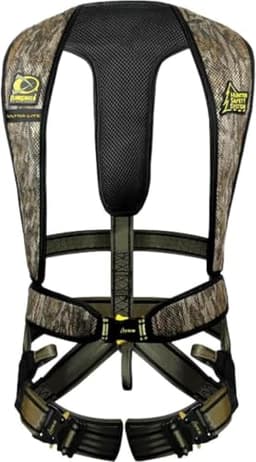
Hunter Safety System Ultra-Lite Harness (Mossy Oak Bottomland)
A stand or saddle hunter who wants a harness light enough to wear every sit
- Type
- Full-body harness vest, mesh upper
- Harness weight
- 2.5 lb
- Capacity
- S/M 100-175 lb; L/XL 175-250 lb; 2X/3X 250-300 lb
Price as of October 10, 2026. #ad How we’re funded
The climb
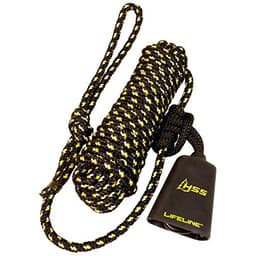
Hunter Safety System Reflective Lifeline
Every stand you hunt more than twice — one lifeline per tree, left in place
- Type
- Lifeline with prusik, carabiner and sound dampeners
- Service life
- 3 years from date of purchase (maker's updated statement)
- Visibility
- Reflective sheath
Price as of October 10, 2026. #ad How we’re funded
Getting there
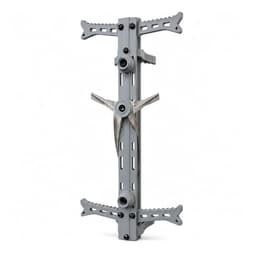
Hawk Helium Climbing Sticks (4-pack)
Getting up to a hang-on or saddle
- Type
- Aluminum climbing sticks (set of 4)
- Pairs with
- Hang-on stands and saddles
- Material
- Aluminum (lightweight)
Price as of October 10, 2026. #ad How we’re funded
The harness is published at 2.5 lb with built-in lineman’s loops and a shock-absorbing tether; note honestly that its maker names no standard, test or certifying body on the product page, and that Hunter Safety System’s own FAQ recommends replacing a harness every three to five years, or immediately after any fall or sign of wear.
The lifeline is the piece most hunters do not own and should. It keeps you connected from the ground to the platform and back, which is precisely the window a harness alone leaves open, and it is cheap enough to leave one on every stand you hunt more than twice. It has a service life too: HSS states a three-year lifespan from date of purchase, which supersedes the two-year warning printed on some ropes. It publishes no breaking strength, rope diameter or length, which we record rather than estimate. A rope left on a tree all year is exposed to UV and weather, so a faded one is a rope to retire.
Our harness and fall-arrest guide covers the full system, our harness picks compare published weights and capacities, and our guide to hanging a stand covers the lineman’s-rope sequence and the stick-to-platform transition that is the single most dangerous moment of the whole process.
The practical summary
Set at 15 to 20 feet as a default. Go lower when the tree gives you real cover or the shot is close, which it usually is — most whitetail shots happen inside 30 yards. Go higher only when you have a specific reason you can name: an open approach with no cover, a trail that runs further out, or a tree whose only usable platform is up there.
And treat the tree as the decision rather than the number. A good tree at twelve feet is a better stand than a bad tree at twenty-five, and it is a far better shot. Our tree stand picks cover the platforms, our ladder stand picks cover the semi-permanent option at 16 to 20 feet, and our saddle hunting guide covers the mobile approach that lets you pick the tree on the day.
General guidance, not legal or safety advice. Hunting regulations vary by state and change every year — always verify seasons, legal equipment and requirements with your own state wildlife agency before you hunt. Wear a full-body harness and stay attached to the tree from the ground up whenever your feet leave the ground.
Frequently asked questions
How high should a tree stand be for deer hunting?
Fifteen to twenty feet suits almost every whitetail setup, and that is the height most ladder stands and four-stick climbing setups are built around. Height is a tool for breaking your outline and getting your silhouette out of a deer's normal line of sight, and by about twenty feet you have most of what altitude can give you. Above that you are mostly adding risk and steepening your shot angle without a matching gain.
Does hunting higher help with scent?
Not reliably, and this is the belief worth retiring. Your scent does not rise and disappear — it goes wherever the air goes, and near the ground the air in deer country moves on thermals that reverse through the day, rising as the ground warms in the morning and sinking as it cools in the evening. The National Deer Association's work on thermals makes exactly this point: wind and thermals decide where your scent ends up. Twenty extra feet of height does not beat a wind that is carrying you into the bedding area.
Is 10 feet high enough for a tree stand?
It can be, and in the right tree it is an excellent height. Ten to twelve feet with good natural cover behind you — a cluster of trunks, a cedar, a tree that still holds leaves — conceals you better than twenty feet in a bare, isolated tree. It also gives a much better shot angle. The reason ten feet gets dismissed is that most hunters pick the wrong trees, and then need height to compensate for being skylined.
What is the disadvantage of hunting high in a tree stand?
Three things get worse as you climb. The shot angle steepens, which narrows the path an arrow can take through both lungs and makes a one-lung hit more likely. The amount of movement a deer can detect against the sky goes up if the tree has no cover. And the consequences of a fall increase, while the climb that produces most falls gets longer. None of those is a reason never to go high — they are reasons to need a justification for it.
How many climbing sticks do I need for 20 feet?
Four sticks reach a typical fifteen-to-twenty-foot hunting height for most hunters, which is why they are sold in four-packs. Count on each stick gaining you roughly its own length in climbable height, then add the platform on top. On a fat trunk you will get less out of each stick, so a very large tree can leave a four-stick set short of where you wanted to be — which is a good reason to pick your tree before you count your sticks.
Do I need a harness at 10 feet?
Yes. There is no height at which a fall stops being serious, and state-approved hunter education guidance is to stay attached to the tree from the ground up, every hunt — which means the climb, not just the sit. The National Deer Association has documented that falls cluster around getting in and out of the stand rather than sitting in it. The practical system is a harness plus a lineman's rope for hanging and a lifeline left on the tree for the climb.
Does height change where I aim?
Yes, in two ways, and both matter more than the height itself. An arrow follows the true horizontal distance to the deer rather than the longer line-of-sight distance your eye measures down the slope, so a correctly sighted pin shoots high unless you correct for it — and the error is largest at close range from a tall stand. Separately, a steep angle changes where the vitals sit relative to the entry point, so the aiming point moves lower on the visible body.
How high is too high for a tree stand?
Practically, once the shot angle stops letting you reach both lungs on the deer you expect to shoot, you are too high for that setup. There is no single number, because it depends on how close the trail is: twenty-five feet over a trail forty yards out is a flatter shot than fifteen feet over a trail at ten yards. Work it backwards from where you expect the deer and what angle that produces, rather than from a height you read somewhere.
Sources
- National Deer Association — Treestand Accidents: Can We Stop the Insanity? — NDA on the leading causes of treestand falls and the case for a harness on every hunt (accessed July 22, 2026)
- Tree Stand Safety Awareness Foundation — Industry safety foundation tracking treestand-fall statistics and the ABCs of safety (accessed July 22, 2026)
- Tree Stand Safety Awareness — Resources — Safety education materials and fall statistics by stand type (accessed July 22, 2026)
- Hunter-Ed — Fall-Arrest System Safety Guidelines — Hunter-ed rule: stay attached to the tree from the ground up, every hunt (accessed July 22, 2026)
- Wisconsin DNR — Tree Stand Safety — State wildlife agency guidance on harnesses and safe stand use (accessed July 22, 2026)
- National Deer Association — To Beat a Buck's Nose, Remember Thermals — NDA on how wind and thermals carry human scent — why playing the wind beats trusting scent products alone (accessed July 22, 2026)
- National Deer Association — Understanding Deer Senses (Dr. Gino D'Angelo) — NDA research summary on the three senses that keep a deer alive — sight, hearing, and, above all, smell (accessed July 22, 2026)
- Realtree — Can You Trust Angle-Compensating Rangefinders? — On why an arrow follows the true horizontal distance, not line-of-sight, on an angled shot from a stand (accessed July 22, 2026)
Keep reading
How to hang a tree stand
The lineman's-rope sequence and the stick-to-platform transition, step by step.
Read the guideShooting a bow from a tree stand
The angle correction height creates, and where to aim once you are up there.
Read the guideClimbing sticks guide
How many sticks reach what height, and how to hang them quietly.
Read the guideBest tree stand safety harnesses
Published weights and capacities, and the replacement intervals makers do publish.
See the picks