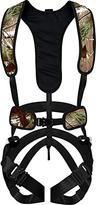
Why a harness is not an accessory, and a lifeline is
The hunter-education rule is not “wear a harness in the stand.” State- approved fall-arrest guidance is to stay attached to the tree from the ground up, on every hunt. That single sentence is what separates the two purchases. A harness is the thing you wear; it does nothing at all until it is connected to something. The connection is the accessory, and it comes in two forms.
A lifeline is a fixed rope you leave hanging at a stand you hunt repeatedly. You clip on at the base, slide the prusik up as you climb, sit connected, and slide it back down on the way out. The lifeline here ships with the prusik, a carabiner and sound dampeners, carries a reflective sheath so it is findable with a headlamp at 5 a.m., and is the reason the hunters who use one are never unclipped. One per tree, left in place.
A lineman’s rope is the other job: it holds you to the trunk while your hands are busy, which is what you need when you are hanging sticks and a stand rather than climbing a set that is already up. The one below is 8.5 feet with two carabiners included. If you hunt public ground and strip the whole setup out the same day, you need this one more than the lifeline, because you are never climbing a tree that is already rigged.
Both of those are the climb. Our harness and fall-arrest guide walks the full system, and how to hang a tree standis the sequence the lineman’s rope exists to make survivable.
The disclosure test: which standard is it certified against?
This is the most useful question to ask of any safety accessory, and the answers in this category are not equally good.
Hunter Safety System’s own product page for its Ultra-Lite harness says the harness “surpasses all industry safety standards.” It names no standard, no test and no certifying body, and it publishes no warranty period. It does publish real, checkable figures elsewhere — 2.5 pounds, 1.25-inch upper-body webbing, and a weight capacity that changes with size: 100–175 lb for S/M, 175–250 lb for L/XL and 250–300 lb for 2X/3X.
Summit, by contrast, publishes the document. All three of its harnesses are stated to be designed and certified to meet or exceed the ASTM industry standards recognised by the Treestand Manufacturer’s Association, all three carry a 300 lb limit, sizing is published as a waist range rather than a letter, and all three carry a one-year limited warranty. Its instruction on service life is to inspect before every use and replace frayed webbing, cracked buckles or compromised stitching immediately.
Neither of those is a verdict on strength — we have tested nothing, and a named standard is a disclosure rather than a measurement. But when two makers describe the same product class and only one of them names the standard, the one that names it is giving you something you can check. The weight-capacity point matters practically too: the capacity moves with the size you order, so a harness is one of the few pieces of hunting gear where ordering a size up is a safety decision rather than a comfort one.
What the sticks and the light are doing on this list
Our full climbing stick roundup ranks the whole registry, and the set here earns its place on this page for one reason: it is a double-step design, two steps per stick, so a three-pack gives you more usable steps than a conventional three-pack at the same height. That is the right trade for a set-and-leave climb on private ground, where the sticks go up once and weight on the walk in does not matter. It is the wrong trade if you carry the sticks every sit, which is a different question we answer on our climbing sticks for saddle hunting page.
The headlamp is on the list because the two most dangerous parts of a stand hunt happen in the dark and both of them are made safer by thirty dollars of light. The TIKKINA runs on AAA batteries, which is the honest trade for the price: no rechargeable cell to die at 20F, and no red mode either, so it is a backup and a walk-in light rather than the one light you own. If you want the red or green mode that keeps your night vision and your presence quieter, our headlamp roundup covers the models that publish one.
What this page deliberately does not sell you
Three things, and the reasons are worth stating.
A second harness. The X-1 is here for the hunter who owns none. If you own a harness that is inside its service window and passes the before-every-hunt check, a new one is not an upgrade; a lifeline is. Our harness roundup is the page for replacing one.
Bow hangers, gear hooks and umbrella brackets. We do not stock them, so there is nothing here we can put a published figure against, and we are not going to invent a slot to fill the page.
A heater.A propane heater is a blind accessory, not a stand accessory, and the distinction is a safety one rather than a pedantic one — the makers publish coverage areas and oxygen-depletion sensors for enclosed fabric blinds. That belongs on our ground blind heater roundup, and the chair that goes with it on our blind chair roundup.
The National Deer Association has been blunt for years about where stand accidents come from, and the Tree Stand Safety Awareness Foundation publishes the fall statistics by stand type. The short version of both is that the equipment is rarely the failure. The sequence is: the climb, the transition on and off the platform, and the hunter who was attached for the sit but not for the ten feet either side of it. Everything ranked first on this page addresses that sequence.