Synthetic or natural: the word that decides whether you can carry it
This used to be a preference. It is now, in a lot of the whitetail range, a rule.
Scent products made from real deer material — urine, gland secretions, bedding litter — are restricted or banned outright in a growing list of states and CWD-management zones, and the restrictions are typically written about the source materialrather than about the product name on the bottle. That is why “synthetic” is the most consequential word on a scent label right now, and why the two Conquest sticks on this page — identical in size, identical in format, identical in stated use — are not interchangeable purchases. One is collected from bedding areas on the company’s Michigan farm. One is a stated synthetic reproduction. In a restricted county, only one of them is legal to have in your pack.
The reason behind the rules is not arbitrary. CDC guidance on chronic wasting disease treats cervid tissue as the thing to minimize handling of, and the National Deer Association’s work on baiting and feeding explains the broader mechanism: anything that concentrates deer, or that moves material from one deer herd to another piece of ground, increases direct and indirect contact. Transporting bedding litter across state lines is exactly the kind of movement those rules are trying to stop.
We are not going to tell you what your state says, because it changes and because the authoritative answer is always your own agency’s regulation book. Our guide to attractant legality explains how to find the rule that governs you rather than the rule a forum told you about. Read it before you buy anything natural.
Three mechanisms, and only one of them is honest about what it is
These five products are sold in the same aisle and they are not doing the same job.
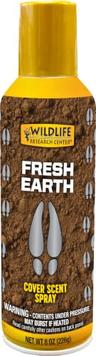
An earth scent— the Wildlife Research aerosol and the Hunters Specialties wafers — tries to put a background smell on you. The aroma Wildlife Research publishes is fresh scraped earth and fall forest floor, which is the correct claim for a cover scent: you want to smell like the place, not like a product. This is the oldest idea in the category and the easiest to reason about. Its weakness is that a deer standing in that place already knows what the place smells like, and an extra-concentrated version of it is itself an anomaly.
A herd scent— both EverCalm sticks — takes a different swing: smell like deer rather than like dirt. Conquest’s stated source for the natural version is bedding-area material, and the pitch is that a deer reads the scent as a herd that has already bedded there and found the spot safe. That is a more interesting theory than earth scent and a harder one to verify; Conquest publishes no study and we have run none.
Scent jamming— Nose Jammer — argues that masking is the wrong model entirely. Its stated aim is to flood a deer’s nose with enough natural aromatic compound that it cannot pick your scent out of the cloud. We cite that as the manufacturer’s claim and nothing more. We own no laboratory, we have run no trials, and the listing’s own line about neutralizing every trace of your scent is a marketing absolute that no product in this category can deliver. What we can say is that the format — a 6 oz pump spray rather than a pressurized can — is the one most hunters will actually keep in a pack.
Form matters more than fragrance
Because none of these products publishes a duration, the thing you can actually compare is how each one behaves in the field. That is a real decision, not a consolation prize.
A wax stick cannot spill, cannot leak and cannot soak your spare gloves on the drive out. Both Conquest sticks are 2.5 oz solids that ship in a resealable bag, which is the detail that keeps the scent in the bag instead of in everything you own. They apply to a tree, brush, a boot or a scent dispenser, so one stick can treat an approach route and a stand site. Of all the formats here, this is the one least likely to create its own problem.
An aerosolis the fastest. Eight ounces of Fresh Earth treats boots, pants, pack and the brush at the base of your tree in under a minute, and coverage — not placement — is the actual job of a cover scent. The cost is bulk and a pressurized can you pack in and pack out.
A pump spray splits the difference: less volume than the aerosol at 6 oz and slower to apply, but it is not pressurized and you control exactly where it lands.
Wafersare the passive option. Nine of them, in three sealed storage containers, with nothing to spray — you clip or hang them and forget about them. They are also the only product here you can leave in a stand between hunts rather than carrying in and out.
One priority worth stating, because almost nobody gets it right: treat your boots first. Your boots are the only part of you that makes contact with ground a deer may put its nose on an hour later. Everything else you are wearing is airborne scent that the wind carries somewhere; your boot track is a deposit that stays. Then treat the pack and the outer layer, and only then worry about your jacket.
Where a cover scent sits in a real scent-control routine
A cover scent is the last step of a system, not the system. In order of how much each step actually buys you:
- Hunt the wind. Nothing else on this list is close. Thermals, not the forecast, decide where your scent goes in the first and last hour of light.
- Wash and store your clothes clean. A garment that smells of laundry brightener cannot be rescued by a wafer. Our scent-free detergent roundup covers that half, and our washing guide covers the mistakes that undo it.
- Control your body and breath. This is the part hunters skip and the part that produces scent continuously for the whole sit.
- Then cover. One of the products above, on your boots first, as a hedge against the swirl you cannot predict.
Our scent control pageis the long version of that hierarchy, including an honest assessment of what the carbon and ozone end of the market can and cannot claim. If you only have budget for one layer of this, it is not the cover scent — it is the detergent.
Cover scent is not attractant, and the difference is money
It is easy to buy the wrong bottle here, because the shelf mixes two categories that behave in opposite ways.
A cover scent is about you: the goal is that a deer notices nothing. An attractant or lure is about the deer: the goal is that it notices something specific and comes to investigate. Put an estrus lure on your boots and you have not covered your scent, you have advertised a doe in a place where a buck is about to find a human instead. Our deer scents and lures roundupranks the attractant side of the aisle — estrus, scrape scent and drippers — and it is the page you want if your question is how to pull a buck rather than how to disappear.
The two do work together, and nowhere more than around rattling. If you are staging a fight with a pair of synthetic antlers, the research says a majority of the bucks that respond will arrive from downwind to verify it with their nose — our rattling antlers roundup has the numbers. That means a successful calling sequence is also a scent test you designed for yourself. Plan the cover before you make the sound.
What a cover scent will not do
It will not make you scent-free. Nothing will. You are a warm, continuously off-gassing animal in a place where the resident species identifies everything by smell.
It will not last a measurable length of time, because no maker on this page is willing to publish one. Treat it as something you reapply when you notice the smell fading, and accept that you are estimating.
It will not fix a bad stand. If the only tree with a good shot is upwind of the bedding area, the answer is a different tree, not a different bottle. And it will not help at all if the product itself is the anomaly — an extra-concentrated earth scent in a cedar swamp smells like nothing that grows there.
Used honestly, as a hedge on the margins of a setup that is already correct, it is one of the cheapest things in a pack. For the rest of the rut-week kit, our rut hunting gear page puts this purchase in order against the five others that window calls for.