The two claims that decide this purchase
A hunting detergent is not sold on cleaning power. Every detergent cleans. It is sold on two claims, and they are not equally well evidenced.
Claim one: it adds no scent.This one is straightforward and every product here delivers it in one form or another. Household detergent is heavily fragranced by design, fabric softener more so, and dryer sheets most of all — and fragrance is engineered to survive a rinse and a tumble dry, because that is what consumers are paying for. Washing a hunting jacket in it is self-defeating in an obvious way, and it is why our washing routine tells you to run hunting clothes as their own load and never with a dryer sheet.
Claim two: it adds no UV brighteners.This one is where the category gets interesting, and where we are going to be more careful than the packaging is. The National Deer Association’s own guide to deer vision is the right place to start, because it states the biology and then states the limits of the inference.
On the biology: “unlike humans, deer lack a UV filter in their eye”, their color vision “is limited to the short (blue) and middle (green) wavelength colors”, and the research it summarizes found that UV light “could be noticeable to deer”. That is real, and it is the same piece of biology that makes blaze orange free in concealment terms — a deer missing the long-wavelength cone cannot pick orange out of green, but it is not missing anything at the blue and ultraviolet end.
On the inference, the NDA is explicit, and so are we: the idea that a hunter in UV-treated clothing “glows” to a deer is something that “has been proposed”, not a confirmed finding. Nobody has published a controlled field study in which deer measurably respond to a washed garment. What the NDA does give is a practical test and a practical recommendation: put a UV or blue light on your hunting clothes, and if they do not glow, “simply avoid washing them in laundry products containing UV brighteners”. Clothes that already glow need a dedicated product to remove the radiance.
That is the honest version of this category, and it still points at the same purchase. A brightener-free detergent costs about the same as a brightener-free household detergent, the downside risk is nil, and the upside is the removal of one variable you cannot otherwise rule out. Buy the brightener-free bottle. Just do not believe anyone who tells you it is the reason you did or did not see a deer — that is the wind, which is why our scent-control page puts the whole category in its place.
What the six listings actually publish
This is the comparison table the category does not want you to see, because its most common entry is a blank. Volume is the one spec every product publishes; the load count by two; the UV-brightener claim by three.
| Product | Volume | Format | Scent | “No UV brighteners” claimed? | Loads published |
|---|
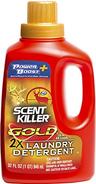
| Scent Killer Gold Power Boost | 32 oz | Liquid | Unscented | Yes | No |
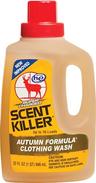
| Super Charged Scent Killer Autumn | 32 oz | Liquid | Autumn (cover scent) | Yes | No |
| Atsko Sport-Wash | 64 fl oz | Liquid | Unscented | Yes — as an ingredient statement | About 64, at 1 oz per load |
| Scent-A-Way MAX Odorless | 32 oz | Liquid | Odorless | Not published | No |
| Dead Down Wind BLACK pods | 36 pods | Pods | Unscented | Not published | 36 |
| Dead Down Wind Unscented | 40 oz | Liquid | Unscented | Not published | No |
Three things to read off that. First, the two products that claim no UV brighteners on the listing are both Wildlife Research Center — one brand is doing the disclosing in this category, and one of its two is a cover scent. Second, Atsko is the only maker that states the position as an ingredient line rather than a marketing badge: its own Sport-Wash page says “No dyes, fragrances, or optical brighteners”, and separately “No softeners, no brighteners, no fragrance”. Third, the load-count column is the one that decides real cost, and four of six leave it blank.
Atsko’s dose figure is therefore worth more than it looks: “just one ounce cleans a full load” turns a 64-ounce bottle into roughly 64 washes, which is the only cost-per-wash number any of the liquids on this page lets you calculate. We have not verified that dose and we are quoting the brand, not testing it. But a published number you can check against your own laundry is a different class of claim from no number at all.
Unscented, odorless, or a cover scent — pick one deliberately
These labels are not interchangeable and the difference is a real buying decision. Unscented and odorless mean the same thing on a detergent bottle, and neither word is regulated — they both mean “we did not add a fragrance”. “Fresh Earth”, “Autumn” and “Vanilla” mean the opposite: a fragrance was added on purpose, chosen to read as woods rather than as laundry aisle.
Our position is that clothing is the weakest possible place to deploy a cover scent. A cover scent on a wafer or a drag rag is downwind of you and can plausibly do something. A cover scent on your jacket is attached to the one object in the woods you are trying to make undetectable, and it arrives at the deer in the same air as everything else you smell like. If you want to use a cover scent, our deer scent picks cover the formats designed for it.
That said, two of the brands here sell the same detergent in both versions at nearly the same price, which is how hunters end up with a bottle they did not mean to buy. Read the word on the label. If it names a season, a plant or a smell, it is a cover scent.
Liquid or pods, and why over-dosing is the common mistake
The pods are the only pre-measured option here and that solves a problem most hunters do not know they have. The instinct with a specialty detergent is to use plenty of it, on the theory that more detergent means cleaner, lower-odor fabric. It does not. Excess detergent is the thing that fails to rinse out, and detergent residue in a fabric is both an odor of its own and a coating that works against a technical fabric’s ability to move moisture — the same reason our washing guide bans fabric softener outright.
Atsko’s own account of the mechanism is the clearest in the category and worth quoting because it explains why a double rinse does not fix a bad wash: conventional detergent additives, it writes, “bond to the fabric fibers and stay there after the rinse cycle”. Sport-Wash, by its own claim, leaves “nothing left to rinse out but the dirt and the smell”. Take that as the brand’s marketing and the mechanism as the point: what you wash a garment in does not simply leave when the water does.
Liquid wins if you wash small, mixed loads — a pair of merino base layers on their own, say, where a whole pod is a waste. Pods win if you wash a full load of outerwear at a time and want the dose settled for you. Pods need a cycle with enough water and enough time to dissolve, so a short cold wash is the one case where a liquid is simply better.
Fabric-specific cautions this category mostly ignores
Only one product here says anything about what it is safe on. Atsko’s page states Sport-Wash is “Safe for Gore-Tex, down, softshell, and fleece” — and notably does not mention wool. That matters in both directions, because a hunter’s wardrobe is now mostly membranes and merino.
For a waterproof shell, the risk with any detergent is residue sitting in the face fabric and holding water against the membrane, which reads to you as the jacket having “stopped being waterproof” when the laminate is fine. A wash that rinses clean is the correct answer, and it is why the rain gear in our rain gear roundup benefits more from the right detergent than from anything else you can do to it.
For merino, the risk is the opposite one: ordinary detergents are built around enzymes that break down protein soils, and wool is a protein fiber. Wash a merino base layergently, in cool water, in something that does not advertise enzymes, and lay it flat. Merino’s real advantage is that it needs washing far less often than a synthetic does — The Woolmark Company’s own research is the basis for that — so the best thing you can do for a wool layer is wash it less and air it more.
What a detergent cannot do
It cannot make you scent-free, and nothing in this category can. Washing clean clothes and then driving to the property in them, filling the truck with gas, and walking in with the wind at your back undoes the whole exercise before you reach the tree. The sequence that makes a clean garment worth anything is the one our washing guidelays out: wash separately, dry away from household odors, store sealed, dress at the truck — and then hunt the wind anyway, which is the only one of those steps that is not optional.
It also cannot remove brighteners that are already in the garment. A jacket washed in household detergent for five seasons has brightener bonded into the fibers, and switching detergents going forward stops you adding more rather than stripping what is there. The NDA’s advice is the practical one: check the garment under a UV or blue light first, and if it glows, deal with that specifically before you decide the new detergent has fixed it.
Lastly, it is a consumable, which is the argument for buying the volume rather than the label. If you are building the whole routine rather than replacing one bottle, the scent-control roundup covers the sprays, the storage bag and the ozone option, and tells you honestly which of them we think is worth the money.