Three ways to make heat, and what each one costs you
Every warmer on the shelf is one of three chemistries. They are not really competing products — they fail in different places, and most hunters who sit through a full season end up owning two.
Air-activated: rust, on purpose
Kobayashi, which makes HotHands, lists the contents of its warmers as iron powder, water, salt, activated charcoal and vermiculite, reacting on exposure to air in an oxidation process. That is the whole trick: the packet is rusting, quickly and under control, and rusting gives off heat. Across the product line the company states a range of 100°F to 180°F for anywhere from one to 18-plus hours depending on which item you bought.
Two consequences follow directly from the chemistry, and both are practical. First, it needs air — a warmer crushed into an airtight pocket or left in a sealed bag will not come up to temperature, because you have cut off the oxygen the reaction runs on. Second, it is genuinely one-use. Kobayashi says its warmers are designed to be used once and then thrown away, so plan on a pair per sit and buy in bulk rather than rationing.
The upside is the one that matters most on this site: nothing about oxidizing iron smells like anything. For a whitetail hunter that quietly makes air-activated the default.
Rechargeable electric: the only off switch
A lithium cell driving a resistive element in a metal or plastic shell. It is the only type here you can turn off, turn back on, and run at a chosen level rather than whatever the chemistry decides — which turns a four-hour morning sit into four hours of heat instead of ten hours of waste.
The trade is the battery itself. Lithium cells lose usable capacity as they get cold, and a hand warmer is a battery that is fighting the cold on both jobs at once: it has to heat you and hold charge in the same conditions that are draining it. Rated runtimes come from a warm room. Plan for less, and keep it inside a layer rather than in an outside pocket.
The same chemistry, scaled up, is what powers a heated vest or a heated seat cushion — and that is where a battery usually belongs, because warmth at the core reaches your fingers better than warmth in your palm does. Our heated hunting gear roundup covers the garments worth the money, why the mAh figure on the box is not comparable between brands, and the low-temperature-burn window a 131°F setting sits inside.
Catalytic fuel: the most heat and the most rules
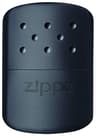
The Zippo style. Lighter fluid vaporizes and reacts across a catalyst without a visible flame, producing a lot of steady heat from a small metal case. Zippo’s own numbers are refreshingly specific: fill the supplied cup to the lower line for up to six hours, to the upper line for up to twelve.
Zippo is equally specific about the limits, and they are worth reading before you buy rather than after. Once it is lit, there is no way to stop the heating action. And the supplied bag is not packaging — Zippo states the bag regulates the amount of oxygen and therefore the temperature, and that without it the warmer may get too hot and cause injury or fire. Use genuine Zippo fuel and burners, and let it cool completely before it goes back in a pack.
Then there is the smell. It runs on lighter fluid, and you are hunting an animal whose nose is the reason most hunts end badly. Fuel it at the truck, keep it away from the clothes you will hunt in, and think hard about whether you want it in an archery stand at all.
Why a muff beats a glove for a bowhunter
A glove has to be two things at once and cannot be. Thick enough to keep a hand warm through a two-hour sit is thick enough to put insulation between your finger and a release trigger, and every bowhunter who has fumbled a shot in December knows how that ends. The usual compromise — thin gloves you can shoot in — is really just choosing to be cold.
A belt-mounted muff breaks the compromise instead of splitting it. Your hands live bare inside an insulated pouch, warmer than any glove could make them, and they come out with full feel the moment a deer steps out. Nothing has to be removed, unzipped or peeled off; you just take your hands out. Add a pair of disposable warmers inside the muff and you have the warmest hand setup available to a hunter, with no penalty at the shot.
Two things to check before you rely on one. Practice your draw wearing it, in the coat you will actually hunt in — a muff on your waist is one more thing a bowstring can find. And if you hunt firearms seasons where blaze orange is required, remember that a camo muff across your midsection is square footage that is not counting toward the requirement, which is exactly why a reversible one is worth the small premium. Our glove roundup covers the other half of this decision, including the thin liners most muff users pair with it.
Warm your blood, not your fingers
Here is the part that changes results more than any product on this page. When you get cold, your body protects your core by pulling blood back from your extremities. Your fingers are not cold because your gloves failed; your fingers are cold because your body made a decision about your chest. Insulating a hand that is not receiving warm blood treats the symptom.
Federal cold-safety guidance for working in the cold is layered clothing, a base layer kept dry, and protecting the extremities. In stand-hunting terms that means the fix order runs: get the base layer dry, get the core insulated, cover your head, and then worry about hands. A large warmer between your base and mid layers over the chest or kidneys does more for your fingers than a second pair of gloves, which is precisely why a body-sized warmer earned a place on a hand-warmer list.
Sweat undoes all of it. Walking in wearing everything you own soaks the base layer, and a wet base layer is a refrigerator for the rest of the sit. Carry the outer layers and put them on when you get to the tree — the layering guide covers the whole sequence, and the cold-feet guide makes the same circulation argument from the other end.
The scent question
Smell is the sense that actually beats hunters. Sight and hearing get you busted occasionally; a nose gets you busted before you knew a deer was there. So it is worth being deliberate about carrying a heat source that has an odor.
Air-activated warmers are the safe answer here — the hunting SKUs are explicitly marketed as odorless, and the chemistry backs that up, because iron oxide does not off-gas anything interesting. Rechargeable electrics are neutral too. Catalytic fuel warmers are the exception, and the honest position is that they are a fine choice in a box blind at 150 yards with a rifle and a questionable one in a bow stand at fifteen yards.
The practical middle ground: fuel and light a catalytic warmer at the truck, before you put your outer layers on, and never store it in the same tote as your hunting clothes. None of that makes it odorless, but it keeps the smell off the fabric you are wearing. Our scent-control page covers how far that whole category can and cannot take you.
What the duration numbers actually mean
Every number on every one of these packages is a best case, and the failure modes are different for each type.
Air-activated durations assume the warmer gets air. Sealed in a tight pocket or squashed under a glove against your palm, it will run cooler and often shorter, because you have throttled the oxygen. Give it a pocket with some slack, or a muff.
Electric runtimes are rated at room temperature and at a level you probably will not use. Running the top heat setting on a 20°F morning is the fastest way to discover that the number on the box was a laboratory figure.
Catalytic durations are the most trustworthy of the three because they are a straight function of how much fuel you poured in — which is why Zippo can quote six hours and twelve hours off two fill lines. The catch is that the clock starts when you light it and cannot be paused.
Safety, briefly and seriously
These are heat sources, and two of the three have real warnings attached from the manufacturers themselves.
Keep air-activated warmers off bare skin for long periods. Kobayashi notes that some people — particularly young children, people with diabetes and older adults — have reduced sensation to heat. A warmer at the top of its range is hot enough to cause a low-temperature burn on skin that is not reporting the problem. Put it in a pocket or a muff, not taped to you.
Respect what Zippo says about its own product. No off switch once lit, the bag is a temperature control rather than packaging, and it needs to be cool before it is stored. Those are the manufacturer’s words, not caution we invented.
Do not put any of this inside a sealed, unventilated space and forget about it. A warmer left burning in a zipped pack against synthetic fabric is a problem regardless of which type it is.
How to actually run a cold sit
Open the warmers at the truck. Air-activated warmers need time to come up to temperature, and the reaction has to start somewhere with air. Opening them when your hands are already numb is twenty minutes too late.
Walk in cold and dress at the tree. Arriving dry beats arriving warm every single time.
Core warmer first, hand warmers second. One large warmer between the base and mid layer, then a pair in the muff or pockets. If you are only carrying one thing, carry the big one.
Cover your head before you add a third warmer. The fix order above puts a covered head ahead of hands for a reason, and a two-ounce beanie is a cheaper answer than another packet. Our face mask and headwear picks cover the last bare patch, and the one a deer is actually looking at.
Keep the electric one inside a layer. An outer pocket at 20°F is the worst place to store a lithium battery you are relying on.
Rehearse the hands-out motion. Whatever your setup, the last movement before a shot should be one you have made a hundred times in the yard, not one you are improvising with a buck at thirty yards. The same logic as practicing from height on the archery target page applies to every layer between you and the release.
What a hand warmer will not fix
It will not fix boots that are too tight. Compression is the most common cause of cold feet and the same principle applies to gloves — a glove tight enough to restrict circulation makes a hand colder than no glove at all.
It will not fix a wet base layer, a coat with no wind resistance, or the decision to hunt an exposed field edge in a 25 mph crosswind. Those are jacket and layering problems with their own answers.
And it will not make you sit longer than your patience allows. What it will do — for less than the price of a box of broadheads — is remove the single most common reason good hunters climb down at ten in the morning during the one week of the year when sitting all day is the entire strategy.