Why a mitten beats a glove
This is simple physics and it is worth understanding before you spend money. In a glove, each finger is its own little chamber with its own surface area losing heat to the air. In a mitten, your fingers sit together in one chamber, sharing warmth and presenting far less total surface area to the cold.
The result is that a mitten is meaningfully warmer than a glove built with the same insulation. The reason more hunters do not wear mittens is obvious — you cannot operate a release aid or a safety in one. The pop-top design fixes exactly that: fold the top back, your fingers come free, and the mitten body is still on your hand. You never take anything off, drop anything from twenty feet up, or expose bare skin to a freezing bow riser.
Practice with the flap
Fold-back mittens have one failure mode: the flap catching a bowstring. Shoot a dozen arrows in the yard wearing the mitten before you hunt in it, with the top folded back the way you will actually use it. Better to find that out in October in daylight.
The two-piece system
The best cold-weather hand setup for a stand hunter is not one item, it is two:
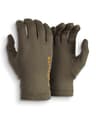
- A thin merino liner that stays on for everything, including the shot. Merino keeps insulating when it is damp with hand sweat, which synthetics manage less well, and modern liners work with a phone touchscreen so you are not stripping a glove off to check a map, a weather app or a cellular trail camera.
- A warm outer — a pop-top mitten, a heavy insulated glove, or a muff at your waist — that comes off or folds back at the moment of truth.
A hand muff worn on a belt is the underrated third option: it is warmer than any glove because you can put chemical warmers in it, and your hands come out clean and unencumbered for the shot. Many serious late-season bowhunters carry a muff and thin liners and no proper gloves at all. Our hand warmer and muff picks cover the muffs themselves and the three kinds of warmer that go inside them.
Waterproof or not?
Insulation works by trapping still air. Water displaces that air and conducts heat away from you dramatically faster, so a soaked glove is not a slightly worse glove — it is close to no glove. If you hunt rain, wet snow or heavy dew-laden brush, buy a waterproof outer and accept that it breathes less.
One detail worth getting right: a gauntlet cuff belongs over your jacket sleeve, not tucked under it. Worn under the sleeve it funnels water straight into the glove, which is the opposite of the intended effect.
Before you buy heated gloves
Battery-heated gloves work, and for a hunter with genuinely poor circulation in the hands they can be the difference between hunting the last hour and not. But they treat a symptom. Federal cold-safety guidance is consistent that extremities go cold because the body is protecting the core — so if your torso is under-layered or you arrived at the stand sweating, your hands will be cold no matter what you put on them.
Work through the cheap fixes first: a proper layering system, walking in slowly enough not to sweat, a hat (you lose a great deal of heat from an uncovered head), and dry socks. If your hands are still numb after all that, heated gloves are a reasonable answer rather than a first resort.
If you do decide battery heat is the answer, put it in the right place. A heated garment at the core does more for cold fingers than a heated glove does, for exactly the reason above — it addresses the decision your body made rather than the consequence. Our heated hunting gear roundup covers the vests, jackets and seat cushions worth that money, plus the published watt-hours and the burn risk nobody prints on the box.
Camo, color and what deer see
Your hands move more than any other part of you in a stand, so covering them matters. What covers them matters less than hunters think: the National Deer Association’s summary of deer vision research notes that deer lack the long-wavelength cone, meaning they cannot distinguish green, red or orange from one another — but they see blue well, and they lack the ultraviolet filter our eyes have. Practical upshot: any earth tone or camo works, blue is the one to avoid, and washing hunting gloves in a UV-brightening detergent is worse than the pattern being “wrong”. Our washing guide covers that.
Hands are one of the two bare patches that move. The other is your face, and it is larger, higher and pointed straight at the deer — our face mask and headwear picks cover it, including which formats you can get out of the way without taking them off.