Tag & Timber

Clothing · Staying warm

Best Heated Hunting Gear: Vests, Jackets, Seats, Socks and Insoles

Battery heat is the only warmth you can turn up at 7 a.m. and down at nine. Here is where to put it, why the number on the battery is the wrong number, and the one setting that can burn you through a sock.

By Stephen V.Last updated How we pick

Every other layer you own is a fixed decision. You pick an insulation weight in September and you live with it from the October lull through the second week of December, which is why most hunters end up sweating on an opening-day walk in and shivering through the rut in the same coat. Battery heat is the only piece of cold-weather kit that changes its mind — it can be off for the hike, on high at first light, and back to low by the time the sun clears the ridge.

It is also a category that has learned to advertise the wrong things. The front of every box carries a milliamp-hour figure and a number of heating zones, and neither one tells you how long you will be warm or where the warmth will land. So we ranked on four things, in this order:

  • Where does the heat go? Heat at the core outperforms heat at the fingers, because cold fingers are usually a circulation symptom rather than an insulation failure. A vest with zones at the collar and mid-back does more for your hands than a heated glove does. The exception is conduction — the warmth draining out of you through a steel seat — and that needs its own product.
  • Watt-hours, not milliamp-hours. A 10,000 mAh pack and a 4,800 mAh pack are not two sizes of the same thing if one runs at 5 V and the other at 7.4 V. Exactly one maker here converts its battery to watt-hours, and that transparency is worth more than the bigger number on the other box.
  • Is it quiet, and is it camo? A slick nylon shell that rasps on a bow draw is a mid layer, not an outer layer, no matter how many zones it has. Two picks here are camo with a soft face; one is black on purpose and belongs under something else.
  • Can you turn it down? Several of these products publish a high setting of 131°F, and a Japanese national institute publishes what prolonged contact at that temperature does to skin. Being able to run low is a safety feature, not a compromise.

Prices are live and dated. We have not run these against each other with a thermocouple and we are not going to claim we have — the reasoning below comes from each maker’s own published figures, from the figures those makers decline to publish, and from arithmetic anyone can check.

How this is funded:we earn a commission if you buy through our links, at no extra cost to you. It never changes which product we recommend, and we’ll tell you plainly when to skip one. Full disclosure.

Quick picks

Ranked on published specs, package value and buyer fit. Select a row to jump to the full write-up. We have not tested these products — here is exactly what we do instead.

#ProductBest forPrice
1
TIDEWE ThermCore Heated Hunting Vest (Double-Sided Fleece)

TIDEWE ThermCore Heated Hunting Vest (Double-Sided Fleece)

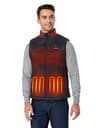
The right first piece of heated gear for a stand hunter, and the reason is where the four zones sit: collar, mid-back and both hand pockets, which is the core and the hands rather than a warm chest and cold everything else. It is also the only garment here that publishes a temperature per setting instead of a vague 'up to' figure, and the only one built out of quiet double-sided fleece in a camo pattern, so it works as the mid layer you actually hunt in.

Best overall
$114.99 · View on Amazon

Price as of October 1, 2026. #ad How we’re funded

2
TIDEWE Heated Hunting Jacket with Back-Pocket Heated Seat (Next Camo G2)

TIDEWE Heated Hunting Jacket with Back-Pocket Heated Seat (Next Camo G2)

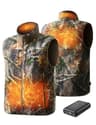
The one heated garment on this page with a genuinely stand-specific idea in it: a heated flap zipped into the lower back that unfolds into a seat cushion or a backrest, so the heat goes where a stand hunter loses it fastest — through the seat, by conduction, into cold steel. It is also waterproof, quiet-faced and the only pick here with published thermal cut-offs, which matters more on a garment you sit on than on one you wear.

Best heated outer layer
$139.99 · View on Amazon

$149.997% off

Price as of October 1, 2026. #ad How we’re funded

3
ORORO Men's Classic 4-Zone Heated Vest

ORORO Men's Classic 4-Zone Heated Vest

Buy this one if you want to know what you are buying. ORORO is the only maker in this category that publishes watt-hours (35.4 Wh), insulation weight (7.1 oz/yd2), garment weight (18 oz in L), battery weight (6.53 oz) and a warranty split — and that split is the most useful spec on the page, because three years on the heating elements against one on the battery tells you exactly which part the company expects to fail first. It is black, so treat it as the mid layer under your camo rather than an outer layer.

Best documented
$149.99 · View on Amazon

$169.9912% off

Price as of October 1, 2026. #ad How we’re funded

4
KEMIMOTO Heated Hunting Seat Cushion with Backrest

KEMIMOTO Heated Hunting Seat Cushion with Backrest

The cheapest way to fix the heat loss nobody budgets for. Sitting still on a metal platform for four hours pulls warmth out of you by conduction through the one part of your body a jacket cannot layer, and a cushion with heating plates in both the seat and the backrest treats it directly. The light-out button — heat stays on with the indicator dark — is the detail that says somebody designed this for a deer stand rather than a stadium.

Best for a tree stand
$89.99 · View on Amazon

$129.9931% off

Price as of October 1, 2026. #ad How we’re funded

5
SNOW DEER Upgraded 7.4V 2200mAh Heated Socks

SNOW DEER Upgraded 7.4V 2200mAh Heated Socks

The sock format beats the insole format for one structural reason: a sock adds no thickness under your arch, so it does not compress a boot that was fitted to fit. SNOW DEER runs 7.4 V rather than the 3.7 V or 5 V most cheap heated socks use, which is the difference between a temperature that holds and one that sags, and its elements wrap the whole toe box rather than heating the sole only.

Best heated socks
$79.99 · View on Amazon

Price as of October 1, 2026. #ad How we’re funded

6
HIWARM Far-Infrared Heated Insoles (4 Temperatures)

HIWARM Far-Infrared Heated Insoles (4 Temperatures)

The right pick if the cold is coming up through the platform rather than in through the leather, which on a metal stand is most of it. HIWARM publishes more than anyone else in the insole category — heating-zone dimensions per size, a 6 mm thickness, a 97-131F range and, unusually, a plain admission that its 4-to-10-hour runtime depends on you and your boots. Buy it only if your boots have room for 6 mm of extra insole.

Best heated insoles
$67.99 · View on Amazon

Price as of October 1, 2026. #ad How we’re funded

The picks in full

#1Best overall

TIDEWE ThermCore Heated Hunting Vest (Double-Sided Fleece)

The right first piece of heated gear for a stand hunter, and the reason is where the four zones sit: collar, mid-back and both hand pockets, which is the core and the hands rather than a warm chest and cold everything else. It is also the only garment here that publishes a temperature per setting instead of a vague 'up to' figure, and the only one built out of quiet double-sided fleece in a camo pattern, so it works as the mid layer you actually hunt in.

Strengths

  • TIDEWE publishes a temperature AND a runtime per setting — 113F for 10 hours, 122F for 5.5, 131F for 3 — which almost nobody in this category does
  • Double-sided polar fleece at 275 gsm outside and 220 gsm inside: warm without the battery, and quiet enough to draw a bow in
  • Four zones at the collar, mid-back and both pockets, which is the core-first placement that actually reaches your fingers
  • The 10,000 mAh pack has two USB ports, so it heats the vest and charges a phone on an all-day sit

Trade-offs

  • TIDEWE publishes no garment weight, so you cannot compare its warmth per ounce against a passive puffer vest
  • The maker's page lists Veil Whitetail and Realtree Edge; the listing for this size ships TrueTimber Kanati, so confirm the pattern before you order
  • Air dry only, which makes a scent-free wash-and-store routine slower than it is for the rest of your camo
  • No numeric overheat cut-off is published for this vest, and the high setting is 131F — see the burn note below before you sleep in it
TypeHeated mid-layer vest, 4 zones
Heat zonesCollar, mid-back, both hand pockets
Settings113F for 10 h / 122F for 5.5 h / 131F for 3 h
FabricDouble-sided polar fleece, 275 gsm outer, 220 gsm inner
Battery10,000 mAh power bank, 3-4 h charge (2 h quick)
WeightNot published

Worth knowing. The heating elements are carbon nanofiber, and TIDEWE says hand or machine wash cold on a gentle cycle and air dry only — the dryer is what kills a heated garment, not the washer.

Specs read from the product listing, on September 30, 2026. “Not published” means the manufacturer does not state that figure.

#2Best heated outer layer

TIDEWE Heated Hunting Jacket with Back-Pocket Heated Seat (Next Camo G2)

The one heated garment on this page with a genuinely stand-specific idea in it: a heated flap zipped into the lower back that unfolds into a seat cushion or a backrest, so the heat goes where a stand hunter loses it fastest — through the seat, by conduction, into cold steel. It is also waterproof, quiet-faced and the only pick here with published thermal cut-offs, which matters more on a garment you sit on than on one you wear.

Strengths

  • The zippered back pocket holds a heated flap that works as a seat cushion or a backrest — conduction through the seat is the heat loss nobody insulates for
  • Listed as 100% waterproof breathable polyester with 120 g insulation throughout, so it still works as a shell with the battery flat
  • The listing publishes real thermal protection: heating pauses above 65C and shuts off entirely at 75C
  • The heat indicator light goes dark after eight seconds, which is the detail that separates a hunting garment from a work jacket

Trade-offs

  • TIDEWE's own Inferno camo jacket page publishes 100F / 113F / 131F for 10 / 6 / 4.5 hours where this listing publishes 10 / 5.5 / 3 hours, so the brand's numbers are not consistent across its own camo heated jackets — treat either set as approximate
  • 120 g of insulation is light for a late-season parka; the battery is doing work the fill is not, so a dead battery is a real drop in warmth
  • No garment weight published, and a waterproof shell plus a 10,000 mAh pack plus a seat flap is not a light jacket
  • The seat flap only helps once you unzip the back pocket and unfold it, which is movement you have to make in the stand
TypeHeated waterproof jacket, 4 zones + heated seat flap
Settings3 levels: up to 10 h low / 5.5 h medium / 3 h high
Insulation120 g throughout; rated by the maker to -5C (23F)
Shell100% waterproof breathable polyester, silent face
Battery10,000 mAh, 3-4 h charge (2 h quick), UL/FCC/RoHS/PSE/CE
WeightNot published

Worth knowing. TIDEWE lists a blaze-orange vest as available separately for this jacket, which is the honest way to handle a firearms-season orange requirement on a camo garment — the hat-and-vest math is set by your state, not by the jacket.

Specs read from the product listing, on September 30, 2026. “Not published” means the manufacturer does not state that figure.

#3Best documented

ORORO Men's Classic 4-Zone Heated Vest

Buy this one if you want to know what you are buying. ORORO is the only maker in this category that publishes watt-hours (35.4 Wh), insulation weight (7.1 oz/yd2), garment weight (18 oz in L), battery weight (6.53 oz) and a warranty split — and that split is the most useful spec on the page, because three years on the heating elements against one on the battery tells you exactly which part the company expects to fail first. It is black, so treat it as the mid layer under your camo rather than an outer layer.

Strengths

  • Publishes watt-hours — 4,800 mAh at 7.4 V is 35.4 Wh — which is the only figure that makes two different battery voltages comparable
  • UL, cUL, CE, FCC and RoHS certified battery with a USB-C input, so it charges off the same brick as your phone and rangefinder
  • Real garment numbers: bluesign-approved FELLEX insulation at 7.1 oz/yd2, 18 oz in size L, 6.53 oz battery
  • Machine washable cold in a mesh bag, which is a lower-friction scent routine than air-dry-only garments

Trade-offs

  • Black, not camo — this is a mid layer, and wearing it as your outer layer in a bow stand is a mistake
  • 100% nylon shell is slick and not a quiet fabric; keep fleece or wool over it
  • The warranty says the battery is the weak link: 3 years on heating elements, 1 year on the battery
  • The most expensive vest here and the smallest pack in mAh — which is not the same as the smallest in energy, but it is one fewer phone charge on a long sit
TypeHeated insulated mid-layer vest, 4 carbon-fiber zones
Heat zonesCollar, mid-back, left and right pockets
Runtime3 h high / 6 h medium / 10 h low
Battery4,800 mAh / 7.4 V / 35.4 Wh, UL-certified, 4 h charge at 15 W
InsulationFELLEX, 7.1 oz/yd2 (bluesign approved)
Weight18 oz (size L); battery 6.53 oz

Worth knowing. ORORO warrants the heating elements for three years and the battery for one. Read that as a specification: plan on buying a replacement pack before you plan on replacing the vest.

Specs read from the product listing, on September 30, 2026. “Not published” means the manufacturer does not state that figure.

#4Best for a tree stand

KEMIMOTO Heated Hunting Seat Cushion with Backrest

The cheapest way to fix the heat loss nobody budgets for. Sitting still on a metal platform for four hours pulls warmth out of you by conduction through the one part of your body a jacket cannot layer, and a cushion with heating plates in both the seat and the backrest treats it directly. The light-out button — heat stays on with the indicator dark — is the detail that says somebody designed this for a deer stand rather than a stadium.

Strengths

  • Heating plates in both the seat and the backrest, so it covers the seat pan and the cold rail behind your kidneys
  • Light-out button keeps the heat running with the indicator dark — the same logic as a trail camera's no-glow flash
  • Longest runtimes of anything here: 10 hours low, 8 medium, 6 high off a 10,000 mAh pack, because a seat is a big slow radiator rather than a small hot one
  • Poly-cotton face fabric and double-layer padding over two support rods, so it is quiet and it holds a shape

Trade-offs

  • KEMIMOTO publishes no dimensions, no weight and no temperature for this cushion, and we could not reach a maker's page for this SKU — the listing is the only documentation
  • It only warms what is touching it. This is not a substitute for a heated garment, it is the other half
  • One more bulky item to haul up a tree and strap in, on top of the pack, bow and harness
  • A cushion between you and the platform raises your seat height slightly, which can change your shooting position in a tight hang-on
TypeHeated seat cushion with backrest
HeatingDual plates, seat and backrest
RuntimeLow up to 10 h / medium 8 h / high 6 h
Battery10,000 mAh, 5 V, included
Face fabricPoly-cotton blend, noise-reducing
DimensionsNot published
WeightNot published

Worth knowing. A heated cushion is the only item on this page that fights conduction rather than convection, which is why it earns a place next to the garments instead of competing with them.

Specs read from the product listing, on September 30, 2026. “Not published” means the manufacturer does not state that figure.

#5Best heated socks

SNOW DEER Upgraded 7.4V 2200mAh Heated Socks

The sock format beats the insole format for one structural reason: a sock adds no thickness under your arch, so it does not compress a boot that was fitted to fit. SNOW DEER runs 7.4 V rather than the 3.7 V or 5 V most cheap heated socks use, which is the difference between a temperature that holds and one that sags, and its elements wrap the whole toe box rather than heating the sole only.

Strengths

  • 7.4 V lithium-polymer packs rather than 3.7 V or 5 V, which the maker says holds a steadier temperature for longer
  • Heating elements cover the whole toe box, top and bottom, not just the sole — toes are what go numb first
  • CoolMax polyester, which the maker says dries about five times faster than cotton: the right fiber for a sock you sweat into on the walk in
  • Adds no thickness under the foot, so it will not turn a correctly fitted boot into a tight one

Trade-offs

  • SNOW DEER publishes no runtime per setting and no temperature range on this listing, which are the two numbers you would actually shop on
  • No published sock thickness or weight — the spec that decides whether they fit inside your boot with room to spare
  • The battery rides at the cuff under your pant leg, which is a lump and a snag point when you are climbing
  • We could not reach a manufacturer's page for these, so the Amazon listing is the only documentation there is
TypeBattery-heated socks, one pack per sock
Heat coverageWhole toe box, top and bottom of foot
Battery7.4 V 2,200 mAh lithium-polymer, two included
Settings3, via an inline controller
FabricCoolMax polyester
Warranty1 year
RuntimeNot published

Worth knowing. Heated socks do nothing for a foot whose circulation is already cut off by a tight boot. Fit first, heat second — that order is not negotiable.

Specs read from the product listing, on September 30, 2026. “Not published” means the manufacturer does not state that figure.

#6Best heated insoles

HIWARM Far-Infrared Heated Insoles (4 Temperatures)

The right pick if the cold is coming up through the platform rather than in through the leather, which on a metal stand is most of it. HIWARM publishes more than anyone else in the insole category — heating-zone dimensions per size, a 6 mm thickness, a 97-131F range and, unusually, a plain admission that its 4-to-10-hour runtime depends on you and your boots. Buy it only if your boots have room for 6 mm of extra insole.

Strengths

  • Heats the whole footbed, toe to heel, with a published zone size per size (4 x 23 cm in L, 4 x 21 in M, 4 x 19 in S)
  • Publishes a real temperature range, roughly 97F to 131F across four levels, with a sensor holding the set point
  • Cuts to fit anything from a 35 to a 46, and the silicone backing stops it sliding or wrinkling on a long walk
  • States honestly that the 4-to-10-hour runtime depends on the user and how well the boot insulates, rather than printing one flattering number

Trade-offs

  • 6 mm of extra insole in a boot fitted for heavy socks is the compression that causes cold feet in the first place — size up or skip it
  • The runtime is a range rather than a figure, so you cannot plan an all-day sit around it
  • The battery packs clip outside the boot or ride at the cuff, which is a snag hazard on climbing sticks
  • 131F under the sole of a foot you do not move for four hours is inside the low-temperature-burn window; run it on a low setting
TypeHeated insoles, cut to fit (EU 35-46)
TemperatureApprox. 97-131F (36-55C), 4 levels
Heating zone4 x 23 cm (L), 4 x 21 cm (M), 4 x 19 cm (S)
Thickness6 mm
Battery7.4 V 2,600 mAh, rechargeable
Runtime4-10 h, stated to vary by user and boot

Worth knowing. HIWARM's own listing explains why the runtime is a range: people with colder feet demand more heat, a better-insulated boot wastes less of it, and a colder day needs more. That is a maker describing its own number honestly, and it is worth more than a precise one.

Specs read from the product listing, on September 30, 2026. “Not published” means the manufacturer does not state that figure.

What heated clothing actually is

Strip the marketing off and every product on this page is the same three parts: a thin resistive element, a lithium battery, and a switch. The element is usually carbon fiber or carbon nanofiber printed or sewn into a panel, it draws a few watts, and it gets warm. That is the whole technology, and it has not changed much in a decade.

What follows from that is the single most important thing to understand before you spend money: a heated garment is a heat source, not insulation. It produces a small amount of warmth continuously, and whether you feel any of it depends entirely on whether something is holding that warmth against you. Put a heated vest on over a fleece with a wind shell on top and it works. Put the same vest on as your outer layer in a 20 mph crosswind and most of what it makes leaves immediately.

This is why the good picks here are also decent garments with the battery flat. The TIDEWE vest is double-sided polar fleece at 275 gsm outside and 220 inside, which is a real mid layer before you switch anything on. ORORO’s vest carries FELLEX insulation at 7.1 oz/yd² and an 18-ounce garment weight in size L. Neither is a shell with wires in it. If a heated garment publishes no insulation at all, you are buying a wired windbreaker, and the day the battery dies is the day you find out.

The number on the battery is the wrong number

Milliamp-hours is the figure this whole category competes on, and it is not comparable between two products unless they run at the same voltage. Energy is capacity times voltage. A 10,000 mAh power bank at 5 V is a nominally larger store than a 4,800 mAh pack at 7.4 V, but not by anything like the ratio 10,000 to 4,800 implies — and because most power banks rate their cells at 3.7 V and then convert, the usable figure is lower again than the label suggests.

ORORO is the only maker we found that does the arithmetic for you: its included pack is published as 4,800 mAh / 7.4 V / 35.4 Wh. Nobody else on this page publishes watt-hours at all. That leaves the runtime claim as the only honest cross-brand comparison available, and the runtime claims happen to be remarkably consistent — TIDEWE says 10 hours on low, ORORO says 10 hours on low, KEMIMOTO says 10 hours on low. The reason they agree is not that the batteries are equivalent; it is that 10 hours is what a product has to claim to be sold as an all-day item.

The practical reading: treat the low-setting runtime as the number, ignore mAh unless two products state the same voltage, and budget a second battery if you sit all day during the rut. Every pack here doubles as a phone charger, which is genuinely useful on a public-land sit and genuinely a way to arrive at 3 p.m. with a flat vest.

Where to put the heat

Federal cold-safety guidance for working in the cold is layered clothing, a base layer kept dry, and protection for the extremities. In stand-hunting terms the fix order runs: get the base layer dry, get the core insulated, cover your head, and then worry about hands and feet. Battery heat does not change that order, it just gives you a stronger tool at each step.

That is why the top two picks here are torso garments. When your core gets cold, your body protects it by pulling blood back from your extremities; a hand receiving less warm blood feels cold no matter what is wrapped around it. Warming the chest and kidneys addresses the decision your body is making. Warming a toe addresses the consequence.

The one loss that torso heat cannot reach is conduction— warmth leaving you through direct contact with something cold. On a hang-on or a ladder stand that means a steel seat pan and a steel rail behind your back, and it is the reason a heated cushion earns a place on a list of clothing. A jacket cannot layer the part of you that is pressed against the platform. This is the same argument our hunting bib picks make about an insulated seat panel, with a battery added.

Feet are last for a reason, and the reason is not that they matter less. It is that the usual cause of cold feet is a boot too tight to circulate blood, and no amount of heat fixes a compressed foot. Our cold-feet guide makes the whole case; the short version is that a heated insole adds 6 mm of material to a boot that was fitted to fit, and a heated sock adds essentially none. Start with the sock.

What the cold does to your battery

Every runtime figure in this category comes from a warm room. A lithium cell has to do two jobs in a deer stand — produce heat and hold charge — in the same conditions that are draining it, so plan on less than the rating and keep the pack inside a layer rather than in an outside pocket.

Storage is the bigger and less obvious problem. Researchers at SLAC and Stanford found that storing cathodes below zero degrees Celsius led batteries to lose up to 5% more of their capacity after 100 charges than batteries stored warmer, and the mechanism is physical rather than chemical: cold shrinks the particles inside the cathode and cracks them, and because the materials contract at different rates it also pulls the cathode away from what surrounds it. A season of living in an unheated garage or the console of a cold truck is a season of that.

So: the garment can hang in the scent-free tote in the shed. The battery comes in the house. Charge it indoors, carry it in a pocket inside your shell, and store it at room temperature between hunts. This is the least glamorous advice on the page and the one most likely to save you a purchase.

Quiet fabric, camo, and blaze orange

Heated gear is a work-wear category that sells a hunting version, and the tell is the shell fabric. A slick nylon outer is chosen for wind resistance and packability, both of which are fine, and it also rasps audibly against itself — which at twenty-five yards with a bow in your hand is a problem no wattage fixes. Two of the picks here are deliberately soft-faced: fleece on the vest, a silent-face waterproof polyester on the jacket. The nylon one is in the list as a mid layer and labelled as such.

On visibility, the useful fact is that a whitetail cannot distinguish blaze orange from green the way you can, so hunter orange costs you nothing in concealment. What it does cost you is square inches, and that arithmetic is set by your state rather than by the garment: a camo heated vest worn over a jacket is orange you are covering up. TIDEWE lists a separate blaze-orange vest for its heated jacket, which is the honest way to handle it. Check your own state’s requirement in visible square inches before you assume a hat covers it.

One more scent note, and it is a quiet advantage. Of the three ways to make heat covered on our hand warmer page, only catalytic fuel warmers smell like anything, and battery heat is odor-neutral like the air-activated packets are. Nothing on this page is a scent liability. The wash routine is where you can create one — see below.

Heat you can be burned by

This is the part the product pages skip, and it deserves plain language rather than a disclaimer. A burn does not need a high temperature; it needs a moderate temperature and time. Japan’s National Institute of Technology and Evaluation publishes the relationship for what it calls low-temperature burns, from products people wear against the body: symptoms may develop after more than three to four hours of contact at 44°C, after thirty minutes to an hour at 46°C, and after two to three minutes at 50°C.

Now put that next to the published figures on this page. TIDEWE’s vest runs 131°F on high, which is 55°C. The HIWARM insoles publish a range topping out at the same 55°C. NITE’s point is that the injury develops even when the temperature feels warm and comfortable, which is exactly the condition you are in on a stand: not moving, not paying attention to your feet, three hours into a sit. It also notes that 16 of the 30 cases it recorded in one year fell between November and March.

None of this makes heated gear dangerous, and none of it is a reason to skip it. It is a reason to run these products the way they are designed to be run:

  • High is for warming up, not for sitting. Use the top setting for ten or fifteen minutes when you first stop moving, then drop to low. You get a longer runtime and you remove the risk at the same time.
  • Keep a layer between the element and your skin. A base layer under a heated vest, a sock inside a heated insole. Nothing on this page should be taped to bare skin.
  • Be especially careful with feet you cannot feel. A numb foot is a foot that will not report a problem, which is the exact situation NITE is describing. If your toes have gone numb, that is the moment to get the boot off and move, not the moment to turn the insole up.

Heated gear versus a two-dollar packet

It is worth being honest about when battery heat is the wrong purchase. Air-activated warmers cost pennies a hunt: Kobayashi, which makes HotHands, describes the contents as iron powder, water, salt, activated charcoal and vermiculite reacting with air, and states a product-line range of 100°F to 180°F for one to eighteen-plus hours. They are odorless, they need no charging, and there is nothing to fail.

What they cannot do is stop. Kobayashi says its warmers are designed for one-time use and disposal, and there is no switch. If you hunt a handful of cold mornings a year, buy a bulk pack of warmers and a better mid layer and put the difference toward boots. Battery heat earns its money on the specific pattern of an all-day rut sit in real cold, where you want a lot of heat at 6:30 a.m., none at 11, and some again at 3 — and on the hunter who is genuinely cold-intolerant and has already fixed everything upstream.

The two also stack well. A disposable warmer in the chest pocket of a heated vest is the cheapest way to get through the coldest hour of a sit without burning battery, and one in each boot is still a better answer than a heated insole in a boot with no room.

Washing and storing heated clothing

Heated garments are washable and most people get this wrong in the same two ways. The first is the dryer. TIDEWE says hand wash or machine wash cold on a gentle cycle and air dry only; ORORO says machine wash cold in a mesh laundry bag, no machine drying, line or lay flat. Tumbling is what breaks the solder joints and the element runs, not the water. The second is leaving the battery in the pocket, which nobody should have to be told twice.

For a hunter there is a third consideration on top of those. Air-dry-only clothing takes a day or more to turn around, which means a scent routine that relied on washing and drying the night before a hunt does not work here. Wash heated garments at the start of the week, store them in the same scent-free tote as the rest of your camo, and use a detergent with no optical brighteners — our wash guide covers why brighteners matter to an animal that has no UV filter in its eye. The battery, again, lives indoors.

What heated gear will not fix

It will not fix a wet base layer. Walking in wearing everything you own soaks the layer against your skin, and a wet base layer is a refrigerator for the rest of the sit no matter what is powered up over the top of it. Carry the outer layers and dress at the tree — our layering guide covers the whole sequence.

It will not fix boots that are too tight, and adding a 6 mm insole to a tight boot makes it worse. It will not fix a shell with no wind resistance, because heat you make and immediately lose is heat you paid for twice. And it will not fix the decision to sit an exposed field edge in a 25 mph crosswind, which is a jacket and stand-placement problem with its own answers.

What it will do, for roughly the price of a decent parka, is give you a warmth dial in a wardrobe that otherwise has none — which during the one week of the year when sitting from dark to dark is the entire strategy is worth more than another hundred grams of fill.

How to run a heated setup on a cold sit

Charge indoors the night before, and carry the pack inside a layer. A battery that spent the night in a cold truck starts the morning down, and a battery that spends the season there stays down.

Walk in with the heat off. Arriving dry beats arriving warm every single time, and you have just saved an hour of runtime for when you need it.

High for fifteen minutes when you stop, then low. This is the whole technique. It uses the setting the way it was designed, keeps you off the top of the temperature range for hours at a time, and roughly triples what the pack gives you.

Sit on something heated before you heat your feet. Conduction through a steel seat is a bigger loss than most hunters realize, and a cushion fixes it with no garment bulk. Our tree stand picks cover which platforms come with a seat worth sitting on in the first place.

Keep a pair of disposables in the pack anyway. Batteries fail, cables pull loose, and a two-dollar packet has never once refused to work at 15°F. Our hand warmer picks cover the bulk packs worth carrying.

Check your orange before opening day, not in the dark. A camo heated garment worn over your orange is orange that does not count. Work out the square inches at home.
Frequently asked questions

Is heated hunting clothing actually worth it?

For a specific hunter, yes. Battery heat is the only layer you can turn up and down, which makes it worth real money on all-day rut sits in genuine cold, and for hunters who are cold-intolerant and have already fixed the basics. For someone who hunts a handful of cold mornings a year, a bulk pack of air-activated warmers and a better mid layer is the smarter spend. Heated gear is also not a replacement for insulation — it is a small continuous heat source, and if nothing is holding that heat against you, most of it leaves. The good picks are decent garments with the battery flat.

How long does a heated vest battery last on a hunt?

Treat the low-setting figure as the number: the makers here publish about 10 hours on low, falling to roughly 3 to 5.5 hours on high. Those are warm-room ratings, so plan on less in the cold, and remember every pack also doubles as a phone charger — which is how people arrive at mid-afternoon with a flat vest. The technique that makes one battery cover an all-day sit is to run high for ten or fifteen minutes when you first stop moving and then drop to low.

Is a bigger mAh battery better for heated clothing?

Not necessarily, because mAh is only comparable at the same voltage. Energy is capacity times voltage, so a 10,000 mAh pack at 5 V and a 4,800 mAh pack at 7.4 V are much closer than the labels suggest, and most power banks rate their cells at 3.7 V before converting. ORORO is the only maker on this page that publishes watt-hours (4,800 mAh / 7.4 V / 35.4 Wh). Since nobody else does, the runtime claim is the only honest cross-brand comparison available.

Can heated clothing burn you?

Prolonged contact can, and it does not take a high temperature. Japan's National Institute of Technology and Evaluation publishes the relationship for low-temperature burns from products worn against the body: symptoms may develop after more than 3 to 4 hours at 44°C, after 30 minutes to an hour at 46°C, and after 2 to 3 minutes at 50°C — and it notes the injury develops even when the temperature feels warm and comfortable. Several products here publish a high setting of 131°F, which is 55°C. Run low for long sits, keep a layer between the element and your skin, and be especially careful with feet that have gone numb, because a numb foot will not report the problem.

Heated socks or heated insoles — which is better for hunting?

Start with socks. The usual cause of cold feet is a boot tight enough to restrict circulation, and a heated insole adds about 6 mm of material to a boot that was fitted to fit — which can make the problem it is meant to solve worse. A heated sock adds essentially no thickness. Insoles have one real advantage: on a metal platform a lot of the cold comes up from underneath, and an insole heats the whole footbed against it. If you want insoles, buy boots with room for them rather than squeezing them into the pair you own.

Will deer smell or hear heated hunting clothing?

Smell, no. Battery heat is odor-neutral, unlike catalytic fuel warmers, which run on lighter fluid. Hearing is the real question, and it is about the shell fabric rather than the electronics. A slick nylon outer is chosen for wind resistance and it rasps against itself, which at bow range matters more than any wattage figure. Look for fleece or a silent-face waterproof shell if it is your outer layer, and keep nylon-shelled heated vests underneath something quiet. Indicator lights are worth checking too — one jacket here dims its light after eight seconds and one seat cushion has a light-out button that keeps the heat running with the LED dark.

Can you wash a heated jacket or heated vest?

Yes, and the washer is not what kills them — the dryer is. TIDEWE says hand or machine wash cold on a gentle cycle and air dry only; ORORO says machine wash cold in a mesh laundry bag, no machine drying, line or lay flat. Take the battery out first. For hunting there is a third consideration: air-dry-only garments take a day or more to turn around, so wash them at the start of the week rather than the night before a hunt, and use a detergent with no optical brighteners so the garment does not glow to an animal with no UV filter in its eye.

How should you store heated gear between hunts?

The garment can live in the scent-free tote; the battery should not. Researchers at SLAC and Stanford found that storing cathodes below zero degrees Celsius led batteries to lose up to 5% more capacity after 100 charges than batteries stored warmer, because the cold shrinks and cracks the particles inside the cathode and pulls it away from surrounding material. A season in an unheated garage or a cold truck console is a season of that. Charge indoors, carry the pack inside a layer while you hunt, and keep it at room temperature in between.

Do you need blaze orange over a camo heated vest?

Check your state, because the requirement is written in square inches of visible hunter orange and varies by state, season and sometimes land type. The relevant point is that a camo garment worn over your orange is orange that no longer counts, so pulling a heated vest on over an orange layer can quietly put you out of compliance. Deer cannot distinguish orange from green the way people can, so orange costs nothing in concealment — TIDEWE sells a separate blaze-orange vest for its heated jacket, which is the honest way to solve it. Work the math out at home rather than in the dark.

Sources

  • TIDEWE — ThermCore Men's Heated Vest, Double-Sided Polar Fleece (product page) — Manufacturer's published figures: double-sided polar fleece with a 275 gsm outer layer and a 220 gsm inner lining; four carbon-nanofiber heating zones at the collar, mid-back and both pockets; three settings published as a temperature AND a runtime — 113F for 10 hours, 122F for 5.5 hours and 131F for 3 hours; a 10,000 mAh power bank charging in 3-4 hours, or 2 hours on quick charge; sizes S through 3XL; Veil Whitetail and Realtree Edge patterns; hand wash or machine wash cold on a gentle cycle and air dry only. TIDEWE publishes no garment weight and no numeric overheat cut-off for this vest. Cited as manufacturer claims (accessed September 30, 2026)
  • TIDEWE — Inferno Men's Camo Heated Hunting Jacket (product page) — Manufacturer's published figures for TIDEWE's camo heated hunting jacket: four carbon-nanofiber heating sheets across the chest and back, plus a heated flap in the back pocket that unfolds to work as a backrest or a seat cushion; three levels published as 100F for up to 10 hours, 113F for 6 hours and 131F for 4.5 hours; a 10,000 mAh power bank; a DWR finish over a TPU membrane; a heavy-brushed polyester tricot shell with cotton fill; NEXT G2 camo; ten pockets; sizes S through 3XL. TIDEWE publishes no garment weight, no insulation gram weight and no waterproof rating for this jacket, and its runtime figures here differ from those on its own Amazon listings for camo heated jackets with the same heated back pocket. Cited as manufacturer claims (accessed September 30, 2026)
  • ORORO — Men's Classic Heated Vest (product page) — Manufacturer's published figures: four carbon-fiber heating elements at the left and right pockets, the collar and the mid-back; three settings running 3 hours on high, 6 on medium and 10 on low; the included MINI 5K battery rated 4,800 mAh / 7.4 V / 35.4 Wh, UL, cUL, CE, FCC and RoHS certified, fully charged in 4 hours from any 15 W (5V/3A) charger, with a USB-C input and a USB output for other devices, and weighing 6.53 oz (185 g); a 100% nylon water-resistant shell over a 100% polyester anti-static lining with bluesign-approved FELLEX insulation at 7.1 oz/yd2; a garment weight of 18 oz in size L; machine wash cold in a mesh laundry bag, no machine drying, line or flat dry; and a warranty of 3 years on the heating elements against 1 year on the battery. This is the only garment in the category we found publishing watt-hours, which is the only figure that makes two different battery voltages comparable. Cited as manufacturer claims (accessed September 30, 2026)
  • SLAC National Accelerator Laboratory — How extreme cold can crack lithium-ion battery materials, degrading performance — SLAC and Stanford researchers found that storing cathodes at temperatures below zero degrees Celsius led batteries to lose up to 5% more of their capacity after 100 charges than batteries stored warmer. The mechanism is physical: cold shrinks the spherical particles inside the cathode and cracks them or worsens existing cracks, and because the battery's materials contract at different rates, extreme cold also detaches the cathode from the material around it. Cited for why a heated-garment battery should not live in an unheated truck or garage all season (accessed September 30, 2026)
  • NITE (Japan, National Institute of Technology and Evaluation) — Prevention of low temperature burn injuries — The Japanese national institute's own press release on low-temperature burns from products worn against the body for long periods, naming hot-water bottles, electric heating pads, electric blankets and disposable body warmers. Its stated temperature-and-time relationship: symptoms may develop after more than 3 to 4 hours of contact at 44C, after 30 minutes to 1 hour at 46C, and after 2 to 3 minutes at 50C, though it depends on the person's condition at the time. NITE notes the injury develops even when the temperature feels warm and comfortable, which is what makes it insidious, and that 16 of the 30 cases it recorded in FY2008 fell between November and March. Cited because several heated garments and heated insoles publish a high setting at or above 55C (131F) (accessed September 30, 2026)
  • CDC / NIOSH — Cold Stress: Cold and Work — Federal cold-safety guidance: dress in several loose layers, keep the base layer dry, and protect the extremities (accessed July 22, 2026)
  • National Deer Association — The Hunter's Guide to Deer Vision — Deer lack the long-wavelength (red) cone, so they cannot distinguish red or orange from green; they lack a UV filter and carry more rods than humans, which is why they see so well at last light (accessed August 19, 2026)
  • Kobayashi Americas — HotHands FAQs — The manufacturer of HotHands on its air-activated warmers: the contents are iron powder, water, salt, activated charcoal and vermiculite, which react on exposure to air in an oxidation process; the range across the product line is 100F to 180F for 1 to 18+ hours depending on the item; the warmers are designed for one-time use and disposal; and people with reduced sensation to heat should avoid direct skin contact (accessed September 3, 2026)

Keep reading