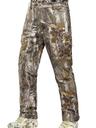
What the $100 line actually costs you, and it is not warmth
This is the useful part of drawing the line here. The two pants above a hundred dollars in our registry are the ScentBlocker Silentec Midweight at $119.99 and the Huntworth Lightweight Stretch at $105.99 — and neither of them is insulated. The Silentec is a midweight pant whose selling point is a named quiet face fabric; the Huntworth is a lightweight stretch pant with reinforced knees for pushing through cover.
So the hundred-dollar line in this category does not separate warm pants from cold ones. The warmest pants we stock are both inside the bracket, because a sherpa or fleece lining is cheap to build and a quiet technical face fabric is not. What the line separates is noise and construction from lining. Spend over a hundred and you are buying a face fabric someone has named and tested for sound; spend under it and you are buying insulation with a face fabric described, at best, as “quiet, per listing.”
For a bowhunter that is a genuine problem, because noise is the first criterion for a pant rather than the fourth. A pant rubs the platform, the seat, a harness and the riser on every shot, which makes it a worse noise offender than a jacket. The National Deer Association’s work on deer hearing is the reason we rank it first in the full roundup. In this bracket, though, you cannot rank on it — nobody publishes a sound figure and three of the four say nothing about face fabric at all. The practical workaround is the one every experienced stand hunter already uses: buy the quietest thing you can get your hands on, and then wear it for an hour at home and listen to it.
Lined or unlined: the only decision that matters here
Two of these four pants are lined and two are not, and that is the real fork in the bracket.
Lined (Mossy Oak Sherpa, NEW VIEW fleece).These are for the hunter who walks a quarter mile, climbs into a stand or a blind and then does not move for four hours. Neither publishes a gram weight for the lining, so you are choosing on the word “sherpa” against the word “fleece,” which is thinner evidence than anyone would like. What the lining does buy you is real: it is insulation in the one place a layering system usually has none, because the three-layer explanation everyone learns — base, mid, shell — is almost always taught about the upper body only. Our layering guide makes the same point.
Unlined (XKG Ridge, Fused Cotton).These are for hunters who generate their own heat and need the pant to let them move: a mobile or saddle hunter, or an early-to-mid-season sit where a lined pant has you sweating on the walk in. Sweating on the walk in is not a comfort problem, it is a cold problem — CDC and NIOSH cold-stress guidance is to dress in several loose layers and keep the base layer dry, and a wet base layer under an insulated pant is how a hunter gets cold at 3 p.m. having been too warm at dawn.
Below about 20F, an insulated bib over your own base layer beats any pant in this bracket, which is a boundary worth knowing before you spend here at all. Our hunting bib roundup is the page for that, and it is the honest answer for late-season all-day sits.
The sizing finding, and why it is the best $4 in the bracket
Here is the detail that surprised us most when we read these listings side by side. Exactly one hunting pant in our entire registry is sold by waist and inseam rather than by a letter, and it is the most expensive pant in this bracket at $96.22. The XKG Ridge listing specifies 34 Regular. The other three are sold as Large, X-Large and Large respectively — a letter, with no waist range published to interpret it.
For a garment you will wear over a base layer, sometimes over a bibbed boot top, and which has to stay up while you climb with a 20-pound pack and a bow, that is not a minor convenience. A letter-sized hunting pant is a gamble on a cut you cannot check, and the return is the expensive part — you find out in the stand in November, not at the kitchen table in September. If you are ordering online and you have had a pair of camo trousers arrive wrong before, the four dollars between the sherpa pant and the XKG Ridge is the cheapest sizing insurance on this page. (The other side of that trade: the XKG is uninsulated, so it is only the right answer if you are a hunter who moves.)
Two construction details on the same pant are worth noting because nothing else in the bracket publishes them: articulated knees and a diamond crotch gusset. Those are the two features that decide whether you can get a foot up onto a climbing stick without the pant binding at the hip, and KUIU publishes articulated knees on the Attack Pant for exactly the same reason. It also carries a Polygiene odour treatment, per the listing — a manufacturer claim we cite as such, and one we would not buy a pant for on its own, since the NDA’s own position on thermals is that playing the wind beats trusting any scent treatment.
Water resistance: one claim in four, and it is on the cheap one
Of the four pants here, one claims water resistance: the NEW VIEW fleece-lined pant at $59.99, and it publishes no rating for it — no hydrostatic head, no DWR named, no test. We record it as a claim rather than a specification. Even KUIU, publishing far more than anyone here, states “Water Resistant, Abrasion Resistant” on the Attack Pant without naming a DWR or a test, so this is a category-wide disclosure gap rather than a budget-end one.
The practical reading is that no pant in this bracket is rain protection, and you should not buy one as if it were. Water resistance on a hunting pant means it will shed a light drizzle and dew off tall grass on the walk in; it does not mean a two-hour rain. For that you carry a shell, which is the right answer anyway because you can take a shell off when the rain stops and you cannot take a pant off in a tree. Our rain gear roundup covers the options, including a full suit for less than the cheapest pant on this page.
About the cotton, said out loud
The budget pick is a cotton pant, and the standard outdoor advice is that cotton kills. That advice is correct and it is also written for hikers and mountain hunters — people who are moving, sweating and a long way from a vehicle. A stand hunter’s situation is different in two ways: the hard-use exertion is a short walk at either end of the day, and cotton is quiet. A fused cotton face is among the quietest materials you can put against a treestand platform, which is why the material survives in this category at all.
So the honest recommendation for the $49.99 pant is: dry early and mid-season sits, with a merino base layer under it and a rain shell in the pack. The wool handles the moisture your body produces — the Woolmark Company’s research reports that wool absorbs twice the water vapour of cotton and thirty times that of polyester, and that unwashed wool retained 66 percent less body-odour intensity than polyester in a New Zealand assessor study — and the shell handles the water from the sky. What you must not do is wear the cotton pant as your only layer in wet cold and expect it to dry on you. See our merino base layer roundup for the layer that makes this pick work.