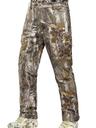
The four things that decide a hunting pant
A hunting pant is not a technical purchase the way a rangefinder is. There are no ranging modes to compare and no published accuracy figures. What there is instead is a short list of properties that decide whether the garment helps or hurts on a specific hunt, and almost every bad hunting-pant purchase comes from optimizing the wrong one.
One: noise.This is first and it is not close. A whitetail hunter spends the productive part of the hunt within forty yards of an animal that can hear a jacket sleeve brush a tree. The pant is worse than the jacket in this respect, not better, because the pant is what rubs against the stand platform, the seat, the harness, the climbing sticks and the bow riser as you turn. Every quiet fabric is quiet in the same way — a brushed or napped face with no slick synthetic surface to click or rasp — and the marketing name changes by brand. ScentBlocker calls its version Silentec. Cotton gets there without a trade name at all.
Two: warmth when you stop moving.A pant that is comfortable on the walk in is almost always too cold for the sit, because walking produces heat and sitting does not. The National Deer Association’s own account of how deer handle cold is a useful reminder of the physics working against you: a whitetail grows a hollow-hair winter coat and lowers its metabolic rate to sit out weather you cannot sit out in a single layer. You are the animal in the tree without the coat. That is why the useful question is not “how warm is this pant” but “how warm is this pant plus the base layer under it, after ninety minutes of not moving”.
Three: weather.Water is the fastest route from comfortable to finished, and legs get wet first — from wet brush on the walk in, from a seat that holds rain, from snow sliding off a platform. There is a hierarchy here that the listings blur: waterproof (a rated membrane), water-resistant (a surface treatment that buys you an hour), and absorbent (cotton, which gets heavier and colder the longer it is wet). Only one of the three is weather protection. The other two are delays.
Four: whether you can move in it. A pant you cannot climb in is a pant that stops you hunting the tree you should hunt. This is the criterion that separates the stand hunter from the mobile hunter more sharply than any other: if you set a saddle and sticks every morning, articulation and stretch stop being nice-to-have and become the reason the pant does or does not survive the season. If you climb into a fixed ladder stand and sit, they barely matter.
Scent control is a fifth consideration and we rank it fifth deliberately. One pant here names Polygiene in the garment, which is a real treatment and a real difference from a spray, and it is still a long way behind the wind. Our scent-control page puts the whole category in its place, and playing the wind is the only step in that sequence that is not optional.
What these six listings actually publish
This is the comparison table the category would rather you did not see, because the most common entry in it is a blank. Construction gets published. Measurements do not.
| Pant | Lining / insulation | Water resistance | Sizing | Fabric weight | Garment weight |
|---|
| ScentBlocker Silentec Midweight | Not published | Not published | S-M-L | Not published | Not published |
| ScentBlocker Fused Cotton Lightweight | None | Not published | S-M-L | Not published | Not published |
| King’s Camo XKG Ridge | None (uninsulated) | Described, not rated | Waist / inseam | Not published | Not published |
| Mossy Oak Sherpa Fleece Lined | Sherpa fleece (no gram weight) | Not published | S-M-L | Not published | Not published |
| Huntworth Lightweight Stretch | None (unlined) | Not published | S-M-L | Not published | Not published |
| NEW VIEW Fleece Lined | Fleece (no gram weight) | Water-resistant (no rating) | S-M-L | Not published | Not published |
Three things to read off that. First, the two right-hand columns are empty across the board. Six pants, twelve cells, twelve blanks. Fabric weight in grams per square meter is the single number that would let you rank these honestly for warmth and durability, and nobody in this bracket prints it. Second, the one pant that publishes a water-resistance claim at all is the cheapest lined pant here, which is not where you would expect the disclosure to come from. Third, exactly one pant is sold the way trousers are normally sold — by waist and inseam — and five are sold by a letter.
For scale on how much is being withheld, the figures are not hard to produce. KUIU publishes 247 g/m² for the Attack Pant’s Primeflex polyester, a garment weight of 18.5 oz / 524 g, and three named inseams. A pant at three times the price publishing three times the data is not a coincidence, and it is the honest argument for the premium brands: you are partly buying measurability. Our KUIU alternatives page works that trade through in detail and reaches the same conclusion from the other side.
Match the pant to the sit, not to the season
“Early season” and “late season” are the categories the industry sells in and they are the wrong categories to buy in, because the variable that matters is how much you move. A 55-degree morning spent hanging a stand and a 55-degree evening spent sitting in one need different pants. Three honest buckets:
Moving, any temperature above about 35F.Uninsulated, stretch, abrasion-resistant. The Huntworth or the King’s XKG. You will be warm from work and the pant’s job is to survive the walk and let you climb. Add warmth with a merino base layer underneath rather than with a heavier pant, because a base layer you can unzip a jacket over is adjustable and a lined pant is not.
Sitting, roughly 35F to 55F.A midweight uninsulated or lightly lined pant over a base layer. The Silentec pant is built for exactly this window and it is the widest window in a whitetail season — most of the rut, in most of the whitetail range, in most years. This is the pant to own first if you are only going to own one.
Sitting, below about 35F. Lined, or a bibinstead. The Sherpa-lined pant is the warmest thing on this page and the NEW VIEW is the cheapest lined option, and both of them have the same failure mode: you cannot walk far in them without sweating, and sweat is what makes you cold two hours later. The CDC’s own cold-stress guidance is blunt about it — wet clothing, including clothing wet from your own sweat, dramatically increases heat loss. Plan to walk in carrying the warm layer rather than wearing it when the approach is long.
Below about 20F with a long stationary sit, our honest answer is that this is bib territory rather than pant territory, and we say so on the bib page. A bib closes the gap at the waist and the kidneys that a pant cannot close, and that gap is where a cold sit actually ends. Pants win everywhere else, which is three quarters of the season.
The cotton paradox, and why the budget pick is a cotton pant
Cotton has been the villain of outdoor-clothing advice for thirty years, and the advice is right: cotton absorbs water, holds it against you, and loses nearly all of its insulating value wet. “Cotton kills” is hiking shorthand for a real mechanism. So it is worth being clear about why a fused cotton pant is still our budget recommendation for a deer hunter.
Because cotton is the quietest fabric you can wear in a tree, and a whitetail stand hunt is the one outdoor activity where that trade is worth making. The hiker’s problem is a long wet day with consequences measured in hypothermia. The stand hunter’s problem is a single sound at twenty yards with consequences measured in a season. A brushed cotton face does not click against a bow riser, does not rasp on a harness strap and does not squeak on a cold platform the way a coated synthetic can.
The rule that follows is simple and it is a rule about weather, not about temperature: wear cotton when it is dry and have something else for when it is not. That something else is a rain shell over the top, not a different pant in the truck — the suit you are carrying beats the better one you left at the road. The ScentBlocker Drencher rain jacket we already recommend has a matching rain pant for exactly this reason.
Sizing: the quiet reason hunters hate their hunting pants
Five of the six pants on this page are sold by letter, and that is the single biggest source of returns in this category. A hunting pant has to fit over a base layer, sit under a harness without riding up, and let a knee come up to a tree step — and an S-M-L garment is sized for none of that specifically. Two practical consequences:
Size up once if you layer underneath, and only once. A pant sized for a bare leg binds at the knee over a midweight base layer, and binding at the knee is what you feel every time you stand up to shoot. Two sizes up and you have a pant that bags at the ankle and catches on everything.
If your inseam is not average, buy by inseam.This is the strongest practical argument for the King’s XKG Ridge pant on this page: 34 Regular is a measurement, Large is a hope. Hunters at the ends of the size range feel this hardest, which is why our big-and-tall gear guide treats waist-and-inseam sizing as a feature rather than a detail.
One more sizing note that is specific to how these listings work: several of these ASINs resolve to a single size, so the price you see on the button is the price of that size and the size selector on the retailer page is where you choose your own. We note the size each listing was read in on every spec table, because it is part of what we actually verified.
What a hunting pant cannot do
It cannot keep your feet warm, and feet are what end most cold sits. The pant stops at the ankle and everything below that is a boot and a sock problem, with its own set of answers that have nothing to do with your legs. Buying a warmer pant to fix cold feet is the most common misdiagnosis in cold-weather hunting clothing.
It cannot make you quiet on its own either. A quiet pant under a crinkling shell is a noisy hunter, and the whole garment system has to agree — which is the argument our layering guide makes at more length. Noise is a property of the loudest thing you are wearing, not an average.
And it cannot do anything about your scent beyond what the garment treatment claims. A Polygiene-treated pant controls odor in the fabric. It does nothing about your breath, your hands, your boots or the thermal that carries all of it up the ridge at ten in the morning. Wash what you wear in something sensible — our scent-free detergent comparison names the bottles that actually publish their claims — and then hunt the wind anyway.