Crossbows · Care
Crossbow Maintenance
Four jobs, three consumables, and one replacement interval a manufacturer actually publishes. Everything else people tell you about crossbow care is embellishment.
How this is funded:we earn a commission if you buy through our links, at no extra cost to you. It never changes which product we recommend, and we’ll tell you plainly when to skip one. Full disclosure.
A crossbow is a machine that takes 150 to 200 pounds of stored energy and dumps it through its own frame several hundred times a year. Everything that goes wrong with one follows from that: fasteners vibrate loose, the string abrades against the rail, and the parts that move get dry. All four maintenance jobs address one of those.
The good news is that the whole routine takes about fifteen minutes and costs less per season than a pack of bolts.
Job 1: Tightness
This is the one hunters skip and it is the one with a safety consequence. TenPoint’s own maintenance guidance leads with it, and the reasoning is plain: every shot sends a wave of vibration through the crossbow, and enough waves loosen anything threaded.
Work around the whole crossbow — limb bolts, riser fasteners, stock screws, the quiver bracket, the scope rings, the rail screws. Tight, not overtightened; you are confirming nothing has backed out, not torquing an engine.
Do this before the season, and do it again the moment a group unexpectedly opens up. “My crossbow suddenly stopped shooting straight” is very often a loose scope ring.
Job 2: String and cables
The string is the consumable that carries the whole load, and it has two separate needs: inspection and conditioning.
Inspect first
Look down the whole length. You are looking for broken strands, loose or unravelling servings, and areas that have gone furry from rubbing. Any of those means replacement, not wax. A string that fails at full draw takes limbs with it often enough to make this the least appealing corner to cut.
Then condition
Run your fingers along the string and cables. Dry and slightly rough means wax. Rub it in with your fingers until it warms and goes tacky — wax sitting on the surface has not penetrated the strands, which is where it needs to be.
Wax the strands, not the served sections. A serving is tightly wound thread protecting the string where it contacts the rail and the latch; wax under it collects grit and accelerates exactly the wear you are trying to prevent.
The replacement interval
This is the one number a manufacturer publishes plainly. TenPoint recommends changing strings and cables at least once every two years, and every 1,000 shots for hunters who shoot often. Two years is a calendar interval, not a usage one — string material ages whether you shoot it or not.
Job 3: Rail lube
The flight rail is the one part of a crossbow with no analogue on a compound bow: the string drags across it under enormous tension on every shot. Rail lube is what stops that contact destroying the serving.
The technique is entirely about restraint. A thin film on the top of the rail, where the string actually travels, and nowhere else. Excess lube does not lubricate better; it collects dust, grit and pine needles, and a rail carrying gritty lube is an abrasive that wears the serving faster than a dry rail would.
Interval varies by manufacturer and by product, so check your manual for a shot count. The practical version: lube after any extended shooting session, and before the season.
Complete kit
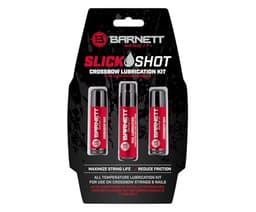
Barnett Rail Lube & Lubewax Combo Kit
The complete crossbow maintenance kit in one purchase
- Contents
- 1 rail lube, 2 lubewax
- For
- Rail, string and cables
- Volume
- Not published
Compact kit
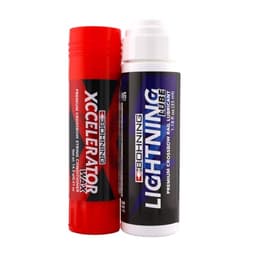
Bohning Crossbow Lube Kit
A compact kit that lives in the crossbow case
- Type
- Crossbow lube kit
- Contents
- Not published
- Volume
- Not published
String wax only
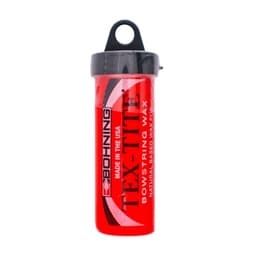
Bohning Tex-Tite Bowstring Wax, 1 oz
String and cable care on any bow or crossbow
- Type
- Bowstring wax
- Volume
- 1 oz
- For
- Strings and cables (not the rail)
Price as of October 6, 2026. #ad How we’re funded
Job 4: Oil the moving parts
With the crossbow uncocked and the safety engaged, TenPoint’s published routine is specific about quantity — one drop, not a squirt:
- Trigger mechanism. One drop of oil to both sides of the safety slide through the safety knob window, then cycle the safety forward and backward several times to spread it.
- String latch. One drop through the string slot in the trigger box, again cycling the safety to distribute it.
- Dry-fire inhibitor. One drop to each side of the DFI wedge, then cycle the inhibitor up and down.
- Axles and cam bearings. One drop to the top of each cam where the axle and bearings pass through.
Then wipe away any excess with a cotton swab. Oil that migrates onto the string is counterproductive, and oil that sits in a trigger group collects grit.
The cocking device is maintenance too
A rope cocker is a consumable that people treat as a permanent tool. Check the rope for fraying and the hooks for cracks or burrs, because a rope that lets go at full draw sends handles and hands in unpredictable directions. Replace it the moment it looks tired — it costs about as much as a takeaway lunch.
If you use a crank, inspect the internal cable, confirm the mount is tight, and check the manual for whether it needs its own lubrication. Our cocking guide covers the choice between the two and how each one wears a string.
Off-season storage
Store it uncocked. Sustained limb and string load over months is the one thing that meaningfully shortens component life outside of shooting.
Beyond that: dry, out of a case that has been wet, scope covers on, and a final tightness check before it goes away so it comes out ready rather than needing an hour of work the week before season. Pull the batteries out of any lighted nocks and out of an illuminated scope — a leaking cell in a scope is an expensive way to learn that lesson.
Then, before the first hunt, run the whole routine above and re-verify zero. A crossbow that sat in a shed for eight months is not a crossbow you know the zero of.
General guidance, not legal or safety advice. Hunting regulations vary by state and change every year — always verify seasons, legal equipment and requirements with your own state wildlife agency before you hunt. Wear a full-body harness and stay attached to the tree from the ground up whenever your feet leave the ground.
Frequently asked questions
How often should I wax a crossbow string?
TenPoint's guidance is to inspect the string and cables every time you take the crossbow out and to condition them whenever they feel dry to the touch. That is a better rule than a fixed interval, because how fast a string dries out depends on weather, storage and how much you shoot. Run your fingers along it — if it feels dry rather than slightly waxy, wax it.
How often should I lube a crossbow rail?
Check your own manual for a shot count, because the interval varies by manufacturer and by the lubricant used. What matters more than the number is the amount: a thin film on the top of the rail only. Excess rail lube collects dust and grit, which turns the rail into an abrasive and wears the string faster than no lube at all.
How often should crossbow strings and cables be replaced?
TenPoint recommends changing strings and cables at least once every two years, or each time you reach 1,000 shots if you shoot often. Replace sooner than that if you find broken strands, loose servings or excessive wear at any inspection — those are failure indicators, not wear-and-tear you can wax away.
What happens if you don't maintain a crossbow?
Three things, in escalating order. Accuracy drifts as fasteners work loose and the string wears unevenly. Then the string fails, which at best ends your season and at worst damages the limbs. And a crossbow with loose limb bolts is a genuine safety problem, because the limbs are storing a great deal of energy and are held on by those bolts.
Can I use regular oil on a crossbow trigger?
Use what the manufacturer specifies. The quantity matters as much as the product: TenPoint's guidance is a single drop applied to each side of the safety slide and to the string latch, cycled to spread it, with excess wiped away. Flooding a trigger group attracts grit and can migrate oil onto the string.
How should I store a crossbow in the off-season?
Uncocked, in a dry place, out of a sealed case if the case has been wet, and with the scope covers on. Do a final tightness check on all the fasteners before it goes away so it comes out ready. Do not store it cocked — sustained load on the limbs, cables and string is exactly the thing to avoid over a long period.
Sources
- TenPoint — 3 Critical Maintenance Tips to Keep Your Crossbow in Top Shooting Form — Manufacturer guidance: check every nut, bolt and screw for tightness; inspect strings and cables each session and condition when dry; TenPoint recommends changing strings and cables at least every two years, or every 1,000 shots if you shoot often; oil the trigger, dry-fire inhibitor, axles and cam bearings one drop at a time (accessed August 22, 2026)
- National Crossbow Association — State Regulations — State-by-state crossbow legality overview; always verify with your state agency (accessed July 22, 2026)
- Bowhunting.com — How Far Should You Shoot With a Crossbow? — On ethical crossbow range for whitetail and how energy drops downrange (accessed July 22, 2026)
Keep reading
How to cock a crossbow
Cocking is what wears the string — doing it evenly makes it wear evenly.
Read the guideHow to sight in a crossbow
The verification step that ends every maintenance session, and why it is not optional.
Read the guideBest crossbow bolts
The other consumable — and why bolt weight is a maintenance issue as much as an accuracy one.
See the picksBest crossbows for deer hunting
What you are looking after, compared on speed, cocking effort and running cost.
See the picks