Tag & Timber

Guides · Big and tall

Deer Hunting Gear for Big and Tall Hunters

Almost every tree stand on the market publishes the same 300 lb limit, almost every ladder stand publishes none at all, and the number is supposed to include your gear. Here is what the specs actually say, and the gear that is rated for more.

By Stephen V.Last updated How we pick

If you are over 300 lb in hunting clothes, buy the Hunter Safety System HSS-9 Big Boy. It is published in 4X/5X and described by its maker as the only harness available to fit hunters up to 400 pounds, and it is the only product in our entire registry rated past the 300 lb ceiling that the rest of this industry stops at. If you are under that ceiling but at the top of it, the right move is a size-rated harness bought on the published bracket rather than on how the straps feel — the HSS Ultra-Lite publishes 250–300 lb for its 2X/3X, and the Summit Pro publishes a 300 lb limit alongside the only named safety standard in the category.

This page exists because of a pattern in the specifications that is hard to see one product at a time. We went through every stand, saddle, harness and seat in our registry looking for a published weight capacity. The result:

  • Every climbing stand and hang-on stand publishes 300 lb. Not 299, not 325. The Summit Viper SD, the Mini Viper SD, the Hawk Helium Kickback XL and the Millennium M100U all publish exactly 300 lb.
  • Every ladder stand publishes nothing. All five ladder stands we cover — including two-person models that obviously carry two adults — have no weight rating we could read anywhere.
  • Of six blind chairs, exactly one publishes a capacity. It is 300 lb, and it is on the cheapest chair in the group.
  • Harness makers are the exception. They publish capacity, and two of them publish it by size, which is the only place in deer hunting where a big-and-tall buyer gets a straight answer.

One more thing that is easy to miss and matters most: a stand’s rated capacity is meant to include everything you take up the tree. Your clothes, your boots, your harness, your pack, your bow and your thermos all count against the number. A 270 lb hunter in late-season clothing with a loaded pack is at a 300 lb limit, not comfortably under it.

Every figure on this page is a manufacturer claim, cited as one. We own none of this gear and have not load-tested anything. Prices are live and dated.

How this is funded:we earn a commission if you buy through our links, at no extra cost to you. It never changes which product we recommend, and we’ll tell you plainly when to skip one. Full disclosure.

Quick picks

Ranked on published specs, package value and buyer fit. Select a row to jump to the full write-up. We have not tested these products — here is exactly what we do instead.

#ProductBest forPrice
1
Hunter Safety System HSS-9 Big Boy Harness, 4X/5X

Hunter Safety System HSS-9 Big Boy Harness, 4X/5X

The answer to a question most of this category ignores. Nearly every harness here tops out at 250 or 300 pounds, which quietly excludes a lot of hunters from the only piece of gear that keeps them alive twenty feet up; HSS publishes this one as the only harness available to fit hunters up to 400 pounds. It also arrives with the lineman's rope and the tree strap in the box, so the whole climb is covered on day one.

Best harness above 300 lb
$209.99 · View on Amazon

Price as of October 16, 2026. #ad How we’re funded

2
Summit Treestands Pro Safety Harness (SU83082)

Summit Treestands Pro Safety Harness (SU83082)

The pick for anyone who wants a certification rather than a slogan. Summit is the only maker in this group that names what its harnesses are tested against — ASTM industry standards recognized by the Treestand Manufacturer's Association — and it publishes a 300 lb limit, a waist range per size and a one-year warranty instead of leaving all three blank. The Pro itself is the padded, MOLLE-equipped version of that line, and it is the natural companion to a Summit climbing stand.

Best harness with a named standard
$109.99 · View on Amazon

Price as of October 16, 2026. #ad How we’re funded

3
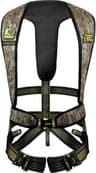
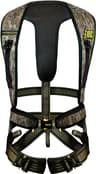
Hunter Safety System Ultra-Lite Harness (Mossy Oak Bottomland)

Hunter Safety System Ultra-Lite Harness (Mossy Oak Bottomland)

The harness to buy if the reason you sometimes skip one is bulk. At a published 2.5 pounds with a mesh upper body and 1.25-inch webbing, it is the lightest thing HSS sells that still comes with a tree strap and a suspension relief strap in the box, and it has lineman's loops built in so you can add a climbing rope later without buying a different vest. The one thing it does not give you is a named standard: HSS says it surpasses all industry safety standards and declines to say which.

Best harness up to 300 lb
$132.99 · View on Amazon

Price as of October 16, 2026. #ad How we’re funded

4
Guide Gear 20' 2-Man Ladder Stand with Blind

Guide Gear 20' 2-Man Ladder Stand with Blind

Twenty feet plus an enclosure is the setup for open ground where there is nothing to break your outline — a field edge, a young pine stand, a picked cornfield. The blind also buys you the ability to move without being caught doing it.

Best stand for deck room
$309.99 · View on Amazon

$324.995% off

Price as of October 16, 2026. #ad How we’re funded

5
Hawk Big Denali Luxury Blind Chair

Hawk Big Denali Luxury Blind Chair

The extra-large chair, and the pick for a big-framed hunter or an all-day rut sit. A chair that is slightly too small is not a comfort problem, it is a movement problem: you shift, you re-cross your legs, you adjust — and at ground level a deer at 20 yards sees all of it. Buying the wide seat is buying stillness.

Best seat for a long sit
$152.00 · View on Amazon

Price as of October 16, 2026. #ad How we’re funded

6
Dr. Scholl's Heavy Duty Support Insoles, Big & Tall (2 pairs)

Dr. Scholl's Heavy Duty Support Insoles, Big & Tall (2 pairs)

Nearly every insole in this category is designed around an average-weight foot, which leaves out a lot of hunters: a heavier hunter compresses a foam footbed faster, and a footbed that has bottomed out is just a sheet of plastic between a heel and a boot. Dr. Scholl's publishes this one specifically for people over 200 pounds, tall builds and wide feet, and it comes two pairs to a box.

Best insole for load
$26.95 · View on Amazon

$29.9410% off

Price as of October 16, 2026. #ad How we’re funded

The picks in full

#1Best harness above 300 lb

Hunter Safety System HSS-9 Big Boy Harness, 4X/5X

The answer to a question most of this category ignores. Nearly every harness here tops out at 250 or 300 pounds, which quietly excludes a lot of hunters from the only piece of gear that keeps them alive twenty feet up; HSS publishes this one as the only harness available to fit hunters up to 400 pounds. It also arrives with the lineman's rope and the tree strap in the box, so the whole climb is covered on day one.

Strengths

  • Published to fit hunters up to 400 lb — the only harness in this roundup that goes past 300
  • Ships with a Lineman's Climbing Rope and a rope-style treestrap, so you are attached from the ground up without a second purchase
  • Two suspension relief strap / deer drags, which matters more the heavier you are: suspension after a fall is the real danger
  • Ten pockets including zippered waist pockets, plus integrated bino and rangefinder straps

Trade-offs

  • HSS again names no standard, no test and no certifying body — only that it surpasses all industry safety standards
  • No harness weight is published, and a ten-pocket 4X/5X vest is not a light garment
  • Priced at the top of the category, and a hunter who needs this size has no cheaper option to compare it against
  • Only one size range, so it is the right harness for 4X/5X and the wrong one for anybody else
TypeFull-body harness vest, 4X/5X
CapacityUp to 400 lb (maker's claim)
In the boxLineman's climbing rope, rope-style treestrap, 2 suspension relief straps
PocketsTen, including 2 zippered waist pockets
Standard namedNot published
Harness weightNot published

Worth knowing. HSS publishes the included rope at a 31.99 USD value and the treestrap at 24.99 USD, which is most of the price gap between this harness and a bare vest.

Specs read from the product listing, on October 5, 2026. “Not published” means the manufacturer does not state that figure.

#2Best harness with a named standard

Summit Treestands Pro Safety Harness (SU83082)

The pick for anyone who wants a certification rather than a slogan. Summit is the only maker in this group that names what its harnesses are tested against — ASTM industry standards recognized by the Treestand Manufacturer's Association — and it publishes a 300 lb limit, a waist range per size and a one-year warranty instead of leaving all three blank. The Pro itself is the padded, MOLLE-equipped version of that line, and it is the natural companion to a Summit climbing stand.

Strengths

  • Summit publishes that its harnesses are designed and certified to meet or exceed the ASTM standards recognized by the TMA — the only named standard in this roundup
  • Published 300 lb weight limit and published waist ranges (Medium 28-35 in, Large 35-46 in) rather than a generic size chart
  • Padded shoulder straps and a torso strap, which is the difference between a harness you tolerate and one you forget you have on
  • MOLLE webbing takes a bino pouch or a release holder without adding a second strap across your chest

Trade-offs

  • The 1-year limited warranty is the shortest here, on a product the industry says to retire after a few seasons
  • Summit's published component list (tether with locking carabiner, 8 ft rope with adjustable prusik) is written for the Sport; the Pro is only described as comparable with added features, so confirm what is in your box
  • No harness weight is published for the Pro — Summit publishes 2 lb for the lighter Element and nothing for this one
  • Waist-sized rather than weight-sized, so a 300 lb hunter at a 47-inch waist has no size here
TypeFull-body harness, padded shoulders, torso strap
Standard namedASTM standards recognized by the TMA (maker's claim)
Capacity300 lb
SizingMedium 28-35 in waist; Large 35-46 in waist
Warranty1-year limited
Harness weightNot published

Worth knowing. Summit's own service-life instruction is to inspect before every use and replace frayed webbing, cracked buckles or compromised stitching immediately.

Specs read from the product listing, on October 5, 2026. “Not published” means the manufacturer does not state that figure.

#3Best harness up to 300 lb

Hunter Safety System Ultra-Lite Harness (Mossy Oak Bottomland)

The harness to buy if the reason you sometimes skip one is bulk. At a published 2.5 pounds with a mesh upper body and 1.25-inch webbing, it is the lightest thing HSS sells that still comes with a tree strap and a suspension relief strap in the box, and it has lineman's loops built in so you can add a climbing rope later without buying a different vest. The one thing it does not give you is a named standard: HSS says it surpasses all industry safety standards and declines to say which.

Strengths

  • Published at 2.5 lb — light enough that early-season heat stops being a reason to leave it in the truck
  • Capacity is published per size (S/M 100-175 lb, L/XL 175-250 lb, 2X/3X 250-300 lb) rather than as one vague number
  • Comes with the adjustable tree strap and a suspension relief strap that doubles as a deer drag, so the box is a complete stand-level system
  • Built-in lineman's loops mean you can add a lineman's rope later and be attached on the climb too

Trade-offs

  • HSS names no standard, no test and no certifying body on this page — only that the harness surpasses all industry safety standards
  • No warranty period is published for this model, which matters on a product the same maker says to replace every 3-5 years
  • Mesh and 1.25-inch webbing is less padded than a heavier vest, which some hunters feel on a six-hour sit
  • Costs more than twice what the brand's own basic vest does, and the extra buys lightness, not a higher rating
TypeFull-body harness vest, mesh upper
Harness weight2.5 lb
CapacityS/M 100-175 lb; L/XL 175-250 lb; 2X/3X 250-300 lb
Webbing1.25 in upper body
In the boxTree strap, suspension relief strap/deer drag, instructions
Standard namedNot published

Worth knowing. HSS publishes its own replacement rule in its FAQ: replace the harness every 3-5 years, or immediately if it shows wear, damage or has been in a fall.

Specs read from the product listing, on October 5, 2026. “Not published” means the manufacturer does not state that figure.

#4Best stand for deck room

Guide Gear 20' 2-Man Ladder Stand with Blind

Twenty feet plus an enclosure is the setup for open ground where there is nothing to break your outline — a field edge, a young pine stand, a picked cornfield. The blind also buys you the ability to move without being caught doing it.

Strengths

  • Twenty feet is genuinely tall for a ladder stand
  • Enclosure hides movement, which matters more than height in the open
  • Two-man platform doubles as a comfortable one-man box

Trade-offs

  • A blind on a ladder stand catches wind — anchor it properly
  • The tallest stand here is also the hardest to raise safely
TypeLadder stand with blind
Height20 ft
Capacity2 people
Weight ratingNot published

Worth knowing. An enclosed stand traps your scent as much as it hides your movement — and then releases it in a plume when you open a window. Set it for the wind you actually hunt.

Specs read from the product listing, on August 22, 2026. “Not published” means the manufacturer does not state that figure.

#5Best seat for a long sit

Hawk Big Denali Luxury Blind Chair

The extra-large chair, and the pick for a big-framed hunter or an all-day rut sit. A chair that is slightly too small is not a comfort problem, it is a movement problem: you shift, you re-cross your legs, you adjust — and at ground level a deer at 20 yards sees all of it. Buying the wide seat is buying stillness.

Strengths

  • Extra-large seat, which is the honest fix for shifting in a chair
  • Silent operation claimed on the listing, like the rest of this brand's line
  • More padding than the value chair for a dawn-to-dusk rut sit

Trade-offs

  • A bigger footprint eats floor space in a one- or two-person blind
  • Heavier to move between blinds than the mid chair
  • No published capacity, seat height or weight on the listing
TypeExtra-large swivel blind chair
Seat sizeExtra large
Seat heightNot published
CapacityNot published

Worth knowing. Measure the floor of your blind before buying the wide chair. A hub blind's usable floor is smaller than its hub-to-hub figure suggests once a chair and a pack are in it.

Specs read from the product listing, on October 12, 2026. “Not published” means the manufacturer does not state that figure.

#6Best insole for load

Dr. Scholl's Heavy Duty Support Insoles, Big & Tall (2 pairs)

Nearly every insole in this category is designed around an average-weight foot, which leaves out a lot of hunters: a heavier hunter compresses a foam footbed faster, and a footbed that has bottomed out is just a sheet of plastic between a heel and a boot. Dr. Scholl's publishes this one specifically for people over 200 pounds, tall builds and wide feet, and it comes two pairs to a box.

Strengths

  • Published as built for individuals over 200 lb, tall stature or wide feet — a fit case almost nobody else addresses
  • Shock-absorbing foam with extra heel cushioning, aimed at the leg and lower-back fatigue of a long day on foot
  • Two pairs per box, so a dry set stays in the truck
  • Trim-to-fit and cheap enough to replace mid-season when it packs out

Trade-offs

  • No insulation and no cold rating — this is a comfort and support insole, not a warmth upgrade
  • No thickness published, and a cushioned big-and-tall footbed is not a thin one
  • Foam cushioning compresses with use, so expect to replace it rather than get seasons out of it
  • Drugstore sizing (men's 8-14) rather than a boot-specific fit
TypeCushioned support insole, foam
Built forOver 200 lb, tall stature or wide feet (maker's claim)
In the box2 pairs
SizingMen's 8-14, trim to fit
ThicknessNot published
Cold ratingNot published

Worth knowing. Trim-to-fit insoles should be cut against the footbed you removed, not against the boot — cutting to the boot outline leaves an insole that buckles under the arch.

Specs read from the product listing, on October 5, 2026. “Not published” means the manufacturer does not state that figure.

What the stand and seat specs actually say

This is the table we could not find anywhere else, which is the reason this page exists. Every entry is read from the maker’s published copy or the listing; a blank means the figure is genuinely absent, not that we did not look.

ProductTypePublished capacityPublished sizing
HSS-9 Big BoyHarnessUp to 400 lb (maker’s claim)4X/5X
HSS Ultra-LiteHarness250–300 lb in 2X/3XS/M, L/XL, 2X/3X by weight bracket
Summit ProHarness300 lbMedium 28–35 in waist; Large 35–46 in
Muddy SafeguardHarness + lifeline kitNot publishedNot published
Summit Viper SD / Mini Viper SDClimbing stand300 lbn/a
Hawk Helium Kickback XLHang-on stand300 lbn/a
Millennium M100UHang-on stand300 lbn/a
All five ladder stands we coverLadder standNot published1- or 2-person deck
Tethrd Phantom XPSaddle300 lbRegular 28–36 in waist; XL
Trophyline Covert Ultra / XOP MutantSaddleNot publishedXOP: Medium–Extra Large
Guide Gear Huntrite 360Blind chair300 lbn/a
Hawk Big DenaliBlind chairNot publishedOversized seat (no dimension published)

The ladder-stand row is the one worth sitting with. These are the stands most often sold as two-person models, they are the ones a father and a grown son share, and not one of them publishes a figure. That is not evidence they are weak — it is evidence that the number you would want to check does not exist to check. Where a ladder stand’s box or manual does carry a rating, treat that as the authority over anything written here.

Buy the harness first, and buy it by the published bracket

A harness is the one piece of equipment on this page where fit and capacity are published in the same place, and it is also the one where getting it wrong matters most. Two rules:

  1. Buy the size that brackets your weight in hunting clothes, not your weight on the bathroom scale. Hunting clothes, boots and a pack can add twenty pounds or more in late season.
  2. Check the waist range, not just the weight. Summit publishes a 28–35 in waist for Medium and 35–46 in for Large. A harness that will not close correctly around the waist cannot distribute a fall load the way it was designed to, regardless of the weight on the label.

Two further things every harness buyer should know and almost none does. First, Hunter Safety System publishes a service life: it recommends replacing a harness every three to five years, or immediately if it shows wear, damage, or has been in a fall. Second, almost nobody names a standard. HSS’s product pages claim only that the harness surpasses all industry safety standards without naming one; Summit is the exception, publishing that its harnesses are certified to meet or exceed the ASTM standards recognized by the Treestand Manufacturer’s Association. If a named standard matters to you — and above 300 lb it probably should — that is the distinction to buy on. Our harness comparison covers the whole group, and the harness guide covers how a fall-arrest system is supposed to be used.

Stands: deck area is the spec nobody prints, so measure it

For a bigger hunter the platform dimensions matter as much as the rating, and they are rarely published in a usable form. A climbing stand wraps you against the trunk and is the least forgiving option on space; a hang-on with a kickback seat gives you a defined platform; a two-person ladder stand gives you the most room by a wide margin, which is why the 20-foot two-man ladder is the pick here even though its rating is unpublished.

Practical approach: find the platform length and width in the listing dimensions, lay that rectangle out on your garage floor with tape, and stand in it wearing your boots. That five-minute exercise tells you more than any review. Our guide to stand types sets out what each type costs you in space and mobility, and ladder stand against hang-on is the decision this usually comes down to.

Seats, boots and the two small things that change a sit

The sit itself gets uncomfortable in two predictable places. The first is the seat: an oversized blind chair exists for exactly this reason, and a seat that is slightly too small is not a comfort complaint, it is a movement problem, because you will shift in it and movement is what a deer detects. The second is underfoot. Dr. Scholl’s publishes its heavy-duty insole as built for people over 200 lb, of tall stature or with wide feet — the only insole in the group with that claim attached — and it ships two pairs, which means one can dry while the other is in the boot.

One warning on footwear: adding a thicker insole to a boot that already fits snugly makes feet colder, not warmer, because it compresses the insulation and restricts circulation. If you are adding volume underfoot, size the boot for it. Our boot sizing guide and insole comparison both work through that trade.

What we deliberately are not telling you

We are not going to tell you that a 300 lb stand is “really” fine at 340, that an unrated ladder stand is good for a given figure, or that a harness rated to 300 lb has a margin built in. Nobody publishes those numbers, we have not tested anything, and this is the one category on this site where a confident guess could get somebody hurt. Where a rating exists, respect it including your gear. Where it does not exist, the manual that came in the box is the authority, and a call to the manufacturer is a reasonable thing to make before spending the money.
Frequently asked questions

What is the weight limit on a tree stand?

On every climbing stand and hang-on stand we cover, the published figure is exactly 300 lb - the Summit Viper SD, the Mini Viper SD, the Hawk Helium Kickback XL and the Millennium M100U all publish 300 lb. That figure is meant to include everything you take up the tree: clothing, boots, harness, pack, bow and anything else. Ladder stands are the gap: all five we cover publish no weight rating at all, including two-person models. Where your own stand's manual or box states a rating, that is the authority.

Is there a tree stand harness for hunters over 300 pounds?

Yes - the Hunter Safety System HSS-9 Big Boy, published in 4X/5X and described by its maker as the only harness available to fit hunters up to 400 pounds. It is the only product in our registry rated above the 300 lb ceiling the rest of the category stops at. As with the rest of the HSS line, the page claims only that the harness surpasses all industry safety standards and does not name a specific standard, which is worth knowing before you buy.

Does tree stand weight capacity include your gear?

Yes, and this is the detail that catches people out. The rating is for the total load on the stand, which means your body weight plus clothing, boots, harness, pack, weapon and anything hanging from a hook. A 270 lb hunter in late-season layers with a loaded pack is realistically at a 300 lb limit rather than 30 lb under it. If you are near the number, weigh yourself dressed and loaded the way you actually hunt.

How do you pick a harness size for a big and tall hunter?

Buy on the published bracket, dressed as you hunt. The HSS Ultra-Lite publishes 100-175 lb for S/M, 175-250 lb for L/XL and 250-300 lb for 2X/3X. Summit publishes a waist range instead - 28-35 in for Medium and 35-46 in for Large - and that is the second number to check, because a harness that cannot be closed properly at the waist cannot do its job whatever the weight label says. Also note HSS's own service-life rule: replace the harness every three to five years, or immediately after a fall or any sign of wear.

Which hunting chair is best for a bigger hunter?

Of the six ground-blind chairs we cover, exactly one publishes a weight capacity - 300 lb, on the cheapest chair in the group - and the oversized option, the Hawk Big Denali, publishes neither a capacity nor a seat dimension. That is the honest state of the category. The practical test is to measure your blind's window height and your own seated shooting height before you buy, because a chair that puts you at the wrong height for the window is a worse problem than a chair that is slightly too small.

Sources

  • Hunter Safety System — HSS-9 Big Boy Harness, 4X/5X (product page) — Manufacturer's published figures: described as the only harness available to fit hunters up to 400 pounds; ten pockets including two zippered pockets built onto the waist strap; integrated adjustable bino and rangefinder straps; a shock-absorbing tether; built-in lineman's loops; rubber-coated leg buckles and quick snap buckles. The box contains the harness, a rope-style treestrap with carabiner (published at a 24.99 USD value), a Lineman's Climbing Rope (published at a 31.99 USD value), two suspension relief strap / deer drags, a tree stand safety DVD, safe-use instructions and a warranty card. As with the rest of the line, the page claims only that it surpasses all industry safety standards. Cited as manufacturer claims (accessed October 5, 2026)
  • Hunter Safety System — Ultra-Lite Realtree Harness (product page) — Manufacturer's published figures: harness weight 2.5 lb; 1.25 in upper-body webbing; weight capacity by size, with S/M rated 100-175 lb, L/XL 175-250 lb and 2X/3X 250-300 lb; ventilating mesh fabric, rubber-coated leg buckles, quick snap buckles, built-in lineman's loops and a shock-absorbing tether; the box contains the harness, an adjustable tree strap, a suspension relief strap that doubles as a deer drag, a tree stand safety DVD, safe-use instructions and a warranty card. On standards the page says only that the harness surpasses all industry safety standards — it names no standard, no test and no certifying body — and it publishes no warranty period. Cited as manufacturer claims (accessed October 5, 2026)
  • Hunter Safety System — Frequently Asked Questions — The maker's own service-life rule, in its own words: it recommends replacing your harness every 3-5 years, or immediately if it shows signs of wear, damage, or has been involved in a fall; and before every hunt, checking for frayed stitching, worn straps or damaged buckles, and not using the harness if anything looks questionable. The FAQ does not address lifeline rope lifespan, TMA certification, weight limits or washing. Cited for the replacement interval, which almost no buyer of a harness knows exists (accessed October 5, 2026)
  • Summit Treestands — Safety Harnesses (product line page) — Manufacturer's published figures for the Element, Sport and Pro harnesses: all three are designed and certified to meet or exceed the ASTM industry standards recognized by the Treestand Manufacturer's Association (TMA); all three carry a 300 lb weight limit; sizing is Medium for a 28-35 in waist and Large for a 35-46 in waist; all three carry a 1-year limited warranty covering defects in materials or workmanship for the original purchaser; all include suspension relief straps and instructions for use; the Element is published at 2 lb; the Sport ships with a tether with a locking carabiner and an 8 ft safety rope with an adjustable Prusik knot, and the Pro is described as comparable with added features. Summit's own instruction on service life is to inspect the harness for wear before every use and replace frayed webbing, cracked buckles or compromised stitching immediately. Cited as manufacturer claims (accessed October 5, 2026)
  • Tree Stand Safety Awareness Foundation — Industry safety foundation tracking treestand-fall statistics and the ABCs of safety (accessed July 22, 2026)
  • Hunter-Ed — Fall-Arrest Systems (FAS) — State-approved hunter-ed guidance on full-body harness + fall-arrest components (accessed July 22, 2026)
  • Wisconsin DNR — Tree Stand Safety — State wildlife agency guidance on harnesses and safe stand use (accessed July 22, 2026)

Keep reading