Tree stands · Head to head
Ladder Stand vs Hang-On
One is a chair you leave in a tree. The other is a seat you carry to whichever tree the deer are using this week. The right answer is mostly about who owns the ground.
How this is funded:we earn a commission if you buy through our links, at no extra cost to you. It never changes which product we recommend, and we’ll tell you plainly when to skip one. Full disclosure.
These two stands answer opposite questions. A ladder stand asks “where will I hunt this season?” and commits. A hang-on asks “where are the deer this week?” and follows. Everything else — weight, comfort, safety profile, price — falls out of that difference.
Ladder stand
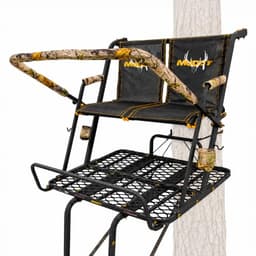
Muddy 2-Person Ladder Tree Stand, 17'
Taking a second hunter — a kid, a partner, a camera
- Type
- Ladder stand
- Height
- 17 ft
- Capacity
- 2 people
Price as of October 6, 2026. #ad How we’re funded
Hang-on
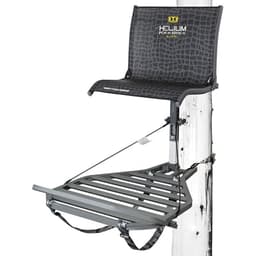
Hawk Helium Kickback XL
Comfortable lock-on hunting on any tree
- Type
- Hang-on / lock-on stand
- Weight capacity
- 300 lb
- Best tree
- Almost any tree (with climbing sticks)
Price as of October 6, 2026. #ad How we’re funded
What a ladder stand does better
Comfort, and therefore hours in the tree
A ladder stand has room for a proper sling seat, a backrest, a footrest and shooting rails, because it does not have to be carried anywhere. A hang-on has to be light enough to walk in with, which caps how much seat it can have.
This sounds like a lifestyle preference and is actually a hunting one. Nobody kills a buck from a stand they climbed out of at half past nine because their back hurt. In the rut, when midday movement is real, the stand you can sit in until two o’clock is the stand that produces.
The climb
You walk up a ladder. There is no technique, nothing to hang in the dark, and no moment where you are transferring your weight between a stick and a platform. For a new hunter, an older hunter, or anyone with a balance or mobility issue, this is not a small advantage — it is the difference between hunting from a tree and not.
Taking someone with you
A two-person ladder stand is the only stand type that puts an adult and a child in a tree together. There is no hang-on equivalent. If mentoring a new hunter is on your list, this decides the question by itself.
What a hang-on does better
Mobility, which is really about pressure
Deer patterns move. Acorns drop and then are eaten, crops come out, the rut scrambles everything, and the wind that made your stand huntable in October is not the wind in November. A ladder stand cannot follow any of that. A hang-on can be hunting a different tree three hundred yards away the next morning.
The related benefit is pressure. A stand hunted repeatedly teaches deer where you are — not because they see you every time, but because your access route, your scent and your entries accumulate. Moving is how you keep a spot fresh.
Public land
Most public areas do not let you leave a stand overnight, and even where they do, an unlocked ladder stand on public ground is a stand someone else is going to sit in. A hang-on that comes down with you is the only workable answer on ground you share.
Tree choice
A ladder stand needs a straight, sound trunk of the right diameter, with somewhere to stand a ladder. A hang-on will go on a leaning tree, a crooked tree, a tree with limbs in the way — which matters because the tree with the best shot angle at the trail is frequently not the tidiest one in the wood.
The safety comparison, honestly
It is tempting to declare the ladder stand safer, and for the climb itself that is fair: fewer transitions, nothing to hang while balancing, no learning curve. That genuinely matters, and it is why ladder stands are the standard recommendation for new and older hunters.
But the comparison flips when you look at how people actually use them. Ladder stands get climbed without a harness far more often, precisely because they feel like a staircase — and Hunter-Ed’s fall-arrest guidance is that you should be attached to the tree from the ground up, every time, regardless of stand type. A hang-on hunter who uses a lineman’s rope going up and a tether once settled is attached continuously. A ladder-stand hunter who clips in only after sitting down is not.
The other asymmetry is setup. Raising a ladder stand is a genuine two-person job with real injury potential, and it is where a share of ladder-stand accidents happen. Hanging a hang-on is a one-person job but a more exposed one, done at height with both hands occupied. Neither is casual.
Cost, over a property rather than per stand
A ladder stand costs more than a hang-on, and then you need one per location. A hang-on costs less but needs a set of climbing sticks, which are often more than the stand, and then you carry the whole lot every time.
The realistic math for someone with private ground: three ladder stands covering three wind directions is a meaningful investment made once, and then hunting is just choosing which one the wind allows. The realistic math for a public-land hunter: one good hang-on and one good set of sticks, carried, forever.
How to choose
- Private ground you hunt every year, all-day sits, or a kid to take. Ladder stand. Set two or three for different winds and hunt whichever the day allows.
- Public land, or leased ground you cannot leave gear on. Hang-on and sticks. It is the only setup that comes home with you.
- You hunt pressured deer and keep finding they have moved. Hang-on. Mobility is the answer to pressure and nothing else is.
- Mobility issues, or you simply do not enjoy climbing. Ladder stand, without hesitation. A stand you are confident climbing is a stand you will hunt.
- You want maximum mobility and are prepared to learn a technique. Look past both at a saddle — our saddle comparison covers what that actually involves.
Most hunters with access to their own ground end up owning both, and that is not indecision. The ladder stand is the November all-day sit on the best funnel you have; the hang-on is how you follow the sign in October and hunt somewhere new when the wind is wrong.
General guidance, not legal or safety advice. Hunting regulations vary by state and change every year — always verify seasons, legal equipment and requirements with your own state wildlife agency before you hunt. Wear a full-body harness and stay attached to the tree from the ground up whenever your feet leave the ground.
Frequently asked questions
Is a ladder stand or a hang-on better for deer hunting?
A ladder stand is better if you hunt the same private ground every year, want to sit all day comfortably, or want to take a second person up. A hang-on is better if you hunt public land, need to move as deer patterns shift, or cannot leave a stand out. Neither is better in the abstract — the question is whether you can leave a stand where you put it.
Which is safer, a ladder stand or a hang-on?
The act of climbing a ladder stand is simpler and involves fewer unattached moments than climbing sticks to a hang-on, so it suits new and older hunters better. But the dominant safety variable in the statistics is whether the hunter was wearing a harness and stayed attached, not which stand they used. A hang-on used correctly with a lineman's rope is safer than a ladder stand climbed without a harness.
Can you hunt public land with a ladder stand?
Usually not practically, and often not legally. Many public areas prohibit leaving stands overnight or restrict where and how long they can be left, and a ladder stand is too heavy to carry in and out each day. A hang-on with sticks is the standard public-land answer for exactly this reason. Check the specific rules for the area you hunt.
How much does a hang-on stand setup weigh?
The stand itself is typically the light part; the sticks are what add up. A lightweight hang-on plus a set of climbing sticks is a real load on your back over a long walk, and it is the honest cost of mobility. This is why hunters who walk a long way often end up looking at saddles instead.
Do I need a lineman's rope for a hang-on stand?
If you are hanging the stand yourself, yes. A lineman's rope keeps you attached to the trunk while both hands are busy hanging the platform — which is the single most exposed moment in the whole process. Hunter-Ed's guidance is to stay connected to the tree from the ground up, and hanging a stand is exactly when people are not.
Can you take a kid hunting in a hang-on stand?
Not in the same stand — a hang-on is a one-person platform. If you want to hunt with a child or a new hunter beside you, that is a two-person ladder stand or a ground blind. This is one of the few situations where the stand type genuinely decides what kind of hunt is possible.
Sources
- Tree Stand Safety Awareness Foundation — Industry safety foundation tracking treestand-fall statistics and the ABCs of safety (accessed July 22, 2026)
- National Deer Association — Treestand Accidents: Can We Stop the Insanity? — NDA on the leading causes of treestand falls and the case for a harness on every hunt (accessed July 22, 2026)
- Hunter-Ed — Fall-Arrest Systems (FAS) — State-approved hunter-ed guidance on full-body harness + fall-arrest components (accessed July 22, 2026)
- Hunter-Ed — Fall-Arrest System Safety Guidelines — Hunter-ed rule: stay attached to the tree from the ground up, every hunt (accessed July 22, 2026)
Keep reading
Best ladder stands
Single and two-person models compared on height, seating and how they go up.
See the picksBest tree stands for deer hunting
The whole category in one roundup — hang-ons, climbers and the trade-offs between them.
See the picksHow to hang a tree stand
The step-by-step for the hang-on side of this comparison, including the lineman's rope.
Read the guideHang-on vs climbing stand
The other half of the mobility question — sticks versus a climber, on the trees you actually have.
Read the comparison