Tag & Timber

Blinds · Chairs

Best Ground Blind Chairs: What You Are Really Buying Is Stillness

At ground level a deer meets you at eye height, so a chair is not furniture — it is the thing that decides how often you move. Six chairs and one stool, ranked on silence, leveling and the seat height almost nobody publishes.

By Stephen V.Last updated How we pick

Buy the Millennium G400 if you hunt real ground — it is the only chair here with four independently adjustable legs, and a ground blind almost never sits level. If the premium price is more than you want in a chair, the Hawk Premium Swivel keeps the feature that actually matters, a silent rotation, for well under half as much. And if you carry your setup in and out every sit, none of these is the right answer — the ALPS tri-leg stool is, and it costs a tenth as much.

It is worth being precise about why this purchase matters more from the ground than it sounds. In a tree you are above a deer’s normal line of sight. In a blind you are level with it, often inside 25 yards, behind fabric that hides your shape but not your motion. The National Deer Association’s own summary of deer vision is the relevant finding: deer carry more rods than we do and lack a long-wavelength cone, so they see poorly in color and extremely well in low light — and they are built to detect movement. A chair is the equipment that governs how much of it you produce.

So the order of criteria here is not comfort. It is:

  • Does it rotate silently? A swivel is what lets you cover four windows without standing up. A swivel that creaks is worse than no swivel, because you will use it anyway.
  • Can it be leveled? Blinds get placed on sidehills, over roots and on ditch edges. A chair that rocks is a chair you fidget in. Exactly one chair here solves this.
  • Does the seat height suit your blind? This is the spec that decides whether you can shoot out of your own window while seated — and it is the spec this category almost entirely refuses to publish.
  • Is the seat big enough that you stop shifting? A seat that is slightly too small is not a comfort complaint, it is a movement problem.

Prices are live and dated. We own none of these chairs and have not tested them — the picks come from the published specifications on each listing, the deer-behavior research cited at the bottom of the page, and honest reasoning about what goes wrong on a ground sit.

How this is funded:we earn a commission if you buy through our links, at no extra cost to you. It never changes which product we recommend, and we’ll tell you plainly when to skip one. Full disclosure.

Quick picks

Ranked on published specs, package value and buyer fit. Select a row to jump to the full write-up. We have not tested these products — here is exactly what we do instead.

#ProductBest forPrice
1
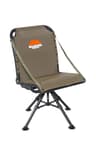
Millennium G400 Ground Blind Chair

Millennium G400 Ground Blind Chair

The pick, on the one feature the rest of the category treats as optional: four independently adjustable legs. A ground blind almost never sits on level ground — it sits on a sidehill, over a root, on a ditch edge — and a chair that cannot be leveled rocks, and a chair that rocks is a chair you move in. Leveling buys stillness, which is the only thing that matters at a deer's eye level.

Best overall
$239.99 · View on Amazon

Price as of October 13, 2026. #ad How we’re funded

2
Hawk Premium Swivel Hunting Blind Chair

Hawk Premium Swivel Hunting Blind Chair

The middle of the category, and the one we would hand to someone buying their first blind chair. It swivels silently, which is the feature that actually kills deer, and it costs well under half the premium chair without giving up the thing that matters. What you give up is leveling on bad ground.

Best value
$111.36 · View on Amazon

$124.9811% off

Price as of October 13, 2026. #ad How we’re funded

3
Guide Gear Huntrite 360 Swivel Hunting Blind Chair

Guide Gear Huntrite 360 Swivel Hunting Blind Chair

The budget swivel, and the only chair on this page that publishes a weight capacity — which is worth noting, because in a category where almost nobody states a number, the cheapest entry is the one that does. It folds, it swivels and it costs under a hundred dollars; it will not level on a sidehill and it is not built for twelve-hour sits.

Best budget
$69.99 · View on Amazon

$79.9913% off

Price as of October 13, 2026. #ad How we’re funded

4
Hawk Big Denali Luxury Blind Chair

Hawk Big Denali Luxury Blind Chair

The extra-large chair, and the pick for a big-framed hunter or an all-day rut sit. A chair that is slightly too small is not a comfort problem, it is a movement problem: you shift, you re-cross your legs, you adjust — and at ground level a deer at 20 yards sees all of it. Buying the wide seat is buying stillness.

Best for all-day sits
$152.00 · View on Amazon

Price as of October 13, 2026. #ad How we’re funded

5
TIDEWE 360 Silent Swivel Ground Blind Chair

TIDEWE 360 Silent Swivel Ground Blind Chair

A direct-to-consumer alternative that puts the silent-swivel claim in the product name and sits between the value and premium chairs on price. It is the same brand as several pieces of heated apparel and safety gear elsewhere in our registry, which is a reasonable basis for buying from them, and the honest caveat is the same as every chair here except one: no published seat height.

Best mid-priced swivel
$129.99 · View on Amazon

Price as of October 13, 2026. #ad How we’re funded

6
ALPS OutdoorZ Tri-Leg Stool

ALPS OutdoorZ Tri-Leg Stool

Not a blind chair, and on this page deliberately. A three-legged stool with a carry strap is what you want when you are moving — a morning on a field edge, a run-and-gun setup, a blind you carry in and out the same day — and it weighs and costs a fraction of everything above. It has no back, no swivel and three legs that sink into soft ground, which is precisely why the chairs exist.

Best packable seat
$26.73 · View on Amazon

Price as of October 13, 2026. #ad How we’re funded

The picks in full

#1Best overall

Millennium G400 Ground Blind Chair

The pick, on the one feature the rest of the category treats as optional: four independently adjustable legs. A ground blind almost never sits on level ground — it sits on a sidehill, over a root, on a ditch edge — and a chair that cannot be leveled rocks, and a chair that rocks is a chair you move in. Leveling buys stillness, which is the only thing that matters at a deer's eye level.

Strengths

  • Four independently adjustable legs level the chair on a sidehill or over a root
  • 360-degree swivel, so you cover every window without standing up
  • The silent-swivel design is the same lineage as the brand's tree seats

Trade-offs

  • The most expensive chair here by a wide margin
  • Heavier and bulkier than a stool — this is a chair you leave in the blind
  • Adjustable legs are one more thing to set in the dark before daylight
Type4-leg ground blind chair, 360 swivel
Leg adjustmentIndependently adjustable (4 legs)
Seat heightAdjustable; retailer spec tables list 16-19 in
CapacityNot published on this listing

Worth knowing. Seat height is the spec to check against your blind's shooting windows before you buy any chair. A chair an inch too low turns a 15-yard shot into a kneel.

Specs read from the product listing, on October 12, 2026. “Not published” means the manufacturer does not state that figure.

#2Best value

Hawk Premium Swivel Hunting Blind Chair

The middle of the category, and the one we would hand to someone buying their first blind chair. It swivels silently, which is the feature that actually kills deer, and it costs well under half the premium chair without giving up the thing that matters. What you give up is leveling on bad ground.

Strengths

  • Silent swivel at roughly half the price of the top pick
  • Established treestand brand rather than a generic import
  • Simple enough to set up in the dark without thinking about it

Trade-offs

  • No independently adjustable legs, so uneven ground stays uneven
  • The listing publishes neither a capacity nor a seat height
  • Mid-size seat — a big-framed hunter should look at the extra-large version
TypeSwivel ground blind chair
SwivelYes
Seat heightNot published
CapacityNot published

Worth knowing. Silence on rotation is the single feature worth paying for in a blind chair. Most of the rest of the spec sheet is comfort.

Specs read from the product listing, on October 12, 2026. “Not published” means the manufacturer does not state that figure.

#3Best budget

Guide Gear Huntrite 360 Swivel Hunting Blind Chair

The budget swivel, and the only chair on this page that publishes a weight capacity — which is worth noting, because in a category where almost nobody states a number, the cheapest entry is the one that does. It folds, it swivels and it costs under a hundred dollars; it will not level on a sidehill and it is not built for twelve-hour sits.

Strengths

  • States a 300 lb capacity, which most chairs here do not publish at all
  • Folds for transport between blinds
  • Cheapest swivel chair here by a clear margin

Trade-offs

  • 300 lb is also the lowest published capacity on this page
  • No leg adjustment, so uneven ground is a problem you live with
  • A lighter build than the Hawk and Millennium chairs for long sits
TypeFolding 360-swivel blind chair
Capacity300 lb
PaddingPadded cushion seat
Seat heightNot published

Worth knowing. A published capacity is also a published limit. Check it against your weight plus a loaded pack, bibs and boots rather than against your weight alone.

Specs read from the product listing, on October 12, 2026. “Not published” means the manufacturer does not state that figure.

#4Best for all-day sits

Hawk Big Denali Luxury Blind Chair

The extra-large chair, and the pick for a big-framed hunter or an all-day rut sit. A chair that is slightly too small is not a comfort problem, it is a movement problem: you shift, you re-cross your legs, you adjust — and at ground level a deer at 20 yards sees all of it. Buying the wide seat is buying stillness.

Strengths

  • Extra-large seat, which is the honest fix for shifting in a chair
  • Silent operation claimed on the listing, like the rest of this brand's line
  • More padding than the value chair for a dawn-to-dusk rut sit

Trade-offs

  • A bigger footprint eats floor space in a one- or two-person blind
  • Heavier to move between blinds than the mid chair
  • No published capacity, seat height or weight on the listing
TypeExtra-large swivel blind chair
Seat sizeExtra large
Seat heightNot published
CapacityNot published

Worth knowing. Measure the floor of your blind before buying the wide chair. A hub blind's usable floor is smaller than its hub-to-hub figure suggests once a chair and a pack are in it.

Specs read from the product listing, on October 12, 2026. “Not published” means the manufacturer does not state that figure.

#5Best mid-priced swivel

TIDEWE 360 Silent Swivel Ground Blind Chair

A direct-to-consumer alternative that puts the silent-swivel claim in the product name and sits between the value and premium chairs on price. It is the same brand as several pieces of heated apparel and safety gear elsewhere in our registry, which is a reasonable basis for buying from them, and the honest caveat is the same as every chair here except one: no published seat height.

Strengths

  • The silent swivel is the headline claim rather than a footnote
  • Priced between the value and premium chairs
  • Same brand as heated apparel and harness gear we already cover

Trade-offs

  • No published seat height, capacity or weight on the listing
  • No leg adjustment for sloped blind floors
  • Sold as the standard size — a big-framed hunter should size up elsewhere
Type360-swivel ground blind chair
SwivelSilent, 360 degrees
SizeStandard
Seat heightNot published

Worth knowing. Every chair here claims a silent swivel. The one test that settles it is turning the chair with your full weight in it, indoors, before the chair ever goes to the woods.

Specs read from the product listing, on October 12, 2026. “Not published” means the manufacturer does not state that figure.

#6Best packable seat

ALPS OutdoorZ Tri-Leg Stool

Not a blind chair, and on this page deliberately. A three-legged stool with a carry strap is what you want when you are moving — a morning on a field edge, a run-and-gun setup, a blind you carry in and out the same day — and it weighs and costs a fraction of everything above. It has no back, no swivel and three legs that sink into soft ground, which is precisely why the chairs exist.

Strengths

  • Packable with a carry strap, which no chair on this page is
  • Cheapest seat here by a wide margin
  • Steel frame and 600D polyester per the listing, in a timber-appropriate pattern

Trade-offs

  • No backrest, which is the thing that makes a long sit possible
  • No swivel — you turn your whole body, which is the movement a deer catches
  • Three legs concentrate your weight and sink in mud and leaf litter
TypeFolding tri-leg stool
FrameSteel
Fabric600D polyester
SwivelNone

Worth knowing. A stool and a blind chair answer different questions. If you sit the same blind all season the stool is a false economy; if you move every sit, the chair never leaves the shed.

Specs read from the product listing, on October 12, 2026. “Not published” means the manufacturer does not state that figure.

What this category publishes, and what it hides

We went looking for the two numbers that decide a blind chair purchase — seat height and weight capacity — and the result is the most useful finding on this page.

ChairSeat heightCapacityLegs
Millennium G400Adjustable (retailer tables list 16–19 in)Not published on the listing4, independently adjustable
Hawk Premium SwivelNot publishedNot publishedFixed
Hawk Big DenaliNot publishedNot publishedFixed
Guide Gear Huntrite 360Not published300 lbFixed, folding
TIDEWE 360 Silent SwivelNot publishedNot publishedFixed
ALPS OutdoorZ Tri-Leg StoolNot publishedNot published3, fixed

One published capacity across six products, and it belongs to the cheapest chair on the page. One adjustable seat height, and it is only readable from retailer specification tables rather than the listing itself. For a category whose entire function is holding a body at a particular height inside a fabric box with windows cut at particular heights, that is a real gap — and it is why every blank row in our spec tables reads “Not published” rather than carrying an estimate.

The practical consequence: measure before you buy. Sit in your blind on a bucket, raise and lower yourself until your bow or muzzle clears the window sill with your shoulders relaxed, and measure that height off the floor. That number is your spec, and it is the one thing about this purchase you can know for certain.

Why leveling is the feature we ranked first

Ground blinds get set where the deer are, which is almost never where the ground is flat. A bench edge, the lip of a ditch, a creek bottom, the uphill side of a logging road — all of them put one or two legs lower than the others, and all of them are exactly the terrain features deer travel.

A chair that rocks on uneven ground does two things, and the second is the one that costs you deer. It is uncomfortable, so you shift. And every shift transfers through three or four legs onto dry leaves, which is a sound at ground level inside 25 yards of an animal whose hearing the NDA describes as covering a range well above our own, with ears that rotate independently to locate a sound. The movement is a visual problem and the rocking is an audible one, and both come from the same failure to sit still.

Four independently adjustable legs fix this directly, and only the top pick has them. Every other chair here asks you to fix it by siting the blind on level ground, scraping the floor flat, or shimming a leg — all of which are things you do once, in the dark, and then live with for the season.

The silent swivel is the feature you will actually use

A hub blind typically gives you three or four shooting windows across something close to a 180-degree arc. Without a swivel, covering the far window means standing up, turning, re-sitting and re-settling — a sequence of large movements at a deer’s eye level. With a swivel, it is a slow rotation with your feet flat.

Which is why a creaking swivel is worse than no swivel at all. If the chair is silent, you will turn it while the deer is in the open and accept the risk. If it squeaks, you will turn it anyway — because you can see the deer and the shot is on the other side — and the noise arrives at the worst possible moment.

Every chair on this page claims a silent or quiet swivel, which means the claim does not discriminate between them. The test that does is simple and should be done indoors: sit in the assembled chair with your full weight and coat on, and rotate it slowly through its whole arc while listening. Do it before the chair ever goes to the woods, and do it again at the start of each season — a swivel that was silent in September is often not silent after a summer in a damp blind.

Seat size, shifting and the long sit

The rut is when ground blinds earn their keep, and a rut sit is long. A chair one size too small does not announce itself as a problem; it produces a slow drip of adjustments — re-crossing your legs, shifting a hip, leaning to one side — and at twenty yards inside a blind, most of those are visible through an open window.

That is the entire case for the extra-large chair over the standard one: not luxury, but the number of times you move in six hours. The counter-argument is floor space. A hub blind’s usable floor is considerably smaller than its hub-to-hub figure suggests once a chair, a pack and a bow are in it, and an oversized chair in a small blind means you brush the walls every time you move — which is its own noise. Our ground blind picks give the published interior figures to check against.

The honest warmth point belongs here too. Sitting still in cold weather is a heat-loss problem, and the CDC and NIOSH guidance is to dress in several loose layers and keep the base layer dry rather than to rely on one heavy garment. A chair that keeps you off the ground helps — conduction into cold earth is real — but it is not a substitute for the clothing. Our layering system guide covers that, and our hand warmer picks cover the extremities a long motionless sit punishes first.

When a stool is the right answer and a chair is not

The ALPS tri-leg stool is on this page deliberately, as the honest alternative rather than a filler pick. If you hunt a blind you carry in and out, or you sit field edges and move between them, a packable stool with a carry strap is correct and a 20-pound chair is not.

Be clear about what you give up. No backrest, which is the single thing that makes a six-hour sit possible. No swivel, so you turn your whole torso — the exact movement a deer is built to catch. And three legs concentrate your weight into three small points, which sink into mud and leaf litter and then shift as they sink. Those three omissions are precisely why the chairs above exist.

The decision rule is simple: if you sit the same blind all season, a stool is a false economy. If you move every sit, a chair never leaves the shed. Our public-land setup covers the mobile case, and our saddle versus tree stand comparison covers the other way hunters solve mobility.

Three things to do before the first sit

Set it up in daylight. Adjustable legs, folding frames and swivel mechanisms are all easy in the yard and all fiddly at 5 a.m. in the dark with gloves on. Level the chair where the blind actually sits, not where it is convenient.

Check the shot from the chair, not from standing. Seated height, window height and the width of your draw are three measurements that have to agree. A compound bow needs clearance for the cams and the limbs, which is more vertical space than a rifle, and finding out that your top cam hits the window frame is a discovery to make in the yard. Our guide to shooting from elevation covers the related form problem, and a seated draw in a tight space is the strongest argument for a rest that holds the arrow on all sides — see our arrow rest picks.

Leave it in the blind if you can. A chair that lives in the blind is a chair whose legs are already set, and that is one fewer thing to do in the dark. If the blind is somewhere a chair will not stay, that is a reason to buy the stool instead of the cheapest chair. Our whitetail season gear checklist puts the blind setup in order with everything else.

What we are not claiming

We have not sat in these chairs, and we are not going to tell you which one is most comfortable — that is a claim you cannot make honestly from a product listing. What is on this page is the design feature set each one publishes, the one capacity figure the category states, and the reasoning about which features matter at a deer’s eye level.

We also cannot tell you how long any of them last. No maker here publishes a service life or a warranty term on the listing, which is a notable contrast with the harness category, where makers do publish replacement intervals because the consequence of failure is different. A chair that fails costs you a sit; it is worth knowing that nobody in this category is making a durability commitment either way.
Frequently asked questions

What should I look for in a ground blind chair?

In order: a silent swivel, the ability to level the chair on uneven ground, a seat height that lets you shoot out of your blind's windows while seated, and a seat big enough that you stop shifting. Comfort features come after those, because at ground level you are at a deer's eye height and the chair's real job is governing how much you move. Note that seat height is the spec this category almost never publishes — measure your own blind's windows before buying.

Do I really need a swivel chair in a ground blind?

If your blind has more than two shooting windows, yes. Without a swivel, covering a window behind you means standing, turning, re-sitting and re-settling — a sequence of large movements inside a fabric box, often within 25 yards of the animal. With a swivel it is a slow rotation with your feet flat on the floor. The caveat is that a creaking swivel is worse than no swivel, because you will use it anyway and the noise arrives at the worst moment.

What seat height do I need for a ground blind?

Whatever height lets your bow or muzzle clear the window sill with your shoulders relaxed, which depends on your blind rather than on a general figure. The practical method is to sit in the blind on a bucket or a stack of something, raise and lower yourself until the shot is comfortable through the window you expect to use, then measure that height off the floor. Only one chair on this page publishes an adjustable range at all, so your own measurement is the specification that matters.

Why does leveling matter for a hunting chair?

Because blinds get placed where deer travel, and that is almost never flat ground — a bench edge, a ditch lip, a creek bottom, the uphill side of a logging road. A chair that rocks is uncomfortable, so you shift; every shift transfers through the legs into dry leaves at ground level, and the movement itself is visible through an open window. Four independently adjustable legs fix it directly. Without them you are leveling by scraping the floor flat or shimming a leg in the dark.

Can a deer hear my chair?

Assume so. The National Deer Association's summary of deer hearing describes a frequency range extending well above the human ceiling, with best sensitivity in the band deer vocalizations fall in, and ears that rotate independently to locate a sound. A squeaking swivel or a rocking leg on leaf litter inside 25 yards is exactly the kind of sound that gets located. Test the swivel indoors with your full weight and coat on, through its whole arc, before the chair ever goes to the woods.

Is a hunting stool good enough instead of a chair?

For mobile hunting, yes; for sitting the same blind all season, no. A packable tri-leg stool with a carry strap is the right tool if you carry your setup in and out or move between field edges, and it costs a fraction of a chair. What you give up is the backrest that makes a six-hour sit possible, the swivel that lets you turn without moving your torso, and stability — three legs concentrate your weight into three points that sink into mud and leaf litter and then shift as they sink.

Will a bigger chair fit in my ground blind?

Check the blind's published interior figures rather than its hub-to-hub width, because the usable floor is considerably smaller once a chair, a pack and a bow are inside. An oversized chair in a small blind means brushing the walls every time you move, which creates its own noise and defeats the purpose of buying the wide seat. The case for the extra-large chair is fewer adjustments over a long rut sit; the case against it is floor space.

How much weight can a hunting blind chair hold?

Most do not say, which is the honest answer. Of the six seats on this page, exactly one publishes a weight capacity — 300 pounds, on the cheapest swivel chair — and that is also the lowest figure here. When a chair does state a capacity, check it against your weight plus a loaded pack, bibs and boots rather than your weight alone. When it does not, that is a gap in the maker's disclosure rather than a reassurance.

Sources

Keep reading