Hunting boots · Head to head
Hunting Boots vs Hiking Boots
Whether the boots already in your closet will do for deer season. Four differences decide it — and for one style of hunting, the hiking boots are honestly the better tool.
How this is funded:we earn a commission if you buy through our links, at no extra cost to you. It never changes which product we recommend, and we’ll tell you plainly when to skip one. Full disclosure.
Almost every new deer hunter asks this, usually while looking at a perfectly good pair of hiking boots and a hunting-boot price tag. The honest answer is that hiking boots will do for some deer hunting and will genuinely ruin other deer hunting, and which one depends on a single question: how much of your hunt is walking, and how much is sitting still?
Everything below follows from that. Hiking boots are built for a person who is generating heat by moving. Hunting boots are built for a person who walks a short distance and then stops producing heat entirely for four hours. Those are different engineering problems.
Insulated rubber hunting boot
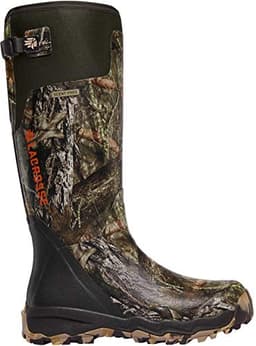
LaCrosse Alphaburly Pro 18"
Scent-conscious whitetail hunting in wet ground
- Height
- 18"
- Material
- Waterproof rubber over neoprene
- Insulation
- Choose 0-1,600 g by model
Price as of October 3, 2026. #ad How we’re funded
Lighter leather hunting boot
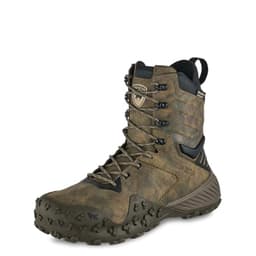
Irish Setter VaprTrek 8"
Early season and hunters who cover ground
- Height
- 8"
- Material
- Leather + nylon, waterproof
- Insulation
- Light / uninsulated (by model)
Price as of October 3, 2026. #ad How we’re funded
Difference 1: Scent
This is the one hiking boots cannot solve. Deer navigate the world primarily by smell, and ground scent is real — a deer that crosses the trail you walked in on can tell a human was there. Leather, fabric, foam and mesh all hold and slowly release human odor. Rubber holds much less of it, which is exactly why the whitetail default is a rubber boot.
Keep the size of the effect honest, though. Boots are one input among many, and wind direction beats all of them. A hunter in perfect rubber boots hunting the wrong wind is busted; a hunter in hiking boots playing the wind correctly usually is not. Treat rubber as a way to reduce one avoidable signal, not as a cloak.
Difference 2: Insulation
Hunting boots publish an insulation figure in grams. Hiking boots usually do not, because most carry none — they are designed to shed heat from a person walking uphill, not retain it for a person sitting motionless in a tree.
That is the whole ball game for stand hunting. Federal cold-safety guidance is consistent on the mechanism: extremities lose heat fastest, and staying still in the cold is what puts you at risk. When your feet get cold at 8 a.m. you do not tough it out, you climb down, and the hunt is over. Our insulation gram guide matches weights to conditions properly.
Difference 3: Height
Hiking boots are ankle or mid height. Hunting boots are commonly 16 to 18 inches. That is about mud, standing water, creek crossings, wet grass at dawn and, in some country, snakes. Wet feet in cold weather are not a comfort problem, they are the fastest route to a ruined sit — water conducts heat away from you far faster than air does.
If your access route is dry and your ground is dry, this difference does not apply to you. If you cross a ditch to get to your stand, it applies enormously.
Difference 4: Sole and quiet
Hiking soles are built for grip on rock and durability over hundreds of miles, with aggressive lugs and stiff midsoles. Hunting soles trade some of that away for quiet and for feel — softer compounds and less aggressive tread make less noise on leaves and let you feel a stick before you snap it.
This is the smallest of the four differences and the one hiking boots lose least on. A hiking boot walked slowly is fine. A hiking boot walked fast on frosty leaves is loud, but so is every boot.
When hiking boots are genuinely the better choice
There is a real case for them, and hunting-boot marketing never makes it. Hiking boots are the better tool when:
- You are scouting, not hunting. Summer and early-autumn scouting is walking, often a lot of it, at a time of year when scent management matters less because you are deliberately not hunting that ground yet.
- Early season, warm weather. An insulated rubber boot in 60°F is a sweat box, and sweaty feet are cold feet later. A ventilated hiking boot is genuinely better.
- You still-hunt or spot-and-stalk. If you are covering ground all day rather than sitting, weight and comfort dominate, and a mile in a heavy rubber boot beats you up for no return.
- Long, steep walk-ins. Hiking boots support the ankle over rough ground better than most rubber boots, which matters when you are carrying a stand or a pack.
The setup most whitetail hunters land on
Two pairs, used for two jobs. A light pair — hiking boots or a lightweight leather hunting boot — for scouting, hanging stands, early season and any hunt that involves real distance. An insulated rubber pair for cold, wet, sit-still hunting from October onward.
If you can only buy one and you are a stand hunter, buy the insulated rubber boot. Carrying a heavier boot for a ten-minute walk is a minor annoyance; sitting through the best hour of the rut with numb feet is how you end up climbing down early. And whichever boot you wear, the cheapest upgrade is not the boot at all — it is a merino sock and a dry spare pair in your pack.
Frequently asked questions
Can you use hiking boots for deer hunting?
Yes, for early-season hunting where you walk a lot and sit briefly. Hiking boots are lighter, more comfortable over distance and better ventilated than most hunting boots. What they cannot do is keep you warm sitting still in cold weather, and their leather and fabric uppers hold human scent in a way rubber does not.
What is the real difference between hunting boots and hiking boots?
Four things: hunting boots are commonly rubber or rubber-clad to reduce scent transfer, they carry insulation measured in grams for sitting still, they are usually taller to handle mud and water, and their soles are built for quiet and grip rather than for miles of trail. Hiking boots optimize the opposite set: light weight, breathability and long-distance comfort.
Do deer really smell your boots?
Deer live and die by their nose, and ground scent is real — a deer crossing your trail can tell you were there. A leather-and-fabric hiking boot holds and releases more human scent than a rubber boot does. That said, playing the wind matters far more than what your boots are made of, and no boot makes you scent-free.
Are hiking boots warm enough for deer season?
For walking, yes. For sitting still, generally not. Most hiking boots carry little or no insulation because they are designed for a person generating body heat by moving. A hunter sitting motionless for four hours in the cold is doing the opposite, and that is the situation insulated hunting boots exist for.
Do I need two pairs of boots for hunting?
Many whitetail hunters end up with two: a light pair for scouting, early season and long walks, and an insulated rubber pair for cold stand sits and wet ground. If you can only buy one and you sit more than you walk, buy the insulated rubber boot — the discomfort of a heavy boot on the walk in beats the misery of cold feet at the stand.
What about wearing hiking boots in and changing at the stand?
It works well and plenty of hunters do it. You walk in comfortably and dry in the hiking boots, then swap into insulated boots at the base of the tree. The cost is carrying the second pair, and you should carry a dry sock change at the same time — that combination does more for warm feet than any single boot.
Sources
- CDC / NIOSH — Cold Stress: Cold and Work — Federal cold-safety guidance: dress in several loose layers, keep the base layer dry, and protect the extremities (accessed July 22, 2026)
- 3M — Thinsulate Insulation — Manufacturer reference on Thinsulate synthetic insulation and gram weights (accessed July 22, 2026)
- National Deer Association — Understanding Deer Senses (Dr. Gino D'Angelo) — NDA research summary on the three senses that keep a deer alive — sight, hearing, and, above all, smell (accessed July 22, 2026)
Keep reading
Rubber vs leather hunting boots
The same trade-off inside the hunting-boot category — scent control against comfort over miles.
Compare the twoBest deer hunting boots
Our picks across rubber, leather and insulation weights.
See the picksHow many grams of insulation do you need?
The number hiking boots do not have, and how to match it to your season.
See the chartBest hunting socks
Whichever boot you wear, the sock inside it decides more than you would think.
See the sock picks