What this category publishes, and what it hides
We went looking for the two numbers that should decide a quiver purchase — weight and arrow capacity — across all six listings. The result is the most useful table on this page.
| Quiver | Arrow capacity | Weight | Detaches | Hood claim |
|---|
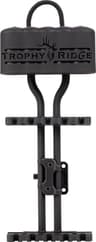
| Trophy Ridge Convoy | Not published | Not published | Yes — detach mount | Silent soft-touch |
| Trophy Ridge 5-Spot | 5 | Not published | Not published | None stated |
| Treelimb Standard 5 | 5 | Not published | Yes — quick detach | Broadhead capture system |
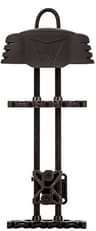
| Trophy Ridge VRSA Light | Not published | Not published | Yes — cam locking | None stated |
| LimbSaver Silent Quiver | Not published | Not published | No — one piece | None stated |
| SAS Compact 4-Arrow | 4 | Not published | Yes — quick release | None stated |
Six products, zero weights, two of six publishing a hood claim, and two of six leaving the arrow count to a product photo. Worth noting that this is not a failure of regulation: bowhunting equipment standards do exist — the Pope & Young Club publishes equipment definitions including a 300-grain minimum arrow weight — and none of them has anything to say about a quiver. Nobody is required to publish anything here, and mostly nobody does.
Capacity: five is the number, and four is a real option
Five arrows is the sweet spot for whitetail hunting, and the reasoning is not about how many deer you expect to shoot. It is that one arrow is in the bow or gone, one gets damaged in a target or lost under leaves, and you want enough left to finish a sit without feeling like each one is precious. Five loaded broadheads is also about as much weight as most hunters want hanging off one side of a riser.
Four is the right answer in two situations. The first is a ground blind, where a five-arrow quiver is longer and finds the window frame on the swing — the same clearance problem we cover for a crossbow in a stand, which is entirely a width-and-length argument. The second is a crossbow, where a compact four-arrow quiver is the normal fitment.
Six-arrow quivers exist and we do not recommend one for deer hunting. The extra arrow is of no use and the extra length is the longest part of your bow catching the most branches.
The hood is the safety spec, and it is the one to check by hand
A hunting quiver hood has two jobs: cover the cutting edges completely, and hold them still. Two of the six listings here make an explicit claim about it — Trophy Ridge’s silent soft-touch hood on the Convoy, and Treelimb’s broadhead capture system — and the other four leave you to judge from the photograph.
What to check on whatever you buy, in your hands, with your own broadheads mounted:
- Does the hood fully enclose the blades at the depth your arrows sit? A hood sized for a 100-grain mechanical can leave a wide fixed head proud of the lip.
- Does the head stop moving once it is seated? A broadhead that can rotate inside the foam is a broadhead that will dull itself against the next one.
- Can you draw one arrow out without touching the other four? This is the test the whole purchase comes down to, and it is also the noise test.
- Does the hood foam hold the head or just shroud it? Some hoods are a cover; the better ones capture. That is what Treelimb is naming.
Our broadhead comparison covers which heads are wide enough to make this a real consideration, and fixed versus mechanical covers the profile difference that decides how your hood needs to be shaped.
Detach or don’t: the decision that actually separates these quivers
This is the real fork in the category, and both answers are defensible.
Take it off. A quiver removed and hung on a hook takes five arrows of mass off one side of the bow, which is the single biggest balance change available to a hunting bow, and it removes the widest thing on your rig from the branches you lean around. The cost is a transition: you are handling the bow and the quiver in a tree, and the arrow you need is now an arm’s reach away rather than in your hand. A quiver with a published hanging loop — the Convoy has one — is the version of this that does not end with your quiver in the leaf litter.
Leave it on. A fixed quiver is one fewer thing to do in the dark, and your spare arrows stay exactly where your hand expects them. If you shoot your bow with the quiver mounted all summer, your sight is tuned to the bow as it is actually balanced — and that is an underrated argument. The cost is permanent width and permanent asymmetry.
The mistake to avoid is mixing them: practicing all year with the quiver on and then hunting with it off, or the reverse. A loaded quiver changes how the bow sits in your hand and therefore where the pin settles. Whichever way you hunt, shoot that way. Our sighting-in guide covers the confirmation step that catches this.
Noise: the quiver is on the short list of culprits
When a bow makes a sound on the draw, the arrow against the rest is the usual suspect and the quiver is the second. Two mechanisms: the arrow you are drawing scraping its vanes past the hood or past the other arrows, and the loaded quiver itself buzzing on the shot because the bracket has worked loose over a season.
Both are fixable and only one of them is a purchase. Tighten every quiver fastener before season — it is a two-minute job and it is the most commonly skipped one. Then do the draw test properly: have somebody else draw the bow while you stand a few yards away in a quiet place, because you cannot hear your own draw. Our full walkthrough is in how to quiet your bow, which treats the quiver, the rest and the accessories as three separate problems in the order they cost you deer.
The light, and whether it is worth the premium
The VRSA Light is the only quiver on this page with a built-in rechargeable LED, and it costs roughly three times the budget pick. Our honest read: the light is genuinely useful at the two moments it is designed for — nocking an arrow before legal light and finding something you dropped at dark — because it puts a small amount of light exactly where your hands are without pointing a headlamp into the woods. Deer lack the long-wavelength cone that lets us distinguish red, which is why a red headlamp mode is the conventional low-impact choice; the LED on this quiver is not published as red, so treat it as a task light to use sparingly rather than a stealth feature.
Also worth knowing before you spend the money: the listing publishes no battery capacity and no runtime for the LED. The adjustable length and customizable grippers are the stronger argument for this quiver, and they are the ones a hunter with an unusual arrow and fletching combination will feel every time they load it.
How we picked, and what we did not do
We own none of these quivers and have not shot with any of them. Every specification above was read from the live product listing on October 19, 2026, and anything the listing does not state is recorded as not published rather than estimated. The ranking is editorial: it weights the features that bear on the four jobs at the top of this page, in that order, and it penalizes non-disclosure — a quiver that publishes a hood claim and a detach mechanism beats one that publishes neither, other things being equal.
There is one more honest disclosure to make. Three of these six picks are Trophy Ridge. That is not a sponsorship and it is not laziness; it is what the volume end of this category looks like, and the same pattern showed up when we ranked arrow rests. We would rather say so than pad the list with a brand we have no reason to recommend.
What to buy with it
A quiver purchase is usually part of finishing a bow rather than a standalone decision. The two things most often bought at the same time are a stabilizer, because a loaded quiver is exactly the kind of asymmetric mass a side bar exists to answer, and arrows, because the capacity you just bought wants filling with five matched shafts rather than four survivors and a borrowed one. If the bow is new, our bow hunting gear list sets the whole kit out in the order it matters.