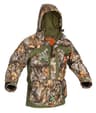
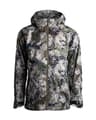
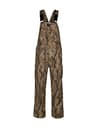
What KUIU is actually selling, in three specifications
Read the two product pages above and the brand’s proposition is not a camo pattern and it is not brand loyalty. It is three numbers.
- Warmth per ounce. 850+ fill power is a high figure for down, and a 14.8-ounce hooded down jacket is a light garment for one described as handling cold-to-freezing conditions. Fill power measures how much volume a given weight of down occupies, which is to say how much heat it traps per gram carried. That is a mountain-hunting specification: it matters most to someone carrying the jacket uphill and putting it on when they stop.
- Packability.“Self-stows in left-hand pocket” is the feature that follows from the first one. A jacket you can compress into its own pocket is a jacket you will actually carry on a walk-in rather than leave in the truck.
- Movement under load.The Attack Pant’s 247 g/m² 4-way-stretch fabric and articulated knees are a hiking-and-climbing specification, not a sitting-still one.
All three are the specifications of a hunter who walks. If you are a whitetail hunter who drives to a property, walks four hundred yards and sits in a tree for five hours, none of those three numbers is the thing that will decide whether you are comfortable — warmth at rest and silence are, and neither is a weight figure. That is the most useful thing on this page, and it is why our first pick is a heavier parka rather than a lighter one.
The spec gap, and it runs entirely one way
Here is the honest counterweight, because an alternatives page that only lists cheaper things is a sales sheet. Not one garment in our clothing registry publishes a weight. Not one publishes a fill power or an insulation figure in grams. Not one publishes a fabric weight in g/m². KUIU publishes all four. That is a real difference in what you can know before you buy, and no amount of price advantage closes it.
What our picks publish instead is prose. “RETAIN heat-reflective lining”. “Retain Active breathable heat retention”. “Bonded sherpa fleece”. “Quiet brushed tricot”. Those are descriptions of warmth and fabric, and not one of them is a number you could rank against another brand. The King’s Camo XKG Windstorm does not publish a waterproof rating or its construction; our card for it says “Not published” on both rows, because that is what the listing gives us.
So the trade is not quality for price. It is measurability for price. If you need to know that a jacket weighs 14.8 ounces because you are carrying it nine miles into a wilderness unit, pay the premium and buy the brand that tells you. If you need a warm, quiet, waterproof layer for a November stand sit, the figure does not exist for either garment and you are choosing on description either way — at which point there is no case for paying several times as much.
The reason people search for this, and it is not only price
Google’s own autocomplete for this brand returns “is kuiu sold in stores”, “where to buy kuiu” and “kuiu retailers near me” alongside the alternatives queries. That is a meaningful signal. KUIU is a direct-to-consumer brand: you order it, you wait for it, and if the fit is wrong you ship it back. There is no rack to try the pant on, and that is a genuine problem for a garment whose published sizing is three inseams with no waist sizes listed on the page.
Every pick on this page is something you can have in a few days with a normal returns process, which is a real advantage on three days’ notice before a cold front. It is the same finding our Mystery Ranch alternatives pageran into from the other direction, where the premium original’s own page could not say when the pack would be back in stock.
It is also worth saying plainly that buying the premium brand is not a mistake. If you hunt the mountain West on foot, carry your insulation, and need a garment whose weight and fill power you can plan a load around, that is exactly the buyer KUIU builds for and our registry does not serve them well. This page is for the other hunter.
Spend the difference on layers, not on one jacket
The practical recommendation that falls out of all of this: a premium down jacket replaced with one of our picks leaves enough budget for a complete layering system, and a complete system beats one excellent garment for a hunter who sits still.
Federal cold-safety guidance is blunt about why — dress in several loose layers and keep the base layer dry. A single very good outer layer does nothing about the sweat you generated on the walk in, and damp base layers are the most common reason a well-dressed hunter is cold by nine in the morning. That is the argument for putting real money into merino against the skin, which is why the merino base layer is on this page at all, and why our layering guide treats the base layer as the decision and the shell as the consequence. Wool also wants a gentler wash than a shell does, which our scent-free detergent comparison covers — and only one product in that whole category publishes what it is safe on.
A sensible build from this page: the merino crew, a fleece mid layer, an insulated parka over the top, and a waterproof shell in the pack. That is four garments covering early season through January, and it is a more capable kit than any single premium jacket. Add insulated bibs if your cold comes up through the seat, which for stand hunters it usually does.
What this page is not
It is not a silence comparison. If the reason you are looking at premium whitetail clothing is that your current jacket rustles when you raise a bow, that is a different specification and a different page — our Sitka alternatives pagetakes that one on, anchored on a brand that publishes a price and sells its whitetail line specifically on being quiet. Deer hearing is why it matters, and the National Deer Association’s summary of the research is the best neutral account of it.
It is not a pant roundup either, and we are going to be straight about the hole in our own registry: we do not stock a hunting pant. The closest thing we have to the Attack Pant is an uninsulated bib overall, which is a genuinely useful early-season and layering garment and is not a stretch-nylon hiking trouser. If a pant is specifically what you came for, that is one where the premium brand has us beaten on availability as well as on specs.
And it is not a claim about durability. We have worn none of these garments and neither brand publishes an abrasion figure you could compare — KUIU states its pant is “Abrasion Resistant” without a number, and our picks do not state it at all. Anyone telling you how many seasons either will last is guessing.