Trail Cameras · Review
Tactacam Reveal Pro 4.0 Review
Our pick for cellular scouting, and the reason is a flash switch rather than a megapixel count. Compiled from published specs and an independent lab's measurements - not a paid field test.
How this is funded:we earn a commission if you buy through our links, at no extra cost to you. It never changes which product we recommend, and we’ll tell you plainly when to skip one. Full disclosure.
Buy the Tactacam Reveal Pro 4.0 if you want trail-camera photos on your phone and you do not want to think about carriers, flash types or aiming. The feature that earns the money is the selectable flash — no-glow or low-glow, your choice, per set — and it has nothing to do with the 4K on the front of the box. It is our overall pick in the cellular category, and the reason is that it removes two decisions a hunter usually has to get right at purchase time and can never change afterwards.
This is a specification review, not a field test. We do not own a Reveal Pro 4.0 and we have not run one on a property. Everything below is read from Tactacam’s published material and the live listing, verified on October 26, 2026, plus the measured figures published by Trailcampro, an independent test lab that puts cameras on a bench and publishes its own numbers rather than repeating the maker’s. Where a figure is not published, we say so instead of filling it in — and on this camera the most important missing figure is one the lab supplies for us.
Our overall pick for cellular scouting
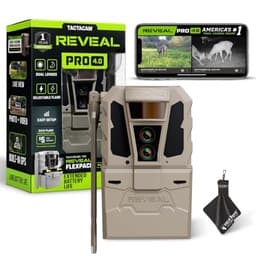
Tactacam Reveal Pro 4.0
Cellular scouting on any carrier
- Connectivity
- Cellular (multi-carrier LTE, auto-carrier selection)
- Flash
- Selectable no-glow (80 ft) or low-glow (96 ft) infrared
- Ongoing cost
- Data plan required; no activation fee
Price as of November 12, 2026. #ad How we’re funded
What the Reveal Pro 4.0 publishes
| Spec | Published figure |
|---|---|
| Connectivity | Cellular LTE, multi-carrier with auto-carrier selection |
| Flash | Selectable: no-glow to 80 ft, or low-glow to 96 ft |
| Photo | 4K (recorded by the test lab as interpolated) |
| Video | 1080p |
| Storage | 8 GB built in; SD card to 32 GB, U3 Class 10, 90 MB/s |
| Power | 12 AA batteries (not included); external battery or solar optional |
| Extras | Built-in GPS; side LCD for aiming; dual sensors |
| Dimensions | 4 in x 3.5 in x 5.25 in |
| Recovery time | Not published by Tactacam — measured at 11.0 s (see below) |
The flash switch is the actual upgrade
Every other decision on a trail camera can be revisited. You can move the camera, change the card, swap the batteries, change the plan. The one thing you cannot change after you buy is the flash, and until recently you chose at the checkout: no-glow for invisibility, low-glow for reach.
This camera lets you set it per location, and that matters because the right answer genuinely differs by set. On a bedding-edge trail or anywhere a camera could walk off, no-glow is the answer: it emits no visible light at all, published out to 80 feet. On a wide field edge or a food plot where 80 feet of illumination leaves your subject in the dark, low-glow buys you a published 96 feet in exchange for a faint red shimmer at the lens that a person looking straight at it will see.
Worth being precise about what the deer sees, because this is the question everyone asks. Published research on whitetail vision indicates deer lack the long-wavelength cone that lets humans distinguish red, which is why red is the conventional low-impact choice for headlamps and for camera flashes. That is not the same as invisible, and it does not mean a low-glow emitter is undetectable at close range — it means the risk is lower, and that the bigger risk at a low-glow set is usually a person rather than a deer. Our no-glow versus low-glow comparison works through both sides.
The number Tactacam does not publish, and the lab does
Here is the most useful finding in this review. Trailcampro measured a trigger-and-recovery range of 0.4 to 11.0 seconds for pictures. That is a fast trigger and a slow recovery. The trigger — roughly 0.4 seconds from detection to shutter — is quick enough to catch a deer crossing a trail at a walk. The recovery — up to 11 seconds before the camera can fire again — is the figure that decides whether you get one photograph of a group of does or three.
Tactacam does not publish a recovery time. Retailer listings quote trigger speeds of 0.2 seconds and 0.35 seconds without saying how either was obtained. We are citing the lab because it publishes a method and its own measurements, and because an 11-second recovery is exactly the sort of thing a spec sheet is designed not to mention. The same lab measured detection at 80 feet with a 35.5-degree detection angle inside a 56.9-degree field of view, and a transmission time of 41.3 seconds per image.
What to do about it, practically: set this camera where deer pass through rather than where they linger, and if you specifically want to count a group, set it over a scrape or a feeder where the animals stay put long enough for the second frame. Our guide to trigger speed and detection range covers how those two numbers interact, and reading your photoscovers what to do with what you get. The National Deer Association’s own work on patterning deer from camera data is built on travel-route photographs rather than on burst sequences, which is a reminder that one good frame at the right time of day is worth more than three of the same deer.
4K, interpolated — and why it does not matter much
The lab records the 4K photo resolution as interpolated: the files come out at 4K dimensions but the sensor is not capturing that much detail. Video is a plain 1080p. We are flagging it because the box does not, not because it is a reason to avoid the camera — nearly every cellular camera in this class advertises resolution the same way, and the image that actually reaches your phone has been compressed for transmission regardless.
The specs that determine whether you can identify a buck at night are the flash range and the sensor’s low-light behavior, not the pixel count. Judge this camera, and every camera in our cellular roundup, on the flash.
Card and batteries: two cheap ways to get this wrong
The published card ceiling is 32 GB, specified as U3 Class 10 at 90 MB/s. That 32 GB figure is not arbitrary: the SD Association’s own capacity tiers put SDHC at up to 32 GB formatted FAT32, with SDXC starting above it on exFAT. A camera that specifies 32 GB wants an SDHC card, and dropping a cheap 128 GB card into it is the single most common cause of a trail camera that “stopped working.” Buy the card the camera asks for — our SD card picks are sorted by exactly this constraint.
Power is 12 AA cells, not included, and this is where a cellular camera quietly costs you money. The lab’s 12.4-month stills figure and 4.4-month video figure were both measured on lithium AA cells at 15 day and 15 night captures per day. Lithium is not a luxury here: Energizer publishes an operating range down to -40 °C for its lithium AA against -18 °C for the alkaline equivalent, along with a lower weight and a far longer shelf life. On a camera that is going to sit out through a Midwest January, that difference is the whole reason the camera is still reporting in February. Our battery and power roundup covers the external pack and solar options too, which is the better answer for a camera you do not want to visit.
GPS, the LCD, and the two features that are quietly the best part
Two things on this camera get no marketing attention and both earn their place.
The side LCD. Aiming a trail camera is normally a two-person job or a guessing game: you strap it to a tree, walk in front of it, check the card at home, come back and adjust. A screen on the camera turns that into thirty seconds on the tree, which means your cameras are actually pointed where you think they are. It is the most underappreciated feature in the category.
Built-in GPS. Its real value is not navigation, it is theft. A cellular camera on public land or a leased property is a $150-plus device hanging on a tree in the open, and a camera that reports its own position after it is removed is a camera with a chance of coming home. It does not replace a lock or a box — see our theft-prevention guidefor the hardware — but it is the only feature here that works after the camera is gone.
The plan is the purchase
Everything above is about the box, and the box is the cheaper half. A cellular camera is a subscription with a camera attached, and the tier matters more than the headline rate: entry-level plans transmit a limited number of images a month, and the features people buy cellular for — Live View, on-demand photos — sit on higher tiers.
We deliberately do not print plan prices on this site, because they change and a stale number is worse than no number. What we will tell you is the method: work out how many photographs your spot will realistically generate in a month — a food plot in October generates several times what a bedding-edge trail does — then price the tier that covers that, times the months you will actually run it, and compare the annual option against the monthly one. Our cellular subscription cost breakdown does that arithmetic properly, including the case for running one cellular camera alongside several no-subscription cameras rather than putting everything on a plan.
Who should buy something else
Three honest cases where this is the wrong camera.
- You check cameras anyway. If your property is small enough that you walk it weekly, you are paying a monthly fee to avoid a walk you are going to take. An SD-card camera costs nothing to run and our no-subscription picks are better value for that hunter.
- You want burst sequences of groups. An 11-second measured recovery is the wrong tool for counting a doe group as it files past. That is a video-mode or fast-recovery problem.
- Your budget is the binding constraint. The camera plus a plan plus twelve lithium AAs plus a card is a real number. If it is more than you want to spend, our budget camera picks will get you photographs for a fraction of it, and our budget gear guide argues that a camera is rarely the first thing worth upgrading.
The verdict
The Reveal Pro 4.0 is the cellular camera we point most deer hunters at, and the reason is that it removes the two decisions people most often get wrong: which carrier covers the property, and which flash they will wish they had bought. Auto-carrier selection handles the first and the flash switch handles the second. Add a side screen that makes aiming it a one-person job and GPS that works after the camera is stolen, and the package is coherent in a way that spec sheets do not capture.
The things to go in knowing: the recovery time between stills was measured at up to 11 seconds and Tactacam does not publish it; the 4K is interpolated; the card ceiling is 32 GB and not negotiable; the twelve AA cells should be lithium; and the plan, not the camera, is what you are really buying. None of those is a reason not to buy it. All of them are things we would want to know first.
General guidance, not legal or safety advice. Hunting regulations vary by state and change every year — always verify seasons, legal equipment and requirements with your own state wildlife agency before you hunt. Wear a full-body harness and stay attached to the tree from the ground up whenever your feet leave the ground.
Frequently asked questions
Is the Tactacam Reveal Pro 4.0 a good trail camera for deer hunting?
Yes, and it is our overall pick for cellular scouting. The feature that earns that is the selectable flash: you choose no-glow out to a published 80 feet to stay invisible, or low-glow out to a published 96 feet when you need the reach, instead of buying one and living with it. Add auto-carrier selection so you are not guessing which network covers your property, built-in GPS, and a side screen that makes aiming it a one-person job. The honest caveat is the recovery time - an independent lab measured 11.0 seconds between stills - and the fact that the camera is the cheaper half of what you will spend.
How fast is the Reveal Pro 4.0's trigger?
Trailcampro, an independent test lab, measured a trigger-and-recovery range of 0.4 to 11.0 seconds for pictures and 0.81 to 5.2 seconds for videos. Read that as a roughly 0.4-second trigger and an 11-second recovery between stills: fast enough to catch a deer walking past, slow enough that you will get one frame of a group rather than three. Tactacam does not publish a recovery figure itself, and retailer listings quote trigger speeds between 0.2 and 0.35 seconds without saying how they were obtained, which is why we are citing a lab that publishes its own numbers.
What does 'selectable flash' mean on a Reveal camera, and which should I use?
It means one camera does the job of two. No-glow infrared emits no visible light at all - invisible to deer and to anyone walking your property - at the cost of range and some image brightness, published here at 80 feet. Low-glow emits a faint red shimmer at the lens, visible if someone is looking straight at it, in exchange for more reach, published at 96 feet. For a bedding-area or trail set where a spooked deer or a stolen camera is the risk, pick no-glow. For a wide field edge or a food plot where 80 feet is not enough, pick low-glow. Our no-glow versus low-glow comparison works through the trade in detail.
Does the Reveal Pro 4.0 really shoot 4K?
It produces 4K-sized files, and the independent lab that tested it records the 4K photo resolution as interpolated - meaning the sensor output is scaled up to those dimensions rather than captured at them. Video is a straightforward 1080p. That is not a scandal and it is not unique to Tactacam; it is how most of this category advertises resolution. The practical consequence is that you should judge a cellular camera on its night-time image quality and flash range rather than on its headline megapixels, because the file you actually look at arrives on your phone compressed anyway.
What SD card and batteries does the Reveal Pro 4.0 take?
It carries 8 GB of built-in storage and accepts an SD card up to 32 GB, specified as U3 Class 10 with 90 MB/s. A 32 GB ceiling means an SDHC card formatted FAT32 - the SD Association's own capacity tiers put SDHC at up to 32 GB and SDXC above it - so a 64 GB or larger card is the wrong purchase no matter how cheap it is. Power is 12 AA batteries, not included. The same lab measured 12.4 months of battery life on a stills setup of 15 day and 15 night photos a day using lithium AA cells, and 4.4 months on the same schedule shooting video.
Is the subscription worth it, and what does it cost?
We do not quote plan prices on this site, because they change and a stale number is worse than no number - check them on Tactacam's own plan page before you buy. What matters structurally is this: with a cellular camera the plan is the real cost, not the box, and the tier matters more than the headline rate. Basic tiers transmit a limited number of images per month; features like Live View and on-demand photos sit on a higher tier. Work out how many photos your spot will realistically generate, then price the tier that covers it - our cellular subscription-cost breakdown walks through that arithmetic.
Sources
- Trailcampro — Tactacam Reveal Pro 4.0 Solar Trail Camera Combo (Cellular) test report — An independent retailer-run test lab publishing its OWN measurements rather than the maker's claims. Measured: trigger-and-recovery speed for pictures 0.4 s to 11.0 s; trigger-and-recovery for videos 0.81 s to 5.2 s; detection range 80 ft at a 35.5-degree detection angle with a 56.9-degree field of view; transmission speed 41.3 s; battery life 12.4 months on pictures and 4.4 months on videos, both at 15 daytime plus 15 nighttime captures per day on Energizer Ultimate Lithium AA cells; resting power consumption 0.79 mW. Manufacturer-claimed figures recorded alongside: 4K photo (interpolated), 1080p video, 12 AA batteries, 8 GB built-in storage expandable to a 32 GB U3 Class 10 card, selectable red-glow or no-glow flash, 4 in x 3.5 in x 5.25 in. The lab marks its overall scoring for this model as still in progress (accessed October 26, 2026)
- National Deer Association — Find Next Season's Buck in Last Season's Trail-Cam Photos — NDA on reading trail-camera data to pattern deer movement and bedding-to-food travel (accessed July 22, 2026)
- SD Association — Capacity (SD / SDHC / SDXC / SDUC) — The standards body's own capacity table: SD up to 2GB (FAT12/16), SDHC more than 2GB up to 32GB (FAT32), SDXC more than 32GB up to 2TB (exFAT), SDUC above that (accessed August 22, 2026)
- Energizer — L91 Ultimate Lithium AA Product Datasheet — Manufacturer datasheet: operating temperature -40C to 60C (-40F to 140F), typical weight 15 grams, shelf life 25 years at 21C (accessed August 22, 2026)
- National Deer Association — The Hunter's Guide to Deer Vision — Deer lack the long-wavelength (red) cone, so they cannot distinguish red or orange from green; they lack a UV filter and carry more rods than humans, which is why they see so well at last light (accessed August 19, 2026)
Keep reading
Best Cellular Trail Cameras
Where the Reveal Pro 4.0 sits against SPYPOINT, Moultrie and Stealth Cam on connectivity and flash.
See the cellular picksCellular Trail Camera Subscription Costs
The half of this purchase that is not on the box - how to size a plan tier to the spot you are watching.
Work out the plan costNo-Glow vs Low-Glow Trail Cameras
The switch this camera gives you, and how to decide which side of it each of your sets belongs on.
Compare the flash typesTactacam Reveal vs SPYPOINT Flex
The two cellular lines deer hunters ask about most, compared on cost, connectivity and who each suits.
Compare the brands