Bows · Sights
Single Pin vs Multi Pin Bow Sight: The Whitetail Answer
A single pin gives you the cleanest sight picture in archery and asks you to predict the future. A multi-pin sight clutters the view and never asks you for anything. For stand hunting whitetails, one of those trade-offs is much easier to live with.
How this is funded:we earn a commission if you buy through our links, at no extra cost to you. It never changes which product we recommend, and we’ll tell you plainly when to skip one. Full disclosure.
For stand hunting whitetails, buy a fixed multi-pin sight — and sight in three pins rather than five. That is not an argument that a single pin is less accurate. It is more accurate, in the sense that matters on a target range. It is an argument that the thing a whitetail hunter lacks is not precision, it is warning.
The whole comparison comes down to one asymmetry. A multi-pin sight is ready for every distance in your effective range at all times and never asks you to do anything. A single pin is ready for exactly one distance — whichever one you last dialed — and is superb at that distance and awkward everywhere else. Which of those you want depends almost entirely on whether you get to choose when the shot happens.
What a single pin actually buys you
Two real advantages, and both are more significant than the arithmetic suggests.
The first is the sight picture. A single aiming point in an otherwise empty housing is the least cluttered view in archery: nothing to pick between under pressure, and nothing sitting on top of the animal. That gets most valuable at the exact moment whitetail hunting gets most interesting. In the final ten minutes of legal light, a stack of five bright fiber pins blooms, and the bloom lands where the deer is. Dimmer is usually more accurate at dusk, which is why a rheostat matters more than headline brightness — and fewer lit pins bloom less.
The second is gap elimination. With a multi-pin sight at 35 yards you hold somewhere between your 30 and 40 pin and estimate the gap. With a single pin dialed to 35 you aim at the spot. Past about 40 yards that difference is real and growing, which is why single pins dominate in western and target archery where shots are longer and more deliberate.
What it costs, in the specific situation you hunt in
A deer appears at 18 yards while your dial is set to 35. Your options are to shoot with a learned hold-under, to move a dial while an animal is looking at the base of your tree, or to let it walk. The standard field method for single-pin hunters is to preset the dial to the most likely distance every time you sit down, which is genuinely effective — and which works right up until the deer comes from the direction you did not plan for, which is most of the time.
That is the asymmetry. On average over a season, the multi-pin hunter is never caught out and the single-pin hunter occasionally is, and the price of being caught out is the entire hunt. The price the multi-pin hunter pays is a busier sight picture and a little imprecision at distances most whitetail hunters should not be shooting at anyway.
Which raises the useful question: what is your actual range? Most whitetails are shot inside 30 yards, and Bowhunting.com’s discussion of ethical range makes the same point from the energy side — the practical ceiling arrives well before the mechanical one. If you are honest that 35 yards is your limit, the gap-estimation advantage of a single pin mostly evaporates, because you never use the distances where it pays off.
The complication nobody mentions: you are twenty feet up
Both sight types share a problem that has nothing to do with pins. From an elevated stand the arrow follows the true horizontal distance to the deer, not the line-of-sight distance your eye naturally uses. Use the line-of-sight number and you shoot high, and the error grows with the angle — which means it is worst in a tall stand on a close deer, the most common shot in whitetail hunting.
An angle-compensating rangefinder does that conversion for you. It is the one optical feature we think an elevated bowhunter should refuse to give up, and it matters more with a single pin rather than less, because a single pin requires you to commit a specific number to the dial. Our rangefinder guide explains how the feature works, and our rangefinder picks cover the units that have it.
There is a third option built specifically for this problem. A pendulum sight uses a pivoting pin that compensates for the downward angle automatically inside a designed range, which is the simplest answer available if you hunt exclusively from elevated stands at close range. Its honest limitation is that it solves the angle rather than the distance, and past its designed range you lock the pendulum and it becomes an ordinary fixed pin. Worth noting on the one in our registry: it publishes neither a pin count nor an effective range, which is a conspicuous gap in a product whose entire value proposition is a range.
The three sights this decision comes down to
The single pin
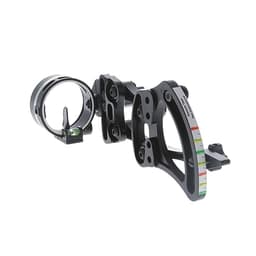
TRUGLO Range Rover Single-Pin Sight
Hunters who range first and shoot second
- Type
- Single-pin adjustable
- Pins
- 1
- Fiber diameter
- .019"
Price as of October 6, 2026. #ad How we’re funded
The default multi-pin
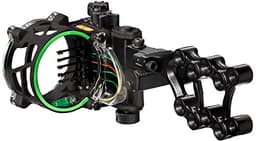
Trophy Ridge Fix 5-Pin Bow Sight
Most whitetail hunters, most of the time
- Type
- Fixed multi-pin
- Pins
- 5
- Fiber diameter
- .019"
Multi-pin, easier setup
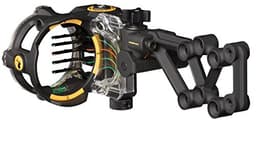
Trophy Ridge React H5 Bow Sight
Getting all five pins genuinely correct without a long range session
- Type
- Fixed multi-pin (auto-positioning)
- Pins
- 5
- Fiber diameter
- .019"
The middle one is the answer for most readers of this page. The third is the same idea with the setup problem solved: an auto-positioning multi-pin sight gets all five pins approximately correct from one sighted-in reference, which saves a long range session. That is worth money if your practice time is limited, and it is worth nothing if you enjoy sighting in. Neither buys a smaller group than the other.
What the sights on this site publish, side by side
| Sight | Type | Pins | Fiber / light |
|---|---|---|---|
| TRUGLO Range Rover Single-Pin | Single-pin adjustable | 1 | .019 in fiber |
| Trophy Ridge Fix 5-Pin | Fixed multi-pin | 5 | .019 in fiber |
| Trophy Ridge React H5 | Fixed multi-pin, auto-positioning | 5 | .019 in fiber |
| LWANO 5-Pin with Rheostat | Fixed multi-pin | 5 | Rheostat (variable brightness) |
| TRUGLO Pendulum | Pendulum treestand sight | Not published | Not published |
Three of the five publish an identical .019-inch fiber diameter, which tells you something about this category: the differentiation is in the mechanism and the mount, not in the pin itself. Handedness is the spec most worth checking before you order, because two of these publish right-hand only, one publishes a reversible mount, and one publishes nothing at all.
A simple decision rule
- Stand hunting whitetails inside 40 yards: fixed multi-pin. Sight in three pins at 20, 30 and 40 and ignore the other two.
- Limited practice time: an auto-positioning multi-pin, so one good sighting-in session gets you five usable pins.
- You range deer long before they are in position — field edges, food plots, open country: single pin, preset to your most likely distance each sit.
- Exclusively elevated, exclusively close: a pendulum sight is a legitimate simplification, as long as you accept it stops helping past its designed range.
- Whichever you buy: pair it with an angle-compensating rangefinder, and verify the pin you expect to use from the position you expect to use it in.
One last specification that belongs in every bow-setup conversation: at the arrow end, the Pope & Young Club’s equipment definitions set a 300-grain minimum total arrow weight. A sight cannot correct for a badly matched arrow, which is the subject of our arrow selection guide, and the bow it all bolts to is covered in our guide to choosing a compound bow and our draw length guide.
General guidance, not legal or safety advice. Hunting regulations vary by state and change every year — always verify seasons, legal equipment and requirements with your own state wildlife agency before you hunt. Wear a full-body harness and stay attached to the tree from the ground up whenever your feet leave the ground.
Frequently asked questions
Single pin or multi pin for deer hunting?
Multi-pin, for most whitetail hunters most of the time. The decisive factor is not accuracy — a single pin is theoretically the more precise instrument — it is that a stand hunter rarely controls when the shot happens. A multi-pin sight is always ready at every distance in your range; a single pin is only ready at the distance you last dialed. Pick a single pin if you hunt where you can range a deer well before it is in position, or if an uncluttered sight picture is what you shoot best with.
What is the advantage of a single pin sight?
Two things. The sight picture is uncluttered, so there is nothing to confuse under pressure and nothing obscuring the animal — which matters most in the last ten minutes of light, when a stack of bright fiber pins can bloom into a glow that hides the deer behind it. And it is more precise at distance, because the pin is dialed to the exact yardage instead of you holding somewhere between two pins and estimating the gap.
What is the downside of a single pin sight?
You have to know the distance before you draw, and you have to dial it. If a deer appears at 18 yards while your pin is set for 35, you have three choices and none is good: shoot with a learned hold-under, move a dial while a deer is looking at your tree, or let it walk. The standard field method is to preset the dial to your most likely distance every time you sit down, which works until the deer comes from the other direction.
How many pins do I need for whitetail?
Three is enough for the vast majority of whitetail hunting, and most sights are sold with five. If your honest effective range is 30 or 35 yards, pins at 20, 30 and 40 cover everything you should be shooting at with nothing left over to clutter the view. Buying five pins and only ever sighting in three is a perfectly sensible way to use a five-pin sight.
Does a single pin sight work from a tree stand?
It works, with one extra complication. From an elevated position the arrow follows the true horizontal distance to the deer rather than the line-of-sight distance your eye wants to use, so dialing the line-of-sight number makes you shoot high. An angle-compensating rangefinder resolves that before you dial, which is why we treat that feature as near-essential for an elevated bowhunter regardless of which sight you run.
What is a pendulum sight and should I buy one?
A pendulum sight uses a pivoting pin that automatically compensates for the downward angle of a treestand shot inside a designed range, which makes it the simplest answer to the angle problem if you hunt exclusively from elevated stands at close range. Two caveats: it solves the angle, not the distance, and past the range it was designed for you lock the pendulum and it becomes an ordinary fixed pin. The one on this site publishes neither a pin count nor an effective range, which is a real disclosure gap in a product sold on exactly that number.
Are bright pins always better at dusk?
No, and this is the most useful counterintuitive fact in sight selection. Pins that are too bright at last light bloom and glow, and the glow sits exactly where the deer is. That is why a rheostat — a variable brightness dial — matters more than headline brightness, and why dimmer is usually more accurate in the final ten minutes of shooting light. It is also a practical argument for fewer pins at dusk, since every lit pin adds to the bloom.
Is a more expensive sight more accurate?
It buys easier setup rather than a smaller group. An auto-positioning multi-pin sight gets all five pins approximately correct from one sighted-in reference, which saves a long range session and a lot of Allen-key fiddling — genuinely worth money if you have limited practice time. What no sight does is replace shooting at the distance you intend to hunt at, from the position you intend to shoot from. Verify at least the pin you expect to use.
Sources
- Pope & Young Club — Equipment Definitions — Bowhunting equipment standards, including the 300-grain minimum arrow weight (accessed July 22, 2026)
- Bowhunting.com — How Far Should You Shoot With a Crossbow? — On ethical crossbow range for whitetail and how energy drops downrange (accessed July 22, 2026)
- Realtree — Can You Trust Angle-Compensating Rangefinders? — On why an arrow follows the true horizontal distance, not line-of-sight, on an angled shot from a stand (accessed July 22, 2026)
- National Deer Association — The Hunter's Guide to Deer Vision — Deer lack the long-wavelength (red) cone, so they cannot distinguish red or orange from green; they lack a UV filter and carry more rods than humans, which is why they see so well at last light (accessed August 19, 2026)
Keep reading
Best bow sights for deer hunting
Every sight discussed here, ranked, with live prices and published fiber diameters.
See the picksBest release aids
The other half of the shot — trigger quality is what stops a flinch developing.
See the picksHow to choose a rangefinder
Angle compensation, and why a single pin makes it more important rather than less.
Read the guideBest archery targets
No sight system replaces verifying the pin you expect to use at the distance you expect to use it.
See the picks