Crossbows · Review
TenPoint Titan X Review
The Titan X is the crossbow we point most deer hunters at under $1,000, and the reason has nothing to do with speed. Compiled from the published specs and the maker's own guidance - not a paid field test.
How this is funded:we earn a commission if you buy through our links, at no extra cost to you. It never changes which product we recommend, and we’ll tell you plainly when to skip one. Full disclosure.
Buy the TenPoint Titan X if you want one crossbow that will do everything a whitetail hunter needs and you do not want to think about it again. The feature that earns the price is the ACUdraw De-Cock, and it has nothing to do with killing deer — it is the only thing on the spec sheet you will use on literally every hunt. At a published 400 FPS with a lighted Pro-View 400 scope in the box, it is also the most complete rig we have found that stays under $1,000, which is why it is our overall pick in that bracket.
This is a specification review, not a field test. We do not own a Titan X and we have not shot one. Everything below is read from TenPoint’s published material and the live listing, verified on October 19, 2026, plus arithmetic we show our working for. Where TenPoint does not publish a figure, we say so rather than fill it in — and on this bow there are three of those worth knowing about.
Our overall pick under $1,000
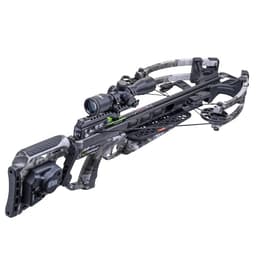
TenPoint Titan X De-Cock
Best overall under $1,000
- Speed
- 400 FPS
- Cocking device
- ACUdraw De-Cock (crank cock + controlled de-cock)
- Package
- Pro-View 400 lighted scope
Price as of October 20, 2026. #ad How we’re funded
What the Titan X publishes
| Spec | Published figure |
|---|---|
| Speed | 400 FPS |
| Cocking device | ACUdraw De-Cock (crank cock + controlled de-cock) |
| Scope | Pro-View 400, lighted |
| Finish | Vektra camo (on the listing verified) |
| Draw weight | Not published |
| Cocked width | Not published |
| Trigger pull | Not published |
| Kinetic energy | Not published |
That last row is not unusual. Across the budget and mid-priced crossbows we cover, only one bow in the whole registry publishes a kinetic-energy figure at all, so an unpublished KE number on the Titan X is the category norm rather than a TenPoint omission.
The de-cock, which is the whole argument
Every crossbow has to be unloaded at the end of a sit. A cocked crossbow has exactly two ways to become an uncocked one: you shoot it, or it has a mechanism that lets the string down under control. Bows without the second option send you home with a loaded weapon that has to be discharged into something first — which means carrying a target in, or finding a backstop you can see and trust in the dark, every single hunt.
The ACUdraw De-Cock is an integrated crank that does both halves. Cocking, it pulls the string to the latch with a fraction of the hand effort and — more important for accuracy than for comfort — it pulls it evenly, because a string that latches slightly off-center shifts point of impact and reads as random inaccuracy. De-cocking, it reverses the same mechanism and carries the string forward under control.
Two practical consequences for a stand hunter. First, you can cock the bow from a seated position once you are secured, rather than standing up in a hang-on in the dark — and the Tree Stand Safety Awareness Foundation’s central message about falls is that they happen in the transitions, not the sit. Second, you climb down with an unloaded bow. Our guide to shooting a crossbow from a tree stand covers that sequence, and how long you can leave a crossbow cocked covers why no maker publishes an hour limit and what they publish instead.
What 400 FPS is actually worth
Crossbow marketing is a speed contest, so it is worth converting the number into the one that does the work. Kinetic energy is total arrow weight in grains multiplied by velocity squared, divided by 450,240 — the formula Wasp Archery publishes. TenPoint does not state the bolt weight behind its 400 FPS claim, so we have to supply one and label it: at a 400-grain finished bolt, 400 FPS works out to roughly 142 ft-lb.
That is our arithmetic from a published speed, not a TenPoint figure and not a test result. It is a muzzle number and it falls off downrange. What it tells you is that this bow has ample energy for a whitetail at the ranges a crossbow should be shot at — and that the difference between it and a 435 FPS bow is on the order of 25 ft-lb, which is not the reason to choose between them. Flight time, group size from a seated hunting position and whether you actually know the distance are the limiting factors, which our effective-range page works through in full.
The scope in the box
The Titan X ships with TenPoint’s Pro-View 400, which is a lighted crossbow scope. That is a genuinely useful inclusion rather than a throwaway: an illuminated reticle is the difference between a usable sight picture and a guess in the last ten minutes of legal light, which on many evening hunts is when the deer arrives.
What we are not going to tell you is how good the glass is, because we have not looked through it. Treat the included scope as competent and sufficient, expect a serious shooter to eventually want more, and know that the upgrade path exists — our crossbow scope guide covers what more money buys. Either way, sight it in properly before season rather than trusting a factory zero; our sighting-in guide has the order to do it in.
The three things TenPoint does not publish
None of these is a reason not to buy the bow. All three are reasons to handle one, or to ask a dealer, before you commit.
- Draw weight. Unpublished on this listing. With an integrated crank it matters less than it would on a rope-cocked bow — but if the crank ever fails in the field, draw weight is what tells you whether cocking it by hand is even an option.
- Cocked width. Unpublished, and this is the one we would most like to see. Cocked width is the spec that decides whether a crossbow swings cleanly through a ground blind window or past the tree behind your shoulder. Compact bows publish it as a selling point — the Ravin R8 publishes 6.5 inches cocked — and bows that do not publish it are usually wider.
- Trigger pull. Unpublished, like almost every crossbow we cover. It has more influence on how well you shoot the bow than any figure that is published, and the only way to assess it is with your finger.
Living with it
TenPoint publishes the clearest maintenance guidance in this category, which is a real ownership advantage, and it is specific: check every nut, bolt and screw for tightness; inspect strings and cables each session and condition them when they feel dry; change strings and cables at least every two years, or every 1,000 shots if you shoot often; and oil the trigger, the dry-fire inhibitor, the axles and the cam bearings one drop at a time. Rail lube belongs on the rail and string wax on the string and cables — our maintenance guide covers why mixing them up is the expensive mistake.
Shoot the bolts the manual specifies, in the length, weight and nock style it names. That is a safety specification and not a preference: the wrong nock can let the string slip past the bolt and dry-fire the bow. Our bolt guide walks the spec, and the bolt comparisonincludes TenPoint’s own Pro Elite 400, which is the specified bolt for TenPoint and Wicked Ridge bows.
One last item that is not optional and not on any spec sheet: crossbow legality for deer varies enormously by state, and seasons, permits and minimum ages are all set at state level and revised frequently. Verify with your own wildlife agency — our laws-by-state overview is a starting point for finding the right rule, not an authority on it.
Who should buy something else
- If your budget is firmly under about $600. The budget tier is a legitimate answer, and our CenterPoint versus Killer Instinct comparison separates the two brands that own it. Note what you are giving up: of those four bows, only one has a de-cock at all.
- If you hunt a tight blind or a cramped hang-on. Width is your binding constraint, and the Titan X does not publish a cocked width. A compact reverse-geometry bow that does publish one is the better buy — see Ravin against TenPoint.
- If you want the fastest thing you can afford. You can buy more FPS for this money. You will not be able to tell on a deer, but if that is what you want, buy it and enjoy it rather than reading a page that argues you out of it.
- If this is a first crossbow for a youth or small-frame shooter. Fit and cocking effort dominate, and our beginner crossbow page is the better starting point.
The verdict
The Titan X is the bow to buy when you have decided you would rather own one crossbow for a decade than optimize a spec sheet. Published 400 FPS is more than enough for whitetail; a lighted scope in the box means it is huntable the week it arrives; and the ACUdraw De-Cock removes the single most awkward moment in crossbow hunting on every sit, forever. Against that, three unpublished specs — draw weight, cocked width and trigger pull — are worth resolving by handling one, especially if you hunt out of a blind.
General guidance, not legal or safety advice. Hunting regulations vary by state and change every year — always verify seasons, legal equipment and requirements with your own state wildlife agency before you hunt. Wear a full-body harness and stay attached to the tree from the ground up whenever your feet leave the ground.
Frequently asked questions
Is the TenPoint Titan X a good crossbow for deer hunting?
Yes, and it is our overall pick under $1,000. The case for it is the ACUdraw De-Cock system: it is a crank that cocks the bow and then lets the string back down under control, so you can end a hunt with a loaded crossbow and make it safe without firing a bolt into the ground. That is a feature you use on every single hunt, where the last 30 FPS of speed is a feature you never notice. It publishes 400 FPS and ships with a lighted Pro-View 400 scope, which is enough crossbow for any whitetail at sensible range.
How fast is the TenPoint Titan X?
TenPoint publishes 400 FPS. For context on what that means for a deer: run the standard archery kinetic-energy formula - total arrow weight in grains times velocity squared, divided by 450,240 - at a 400-grain finished bolt and you get roughly 142 ft-lb. That is our own arithmetic from the published speed rather than a TenPoint figure, and it is a muzzle number that falls off downrange, but it sits comfortably above any commonly cited whitetail threshold at the ranges a crossbow should be shot at.
What does the ACUdraw De-Cock actually do?
It is an integrated crank. Cocking, it winds the string back to the latch with a fraction of the effort of pulling it by hand, and it does so evenly, which matters because a string that latches off-center shifts your point of impact. De-cocking, it reverses: it carries the string forward under control so the bow is unloaded without a shot. Without that mechanism the only ways to unload a crossbow are to fire a bolt into a target you carried in or into a backstop you can see in the dark.
What does TenPoint not publish about the Titan X?
Three things a buyer would want. The draw weight is not stated on the listing, so you cannot predict the hand-cocking effort if the crank ever fails. The cocked width is not stated either, which is the spec that decides whether the bow swings cleanly inside a ground blind or a tight hang-on. And no trigger-pull weight is published, which has more effect on how well you shoot it than any number that is published. None of those are disqualifying; they are things to check by handling one.
Should I buy the Titan X or a cheaper crossbow?
If your budget is firmly under about $600, the budget brands are a legitimate answer and our CenterPoint versus Killer Instinct comparison separates them - note that only one of those four bows has a de-cock at all. The Titan X's premium over that tier buys the integrated crank, the de-cock, a lighted scope and a service network. If you mostly hunt a tight blind or a cramped hang-on, consider a compact bow instead: the Ravin R8 publishes 6.5 inches cocked, which is a stand-and-blind spec the Titan X does not publish at all.
How much maintenance does a Titan X need?
TenPoint publishes the clearest maintenance guidance in the category, and it applies to this bow: check every nut, bolt and screw for tightness, inspect the strings and cables each session and condition them when they feel dry, change strings and cables at least every two years or every 1,000 shots if you shoot often, and oil the trigger, the dry-fire inhibitor, the axles and the cam bearings one drop at a time. Rail lube goes on the rail, string wax goes on the string and cables, and confusing the two is the common and expensive mistake.
Sources
- TenPoint — 3 Critical Maintenance Tips to Keep Your Crossbow in Top Shooting Form — Manufacturer guidance: check every nut, bolt and screw for tightness; inspect strings and cables each session and condition when dry; TenPoint recommends changing strings and cables at least every two years, or every 1,000 shots if you shoot often; oil the trigger, dry-fire inhibitor, axles and cam bearings one drop at a time (accessed August 22, 2026)
- TenPoint — US Crossbow Laws & Regulations by State — Industry-maintained crossbow legality guide, organized by state (accessed July 22, 2026)
- National Crossbow Association — State Regulations — State-by-state crossbow legality overview; always verify with your state agency (accessed July 22, 2026)
- Wasp Archery — How to Calculate the Kinetic Energy of Your Arrow — The kinetic-energy formula (arrow weight and speed) used to judge penetration (accessed July 22, 2026)
- Bowhunting.com — How Far Should You Shoot With a Crossbow? — On ethical crossbow range for whitetail and how energy drops downrange (accessed July 22, 2026)
- Tree Stand Safety Awareness Foundation — Industry safety foundation tracking treestand-fall statistics and the ABCs of safety (accessed July 22, 2026)
Keep reading
Best Crossbows Under $1,000
Where the Titan X sits against Wicked Ridge, Killer Instinct and the rest of the bracket it leads.
See the under-$1,000 picksRavin vs TenPoint
Two premium makers optimizing for different problems - cocked width against controlled unloading.
Compare the brandsHow Long Can You Leave a Crossbow Cocked?
The question the de-cock on this bow exists to answer, and what the makers publish about it.
Read the cocked-time guideCenterPoint vs Killer Instinct
The budget tier below this bow, and the one model down there that also de-cocks.
Compare the budget brands